Recent Articles
Breaking Down Cartoon Network’s THE BIG GAME!
The Super Bowl is next week! As part of your game-day preparations, take a stroll with me down memory lane as I break down Cartoon Network’s football parody THE BIG GAME, an annual four-hour block from the late 90s and early 00s featuring a championship match between famous cartoon rivals. Tom and Jerry! Sylvester and Tweety! Wile E. Coyote and Road Runner! Bugs and Daffy! The gang’s all here!
My relationship with football has always been a little complicated.
I have no problem with the sport, to be clear; although my growth spurt hit at just the right time in childhood to make P.E. classes a logistical nightmare, I was never thrown into any trash cans by varsity linebackers or anything. My issue is more that, living in Sacramento, California, I never had a local team to root for, nor parents who actively cared about one in order to baptise me into a fandom (this is why, unlike everyone else around here, I don’t really have a rooting interest in the San Francisco 49ers).
For a very long time, that lack of a team that played in my actual zip code was a major barrier to entry into the sport. It was only really recently (like in the last two or three years) that that lack of rooting interest has actually become a great relief. As a fan of the Sacramento Kings basketball club for 25 years (a solid 20 of those being actively miserable experiences), sometimes it’s nice to just watch a game knowing that your mood the next day isn’t going to be affected by the outcome.
That said, as mentioned in this space every year around this time, I’ve always enjoyed the trappings of football. In particular, I’ve always found the hoopla around the Super Bowl to be giddy fun, especially since there’s so much offshoot culture that stems out from it; as an example, people sure seem invested in who is doing the halftime show (up to and including watching the whole thing from start to finish despite having spent months talking about how much they hate it and how it sucks every year). I think a lot of this love I have for it all comes from the fact that it remains maybe the last unifying thing we have as Americans. Even those of us that only engage with it in the sense that we make snarky “gO sPoRtS bAlL!” posts on Facebook still care enough to at least mark the occasion. In a time where the country is so intensely divided, the Super Bowl can still become one of the most-watched broadcasts of all time, every year. Maybe that’s what I like about it.
Ah, who am I kidding? The reason I love the Super Bowl is because of a series of marathon blocks that aired on the Cartoon Network in the late 90s/early 00’s.
Let’s talk THE BIG GAME.
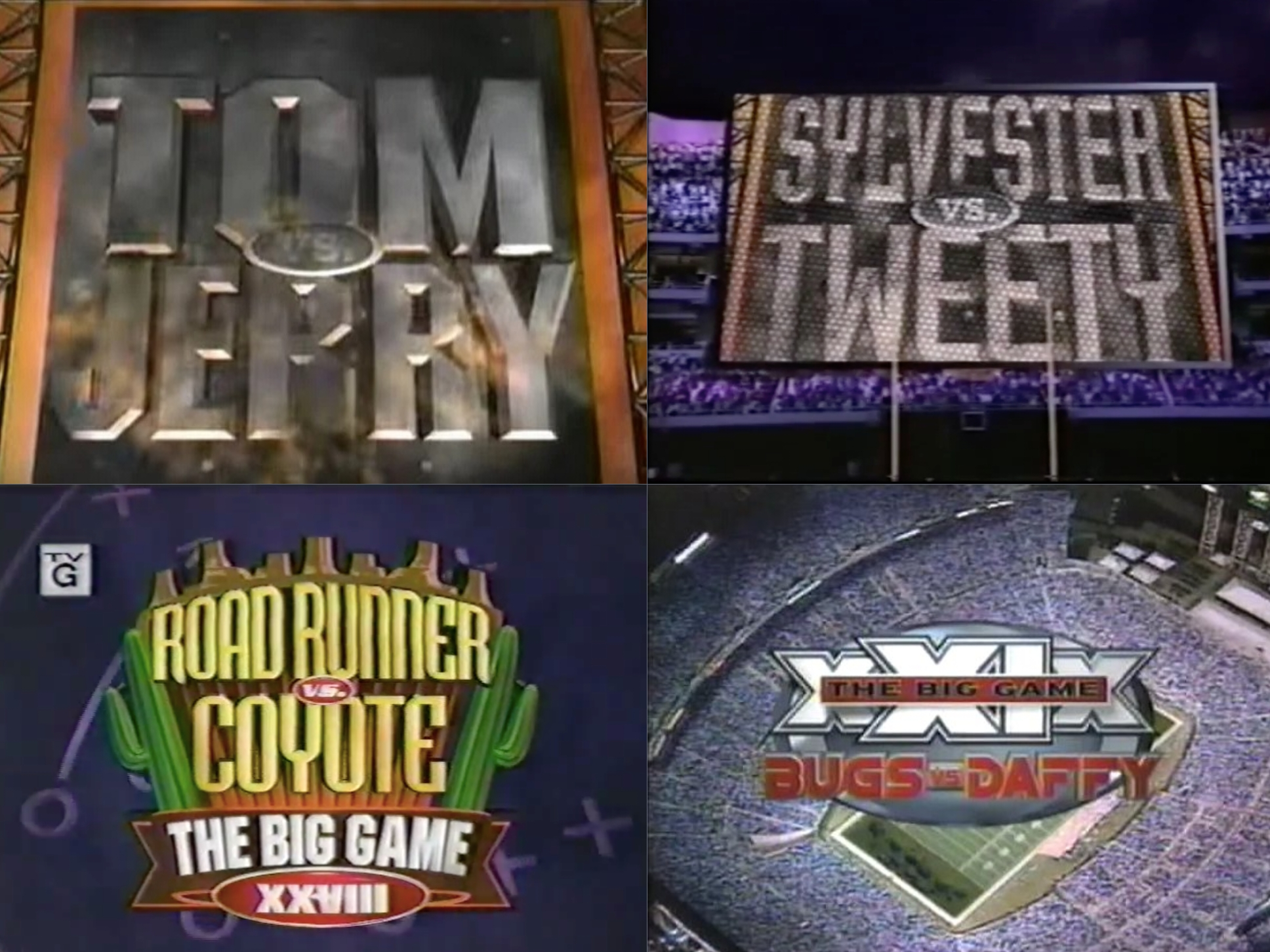
Behind the scenes information on Cartoon Network’s THE BIG GAME broadcasts are sparse, bordering on non-existent. What I can confirm is that, from 1998 to 2001, the first cable channel fully dedicated to animation would run what were essentially glorified themed marathons in late January. What set these apart from other marathon blocks? It strived to emulate the feeling of your typical Super Bowl broadcast, often down to including pre-and post-game commentary by actual football analysts, as well as fake commercials and halftime shows. THE BIG GAME dared to ask…what if the classic Looney Tunes cartoons were actually football matches between the main characters? What if there was a whole league of these cartoon characters? What if, every year, a Big Game was needed to decide once and for all who the champion cartoon character was?
Yeah, they eventually developed a whole mythology around THE BIG GAME, a monumental amount of effort considering that, again, these were basically just marathon programming centered around a theme (and, in a way, corporate advertising, but we’ll get there). But, what could you expect from a channel that had, by 1998, built up a reputation for creativity stemming from an unusual love for its genre? In my youth, Cartoon Network had always had a lot of fun imagining that their roster of acquired IPs were all part of its own world, with its own democratic elections and hierarchies. They were also totally willing to make parodies of things that might only be of interest to their child audiences’ parents, like their bleak Scooby-Doo-starring spoof of THE BLAIR WITCH PROJECT. The end result, at least for me, was a channel that always delighted me while never talking down to me; in a lot of ways, it actually encouraged my curiosity, if only so that I knew what they were making fun of.
So it went with THE BIG GAME. The day tended to go like this: there would be ads for a couple of weeks prior establishing what the “big matchup” was going to be, always centering around famous cartoon rivals. “Bugs vs. Daffy”, the game might feature one year. Or “Tom vs. Jerry”, perhaps. Cartoons starring that year’s rivals would run under the guise of being “previous game film”. Intercutting all this was usually some pre-game analysis from the Cartoon Network Sports Studio. Then, it was time for The Big Game, a series of additional cartoons that now had commentary overlaid on them from John Madden and Pat Summerall. Oh, and to add to the “football” feel, the dialogue in the cartoons are replaced with “football sounds” (“hut-hut-HIKE” or general grunting, that sort of thing). All in all, it was great fun from a bygone era.
THE BIG GAME has also been relatively well-preserved. It was never released on home video or anything (I doubt that they would even have been able to, even if they wanted to), but three of the four broadcasts (at least the pregame and “game” parts) have been available on YouTube for years. The only one that appeared to be lost to time was the first: Tom vs. Jerry. At least, this was the case the first time I wrote a giant BIG GAME tribute article, back in 2017.
However, in the years since, Tom vs. Jerry has resurfaced, and it’s essentially the whole thing, commercials and all! It can be found on the Internet Archive, as can the other three. For this reason, along with the fact that my old article has unfortunately been wiped from the Internet (as well as the fact that I don’t have any other Super Bowl content in mind this year), I thought it’d be time to break down THE BIG GAME one more time, the way it actually aired.
So, let’s go! Omaha! Let’s go through THE BIG GAME!
THE BIG GAME XXVI: TOM VS. JERRY
Aired: January 24, 1998
(The whole dang thing can be found in full on the Internet Archive)
Right from the jump, we have implied (if fictional) history; despite this being the first iteration of THE BIG GAME, it’s numbered as the 26th. What illustrious match-ups might have taken place in the prior quarter of a century? Well, we’ll actually get some of that mythology filled in later on down the road. Just, like, not right now. For the moment, let’s focus on Tom vs. Jerry!
(Fun fact: I had never actually seen this one, as I missed it when it was actually on the first time around. New thing!)
Regardless of its distinction as the 26th BIG GAME, it’s fairly obvious this is Cartoon Network’s first go-around with the format. It’s a fairly bare-bones affair, with a two-hour marathon of Tom and Jerry cartoons, followed by a really brief BIG GAME segment. We’ll dig into how the actual “game” was in a second, but first, let’s dig into the marathon itself.
We got 11 T&J cartoons this time time around. The shorts included in the marathon were:
“Puss Gets the Boot” (1940) - the very first Tom and Jerry cartoon! Several things feel off about it, starting with the fact that Tom’s name here is apparently Jasper. He also has a little bit more of a mean spirit to him than he would later develop; he actually has the upper hand over Jerry in the beginning. This initial outing has a simple conceit: if Tom, er, Jasper knocks over one more thing, he’s sleeping outside. Thus, the entire thing is Jerry throwing crap off the furniture trying to get Jasper in trouble. You’d feel bad, but Jasper really is a bit of an asshole here. He paints a fake mouse hole into the wall, causing Jerry to bash his own head in! So, yeah, fuck Jasper. Does he get the boot? Keep watching to find out.
“Tennis Chumps” (1949) - notable both because of its sports theme (which is why I think this one was included), as well as for its inclusion of a third character, Butch, a fellow cat that Tom both fights and teams up with during the course of eight or so minutes.
“The Bowling-Alley Cat” (1942) - this is the short that really reminded me how strong and endearing the core premise of a Tom & Jerry cartoon (a mouse enacts ruthless violence on a vaguely deserving cat) really is. Not once do you ever really question why Tom or Jerry are in a fully operational, but seemingly abandoned, bowling alley. They just are! Lotta things in there to hit each other with!
“Johann Mouse” (1953) - a fun, atypical change of pace that supposes Tom and Jerry resided in the home of Johann Strauss. Jerry loves to dance, and Tom subsequently learns to play piano in order to get Jerry to waltz around the house (with his guard presumably down). Instead, they rightly become a town sensation. This one is cute, and well deserving of its 1952 Oscar for Best Animated Short Subject.
“Jerry’s Cousin” (1951) - another stone cold classic, this one establishing that Jerry in fact has a mouse cousin. This cousin’s name is Muscles, and he seems to speak English, and appears to maybe hail from Chicago? Anyway, he rolls into town to beat the shit out of Tom. Frankly, Tom deserves it this time around. We first see him in this short chucking firecrackers into Jerry’s mousehole, which is just degenerate behavior. Thank you for re-establishing the rule of law, Muscles the Mouse.
“Tee for Two” (1945) - a benign golf-themed short that ends with Tom swallowing something like a thousand bees. Another one where Tom is the aggressor the entire time; I get the sense he’s one of those who’s riled up by golf rather than relaxed. He’s smacking Jerry in the face with a club, hitting him in the head with golf balls and, most unforgivably, cheating on his stroke count. He also doesn’t appear to be that avid of a golfer, taking 33 strokes to finish one particular hole. Let this be a lesson, kids: be a good sport, or swallow bees.
“Mouse Trouble” (1944) - a short I remember vividly from childhood. Tom orders a book called “How to Catch a Mouse” and with sage advice like “Locate the Mouse” and “Mice Are Suckers For Dames”, it’s no wonder that Tom eventually ends up severed in two and the top of his head blown off. Sometimes, you just can’t learn everything from a book, Thomas. Bonus points for giving us a classic “DON’T. YOU. BELIEVE IT!” cry from Tom.
“The A-Tom-inable Snowman” (1966) - the sole Chuck Jones-produced Tom & Jerry short represented in this marathon. I can’t speak to how the average T&J fan feels about this era, but I always loved these as a kid. The animation style is vibrant, the music is a tad jazzy…the Chuck Jones ones always put me in a good mood. Anyway, I thought this was going to be the one where they meet the abominable snowman (who hugs and squeezes things and calls them George), but then I remembered, no that’s Bugs and Daffy. No, this is one where Tom gets wasted after several rounds of a rescue dog reviving the frozen cat with a faceful of scotch.
“The Two Mouseketeers” (1952) - starts off as a rather cute and charming tribute to THE THREE MUSKETEERS, and ends with Tom being beheaded. Things escalate fast in T&J-land.
“Dr. Jekyll and Mr. Mouse” (1947) - another one I remember vividly from my youth, where Jerry keeps stealing Tom’s bowl of cream. Tom plots his revenge by replacing the bowl with one full of poison. Unfortunately, the poison only makes Jerry stronger, leading to Tom getting pummeled and his cream pilfered. Bad day all around for the cat. Fun fact: this short was briefly shown in the 1983 vampire flick THE HUNGER!
“Jerry and the Goldfish” (1951) - another one where Tom fully deserves the ass-whooping that he gets. Here, he decides he wants to eat the pet goldfish as a snack, and he doesn’t appear to be particularly concerned how the fish is prepared. He starts off with a full recipe he hears on the radio, but he eventually settles for lightly toasting the alive fish and putting it between two pieces of plain bread. Anyway, it’s Jerry to the rescue, and thank god. Tom, I love ya, buddy, but this one’s completely on you.
The Jerry dance sequence in ANCHORS AWEIGH (1945) - I’m delighted they included this, as it’s one of the greatest movie musical clips of all time. A scene that speaks for itself.
In between each cartoons, we get brief commentary from Harry Kalas on what just happened, breaking down “memorable plays”. If Jerry brains Tom with a bowling pin or something, they might talk about “what a hit he took!”. That kind of thing. It doesn’t beat the actual presence of a pre-game show, and none of it is anywhere near as creative as stuff to come, but the idea of “treating classic cartoons like football games” was already there.
Then, it’s time for the Big Game itself and….honestly, it’s a bit of a disappointment! At least, relative to what was to come, this felt a little half-baked, a good premise lacking in details. For one, The Big Game only comprises one short, as opposed to the four (one for each quarter) we would get in later installments. For two, the scoring system is completely overthought; instead of simply doing a numerical score, Tom and Jerry were assigned visual pictures for each play, correlating with something a cat or mouse would enjoy (Tom could earn a dead roach or a little bird, while Jerry might score himself a piece of cheese or some seeds). Finally, there’s a running gag with Shaggy Rogers…er, Shaggy Butkus* as the sideline reporter who doesn’t get how an earpiece works. This whole thing just didn’t work for me: was Shaggy supposed to be stoned? Maybe the idea is that he’s stupid, which he can be, but I’d like to think that, even in a marijauna haze, he could figure out where an earpiece goes.
*Why is his name Shaggy Butkus? Besides it possibly being a strange reference to Dick Butkus, your guess is as good as mine.
On the good side, Pat Summerall and John Madden’s commentary is as good as it would ever be, a perfect mix of calling the “game” seriously, while still knowing that their job is to be funny. Madden at one point muses on why Spike the Dog is talking, before clarifying “not that animals can’t talk, they just make different noises”. Good stuff! Even in the early stages, the writing and general ideas were there. Cartoon Network just needed a little confidence that the Big Game could work as a fun marathon framework.
They got their confidence, and the next year’s match-up was even better…
THE BIG GAME XXVII: SYLVESTER VS. TWEETY
Released: January 30, 1999
Pre-Game: Len Dawson, Jerry Glanville, Nick Buoniconti
Halftime Show: Owl Jolson
(This YouTube video probably represents the most “complete” viewing experience.)
The second year of the Big Game project takes a big step up from the first, with several key additions that would become staples for the next two installments.
First: the addition of an actual, bonafide pre-game show! Yes, this is the first year we see Len Dawson, Nick Buoniconti and Jerry Glanville, the then-hosts of HBO’s Inside the NFL, get in on the action. And, man, it adds so much to the proceedings to see three bonafide football guys sitting around a desk having genuine-sounding discussions and film breakdown about a Sylvester and Tweety cartoon. Their ability to play along with the central joke is infectious; I’m not an Inside the NFL connoisseur or anything, but fire up the BIG GAME pre-show and compare it against any random 90s episode of the HBO series. I defy you to tell me they feel anything beyond exactly alike. Also, this on ebgins the long tradition of Jerry playing the goofy heel, which immediately made him my favorite.
Now, those who are familiar with late-90s broadcasting corporate structure have likely already noted that this was not a purely artistic move on Cartoon Network’s part; in a way, the trio’s presence causes THE BIG GAME to now serve as one long ad for a premium cable program. This could be looked at cynically, but…to be honest, I don’t care. If this is the price to pay in order to get this type of preshow (instead of one anchored by people playing fake NFL broadcasters, with obvious jokes and punchlines), then sell away. Joke was on them; at the time, I was 11. Couldn’t afford HBO anyway!
Second: sprinkled throughout some actual commercials* were some spoof ads, emulating some real ad campaigns of the time. There are a pair of CAT commercials, GAP spoofs starring, respectively, Tom (of Tom and Jerry fame) and Josie and the Pussycats. There are also two fake car ads, one featuring the famous Flintstones vehicle, as well as the Jetsons family spaceship. The “fake ad” aspect will only escalate in the next installment, but even if this was all we got, the effort would be appreciated.
*The upload I watched included ads for Cartoon Network originals Dexter’s Laboratory and Cow & Chicken, as well as a creative spot for the channel as a whole, highlighting its roster of “sidekick” characters.
Oddly, this one is now the least archived of the four Big Game marathons. It’s relatively complete; the entire “Game” is viewable on YouTube, as well as most of the pregame. However, there appear to be a handful of pregame segments that are missing, including a promised look back at last year’s winner (Jerry) and loser (Tom). There also does not appear to be any written record of what Sylvester and Tweety cartoons were aired as part of the marathon. Len Dawson and the gang keep throwing to the shorts, but I have no idea what they were. Alas! At least it spared (you from) me from having to come up with something insightful for another couple dozen cartoons.
As for the actual Big Game, it’s another big leap from last year. We get all four quarters this time (filled out with two cartoons: “Bad Ol’ Putty Tat” and “Tweety’s S.O.S.”), as well as an actual numerical score. More great commentary from Madden and Summerall, this time with more of a tangential nature than last year; at one point, Summerall takes some time to bring down the dramatic arc of a story. It’s here that I wondered if THE BIG GAME came from the same surreal kiln that eventually forged Adult Swim, which was still a few years away for the channel. There are also a lot of great and inspired infographics presented throughout, many of whose punchlines would have gone right over the head of any twelve-year old. As an example, one infographic shows the stat line of Tweety with feathers (undefeated) and without feathers (Woody Allen).
Overall, a great showing for THE BIG GAME, and the first one I remember watching as it happened on TV. From there, they had a fan for life. And my fandom was rewarded the very next year, when Cartoon Network went all out for BIG GAME XXVIII….
THE BIG GAME XXVIII: ROAD RUNNER VS. COYOTE
Aired: Saturday, January 29, 2000
Pre-Game: Len Dawson, Jerry Glanville, Nick Buoniconti, Cris Collinsworth
Halftime: The Spacely Sprockets Halftime Show Spectacular
(You can watch most of it at this Internet Archive link, but the rest of it can be found here.)
Of the four BIG GAME marathon blocks, this one stands head and shoulders above the rest. This was the one where it felt like Cartoon Network had the most confidence in the product, with ideas oozing out of their pores. The pre-game guys are locked the fuck in, the halftime show is the most thought out it’ll ever be, they double up on the amount of fake commercials…it sounds kind of silly, but it barely feels like a glorified Road Runner cartoon marathon. There are moments where you sort of feel like you’re watching an actual fake football game between cartoon characters. It’s the pinnacle of Cartoon Network creativity. At least, in my opinion.
This was absolutely one of my favorite things that ever aired on television when I was a kid, and in the one or two times I revisited it as an adult, I always get nervous its shine will be somewhat blunted, now that I’m 37 and thus too old and busted to believe in magic anymore. But, it still lives up. I’m hoping it always will.
We actually have to take this breakdown in sections, because there’s a lot to THE BIG GAME XXVIII, starting with a full-on fake documentary…
THE BIG GAME: A LOOK BACK
Yeah, that’s right! This whole thing kicks off with a fake retrospective on the fake history of THE BIG GAME, hosted by none other than Jim Huber. Over the course of thirty minutes (with commercials), Huber walks us through the history of cartoon competition, the leadership of Foghorn Leghorn that led to the various leagues combining to play a championship game, and the lows (an extended strike led the Big Game to once have to open for Eddie Money) and the highs (the present day, apparently) of the game’s history. All throughout, we get talking heads from various Big Game “historians” and “fans”, as well as insight from people “who were there”.
I’ve always found this all very impressive, both then and now, for a few reasons. One: they didn’t have to create a whole mythology for THE BIG GAME at all. They didn’t have to make any of this! I think many corporations would have been happy to just run the old cartoons they had access to, interrupted only by commercials for other old cartoons they also had access to. I suspect in 2026, a lot of this would be considered by a boardroom to be “too expensive” and “a waste of time”; why bother getting Jim Huber to do fake narration I have to hire somebody to write, when kids would just be happy to see the coyote fall down in a cartoon they’ve seen a thousand times already?
But they did, and honestly, it vaguely altered my brain chemistry. The effort didn’t go unappreciated, at least not by this particular 11-year old. The idea that adults could still find the playfulness and creativity inherent to the Looney Tunes, or Hanna -Barbera, or King Features or whatever, meant a lot to me at eleven. Hell, it means a lot to me now.
Second, it’s actually pretty funny, and the humor is willing to go to slightly darker areas than you might expect from mainline Cartoon Network. There’s a whole section about Squiddly-Diddly “breaking the octopus barrier” (before he started playing, no Big Game participant had ever had more than four legs) and, look, I certainly think it’s bold for a kid’s program to satirize Woody Strode and Kenny Washington, but it’s just goofy enough that you laugh instead of wince. Sure, not every joke is an A+; there’s an extended runner with the chyrons where every line an author talking head says ends up being the title of one of his books, and it gets old after a while. But most of the script here is pretty sharp. And it’s all facilitated by Huber, who’s so perfectly dry the whole time, even when coming back from commercial with shit like “for those of you just tuning in, shame on you.” Full marks.
PAST MATCHUPS MARATHON
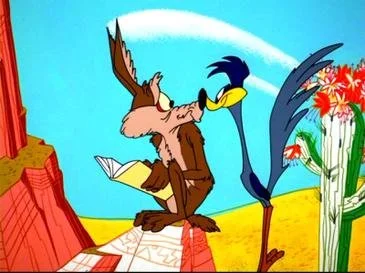
In a break from tradition, Cartoon Network decided this time around to air all of the “past matchup” in one block, rather than airing them throughout the preshow block. In principle, this makes sense, especially since the preshow had become a comedy act all on its own at this point. But, this might be the one tactical error that THE BIG GAME XXVIII makes the whole evening. Because even though this section is only an hour, what you quickly discover watching seven Road Runner cartoons in a row is that they’re all pretty much the same.
This is mostly by design. Firstly, Road Runner cartoons are inherently bound to the same space and dimensions. Tom and Jerry can theoretically appear anywhere: a bowling alley, a golf course, an ornate mansion. Sylvester and Tweety can run around on a boat, or a house. Hell, they can even solve mysteries with Granny. Wile E. Coyote and Road Runner, however, have to be in the desert. This was literally a rule straight from Chuck Jones himself. Second, as a result of these rules, the structure doesn’t change. Every single one of them is just the latest collection of “Coyote uses gadget to catch Road Runner, but it backfires”. It’s why they work! Hell, that structure is why these were probably my favorite cartoon as a kid. But…breaking these up throughout the pregame might have helped each short stand out on its own. All in a row? They mostly run together.
As a result, I’m not going to give each one its own blurb. What is there to say about one that couldn’t equally apply to the others? So, instead, I’m just going to highlight the most insane plan Coyote unleashes in each one:
Fast and Furry-ous (1949) - first Road Runner cartoon ever made! Anyway, although I applaud the creativity of the Coyote’s refrigerator-meat grinder contraption that, through Rube Goldberg engineering, allows him to ski on sand, I have to highlight the Acme Super Outfit. It appears to be a bootleg Superman costume with no other gadgetry. He puts it on, leaps off a cliff, and immediately falls. I’m unsure what Coyote thought was going to happen there.
Ready…Set…Zoom! (1955) - At the very end of this, Coyote dons the Acme Female Road-Runner costume. All this really yields for Wile E. is a cadre of other coyotes that begin to chase him, presumably to…sexually assault him, I guess? Why does Acme even have a female road-runner outfit?
Hip-Hip-Hurry! (1958) - Wile E. attempts to use a slingshot to fling a stick of dynamite at Road Runner, but just kinda stands there too long without slinging, and the dynamite blows up in his face. Skill issue.
Zipping Along (1953) - Wile E. gets a book on hypnotism, with the end goal of inducing the Road Runner to jump off a cliff. This feels a little desperate to me, and it’s all rendered moot when Road Runner shows up with a mirror, bouncing the hypnotism back into Wile E.’s eyes.
Zoom and Bored (1957) - One of Wile E.’s big moves in this one is to distract Road Runner with bird-seed while he unleashes a jar full of bumblebees. You’re never going to believe this, but the only guy who gets stung here is the Coyote.
Gee Whiz-z-z-z-z-z-z (1956) - The winner for “strangest plan” here by a country mile is the Coyote’s fucking ridiculous green “Bat-Man” costume. I get the sense that ACME has a Spirit Halloween vibe to their repertoire, and I understand they’ve always been a disreputable company. But you have to really start questioning Wile E. Coyote’s judgment on this one at a certain point (although I must point out he does manage to fly in this one).
There They Go-Go-Go! (1956) - gotta say, I love the move of hiding a gun on a spring in a trapdoor. It doesn’t work, but I always wish this one did. Imagine if the Road Runner got shot in the face and that’s how the Coyote finally got him.
PRE-SHOW
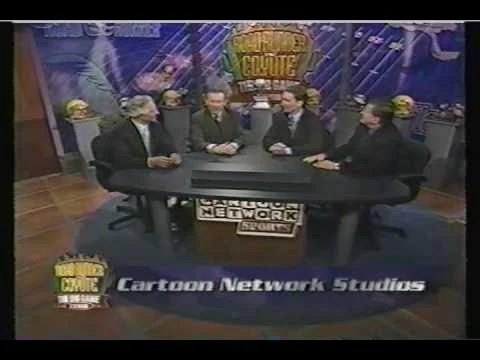
Nick Buonoconti, Len Dawson, and Jerry Glanville all return to the Cartoon Network Sports desk for the Slate Rock and Quarry Pre-Game Show. This time, they’re joined by broadcasting legend Cris Collinsworth, who fits right in. He kind of plays a vague “smug guy who thinks he’s smarter than he is” role in the interview portions, including a sadly now-missing segment where he thinks he’s interviewing Joe Montana (despite the many protestations that he’s actually actor Joe Mantegna). However, he mostly serves as yet another anchor razzing poor Jerry Glanville. Once again, the cadences amongst the crew is so natural, you’d think they were coming up with their analyses on the spot (even though the whole thing is almost certainly rigidly scripted).
The pre-game segment this year helps set the foundation for two of THE BIG GAME XXVIII’s running gags. The first one is the mystique being built around the Halftime Show, this time being helmed by producer wunderkind Helumt Spassmacher*. We get a long sequence with Helmut at his home in Germany, as he goes through all the upcoming details of his halftime spectacular, with potential guest stars like Tom Jones. The segment spends a long time, a conspicuously long time, going over how fucking cool this thing is going to be and how much you shouldn’t miss it. Hmmmm….
*Played by Michael Kohler, who would go on to have a long, still-going musical composition career with Cartoon Network and its spinoff, Adult Swim.
Okay, time for the second running joke that the pre-game seeds. The overwhelming theme of THE BIG GAME XXVIII is “Wile E. Coyote is a big loser with no fanbase and absolutely no shot of ever being anything else”. Like, obviously, THE BIG GAME has always been a show that sucks up to the heroes. Tom gets fairly trounced by Jerry, and Tweety curb-stomps Sylvester 57-3. In both instances, the coverage before-hand made it very clear: there’s no love for the underdogs.
This year, though, that ethos goes into overdrive. At least in the “Sylvester vs. Tweety” BIG GAME, coverage of each team’s fan tailgate felt fairly even. There were just as many cat fans in the parking lot as there were bird fans. This year? The Road Runner tailgate party is a loud, boisterous affair. There are hundreds of people crammed into a restaurant, dressed in purple, chanting “Road Runner” chants, whooping it up, having a grand old time. Wile E.’s tailgate? It’s two sad guys at a dingy bar. Not even enough of a quorum for them to spell “COYOTE” on their chests. What the fuck? Why is there such a concerted effort to paint Wile E. Coyote as this total sad sack? Did he make a pass at Ted Turner’s wife or something? Did he say something racist at a writer’s meeting? This has always driven me insane.
Anyway, at the end of the pregame, Jerry Glanville is the only one brave enough to predict Wile E. Coyote as the ultimate winner of THE BIG GAME XXVIII. Cris, Len and Nick all choose Road Runner like the suck-ups that they are, afraid to stand on their own two feet like Jerry. Anyway, it sure feels like the deck is stacked against poor Wile. E. Surely, this is all building to some kind of comedic turn by the end of all this.
THE BIG GAME XXVIII
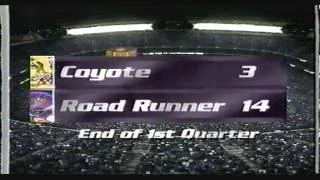
Well, Road Runner beats Wile E. Coyote 59 to -12. -12. Coyote somehow manages to owe points by the end of all this. I don’t know what Cartoon Network’s problem with Coyote was, precisely, but it was clear that they wanted him to suffer. There’s something very Germanic, and kind of poetic, about this whole affair. A born loser somehow manages to get onto the biggest stage of his career, only to suffer the biggest humiliation of his entire existence. Such is life.
Ah, well. At least the actual broadcast is fun. Madden and Summerall are as fun and lively and game as ever, and this time, they’re joined by sideline reporters Bubba Smith and…Scott Hamilton? Bubba, unfortunately, isn’t as adept as everyone else, with some flat line readings all throughout. Hamilton fares better, but…you know, it’s Scott Hamilton. I’m not even sure why he’s here.
Oh, and the payoff on the halftime show is a good one. You knew from the jump that something was going to go wrong to cause us to not see this thing play out to its fullest extent. But I’ve always loved the punchline of the camera accidentally cutting to the sound booth, manned by Fred Jones and Moltar. What I really liked about it was its insistence in making us sit with this joke, as Moltar and Fred have a long, realistic-sounding conversation about the day-to-day of Cartoon Network Studios. It’s all pretty good stuff; at one point, Moltar asks if there’s something going on between Fred and Daphne (Fred declines to answer). What I really thought was interesting was when this scene dropped a conversational reference to THE SCOOBY-DOO PROJECT, the Scooby-Doo-themed The Blair Witch Project collection of shorts the network had ran a few months before, where it appeared that the Mystery Machine gang had all been slaughtered (Fred busts this rumor fairly definitively).
Also, as a result of this halftime show, we get to hear John Madden try to wrap his lips around the name “Helmut Spassmacher” a dozen times, and I think that’s beautiful.
Oh, I should mention that they also introduce a whole new cadre of fake commercials based off of famous campaigns, past and present. There’s another GAP spoof, this one lampooning the Depeche Mode sing-along ad from around that same time. We get a pretty funny Victoria’s Secret parody, with Olive Oyl answering the question “what is desire?” And of course, there’s the parody of the “hey, kid, catch!” ad, with Johnny Bravo in place of Mean Joe Greene. It’s another example of the extreme effort being put into this whole thing. They didn’t have to do a new batch of commercials. But they did! And I love them for it.
Anyway, despite the broadcast’s extreme bias for the Road Runner, this whole four-hour block was a fucking blast to revisit. By the time we got to the end credits, with its faux-sports inspirational music score, I got a little misty-eyed. Possibly because I knew there was only one more BIG GAME left to go…
THE BIG GAME XXVIX: BUGS VS. DAFFY
Aired: January 27, 2001
Pre-Game: Len Dawson, Jerry Glanville, Nick Buoniconti, Cris Collinsworth, Dan Marino
Halftime: Cow from Cow & Chicken
(The whole damn thing can be found on the Internet Archive.)
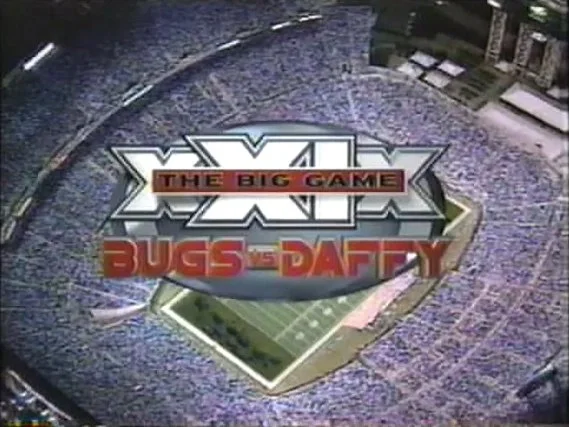
The fourth, and ultimately final, BIG GAME marathon represents both a bit of a step forward from the previous installment, as well as a step back. The elements on its side include perhaps the best list of shorts of the quartet, a massive (and, for me, satisfying) twist at the very end, and some really, really solid running sponsor jokes. Working against it is some imbalance in the chemistry amongst the pre-game crew, and a weird overreliance on “list humor” for Madden and Summerall. It just doesn’t feel as grand of an event as the previous installment.
Anyway, let’s break it down. First up, the preshow! Len, Nick, Cris and Jerry all return, and this time they’re joined by the then-recently-retired, soon-to-be-Hall-of-Famer Miami Dolphins quarterback Dan Marino. And, look, I got no beef with Marino. But, to be blunt, I don’t think he adds anything comedically to the pre-show crew. The already-established quartet were already doing fine with the central conceit of “everybody piles onto Jerry”, with Cris adding a little confident smugness to the proceedings. Marino’s main bit seems to be “dumb guy who’s a step behind”, almost like he’s lampshading the very conceit of “pretending the cartoons are football games” that THE BIG GAME is built off of. He’s doing his best, it just doesn’t work for me.
My bigger issue with the pre-game this time is that it feels too self-consciously jokey. What made the last two so great was that it was written and performed straight, as if they really were analyzing and arguing over a football game being played by Slyvester and Tweety. This time around, there are a couple of self-conscious “ba-tum-tisch” kind of punchlines that wouldn’t exist in a real pre-game. As an example, Cris Collinsworth opens one segment by saying “It’s often been said that behind every great man is a great woman, behind every great player is a great coach and behind Jerry Glanville is a pile of Nilla Wafers this high”. Glanville pops into frame and says “Hey!” like it’s a Christmas pantomime or something. It’s just trying too hard by five percent, but it’s enough to make it feel “off”.
The good news is that, this year, they go back to threading the cartoon marathon through the pre-show to keep things lively. Not that this year’s schedule needed it: the Bugs and Daffy cartoons the network chose to air constitute a fairly comprehensive Best Of in the Looney Tunes canon. It’s so strong that the pre-show ends up feeling like a bit of an afterthought (which may be why it’s got forceful Punchlines this time around).
The cartoons are, as follows:
Show Biz Bugs (1957) - A cartoon that does as much as any other to establish Bugs and Daffy’s central dynamic. Both are showmen, and can sing and dance. Only Daffy actually thirsts for approval from the audience. And this is why he’ll never get it; audiences can sense a try-hard from a mile away. Sorry, Daffy, you’ll never be Bugs.
Bully for Bugs (1953) - one of the greats! It’s got everything you need: Bugs taking a “wrong turn at Albuquerque", declaring to a bull “of course you know, this means war”, and doing slapstick synchronized to a piece of recognizable music. Also, I’ll just say it: I think the bull is kind of cute.
Robin Hood Daffy (1958) - another favorite, with Daffy Duck’s Robin Hood trying his best to convince Porky Pig’s Friar Tuck, that he is in fact the outlaw of legend. He’s unsuccessful. Maybe he shouldn’t have lied about the size of his quarterstaff.
People Are Bunny (1959) - a cartoon that I didn’t recognize, lightly parodying an Art Linkletter TV show I had never heard of (People Are Funny).
Rabbit of Seville (1950) - One of the most famous Bugs Bunny cartoons ever made, and, between this and What’s Opera, Doc? (which I’m genuinely surprised didn’t make the cut in this marathon) it’s one of the primary reasons I have even a perfunctory knowledge of opera. The masterful syncopation between the slapstick and the Barber of Seville overture is the kind of comedy I think we’re really used to today, which belies the fact that it’s really, really fucking hard. There are so many jokes crammed in here. Beyond that, I’ve always thought the fruit salad Bugs makes on Elmer’s head looked good.
What Makes Daffy Duck? (1948) - In which Daffy takes Elmer Fudd and a fox named Fortescue and, over the course of seven minutes, gets them to go from hunting Daffy to hunting each other. Daffy could be just as masterful a manipulator as Bugs in his prime.
Duck Amuck (1953) - Probably the most influential Looney Tunes cartoons of all time, and the short that introduced me to “fourth-wall breaking” in comedy. It’s also probably the cartoon that best cuts to the tragedy of Daffy Duck. His life is consistently being written and revised by a cruel and uncaring god, and that god is his supposed friend Bugs Bunny. Cold shit.
The Daffy Doc (1938) - Daffy at his most unruly and unhinged. The iron lung joke and subsequent animation has always been really satisfying to me, both as a kid and as an adult.
Rabbit Fire (1951) - also known as the one with the “Duck Season!/Rabbit Season!/Rabbit Season!/Duck Season” running joke. Perfection in simplicity.
Beanstalk Bunny (1955) - A fairy tale adaptation where Daffy Duck plays Jack, Elmer Fudd plays the giant at the top of the beanstalk and Bugs plays…Bugs. I guess he was always too cool to be a character actor.
Bugs’ Bonnets (1956) - another cartoon that I really feel like I’ve never seen before. The conceit is simple and creative: after establishing that a creature’s very essence can be altered merely by wearing a hat, Elmer and Bugs constantly change personalities after an Acme Theatrical Hat Co. truck accidentally scatters its wares in the air. It’s important to note that Elmer and Bugs end up getting married by the conclusion of this.
Duck Dodgers in the 241/2th Century (1953) - my personal favorite Looney Tunes cartoon, a belief fueled mostly by the fact that this was the one that constantly played in chunks inside that “Marvin’s Rocket” playroom in the now-defunct Warner Bros. Studio Store at my local mall. Besides it revealing itself as a sly and hilarious commentary on the futility of turf wars, I think this rewatch also confirmed for me that Marvin the Martian might be the most slept-on Looney Tunes character of them all. His opening delivery of “I declare this planet in the name of Mars! Isn’t that lovely?” made me laugh out loud. He’s just so genuine!
Operation: Rabbit (1952) - a very strange one where Bugs faces off against a fully English-speaking Wile E. Coyote. The coyote is weirdly confident, introducing himself as a super-genius, then proceeding to do not one single smart thing before becoming a toasted corpse at the end. Coyote should have probably stayed in his lane, and not come across a buzzsaw like Bugs.
As for the pre-show segments themselves, they’re not bad. My favorite section was a visit to the Daffy Duck tailgate (which at least is nice and full, unlike Coyote’s the year before), which gets crashed by a low-rent Bugs Bunny impersonator; instead of “What’s up, Doc?”, his big catchphrase is “Sup, dude?” Not bad! Oh, and there’s a medical update segment with special guest star Dr. Drew. This may seem like an obvious joke setup in 2026 (since he’s now been revealed to be kind of a dummy), but you have to remember that, in 2001, Dr. Drew was vaguely cool thanks to his work on Loveline*. Before Drs. Phil & Oz, he was just the celebrity doctor one turned to in media. Anyway, he’s just as charmingly stiff as you might remember.
*A monumentally important radio show from the 90s/00s that has aged like milk in the decades since. But perhaps that’s an article for another time.
Oh, and when it comes to prediction time, the entire pre-game crew goes with Bugs Bunny, save for Jerry Glanville, who once again rides with the underdog. Once again, in a world of Goliath nut-riders, I greatly admire Glanville’s admiration for David.
We have a new set of fake commercials this year, scattered amongst reruns of the fake ads of years past (the Gap and “Mean Joe Greene” parodies, the “I Just Can’t Get Enough” sing-along, etc.). These new ones are notable for them obviously being send-ups of real ads, but I have no idea what. There’s one with I.M. Weasel giving an impassioned speech on a stage, there’s one with youthful versions of famous characters (Fred Flintstone and Velma Dinkley among them) talking about what they’d like to be one day. I know these are parodies of something, but the actual answer eludes me. There’s a particularly melancholy one which features the Mystery Machine gang heading to a party, before I. R. Baboon jumps on a car and shows them his butt. The credits reveal its name to be “Baboon Moon”, and I’m telling you, there’s a guitar melody playing throughout that makes me genuinely wistful.
Funnier are the various sponsors of the game, most prominently the Carrot Board and the Spinach Farmers of America, two groups that end up feuding via taglines, with the Carrot Board winning (and being sore winners at that; their last tagline is “you saw what we did to the Spinach farmers. Got Carrot?”). I also liked the constant plugs for Brak Chews, each one coming with an increasingly longer and asinine ramble from Brak himself.
Then, there’s the Big Game itself, with John Madden and Pat Summerall again in the booth. However, after last year, where we often got to see the two on camera, the decision was made to make them voiceover-only. This is presumably because they weren’t available to actually film anything in a studio, but it’s too bad; it feels like we’re getting half the experience again. Also, their bits are relegated to “list graphic” humor; as an example, after a blizzard takes Bugs and Daffy by surprise, Madden and Summerall start listing other big surprises that happened that day. A graphic appears onscreen listing “John forgetting his pants” and “complimentary waffles”. It’s all okay, albeit not really that funny, and to be fair, they had done this kind of thing before. The problem is that there’s way too many of them, almost as if they were running out of any other type of joke. It provides a little too obvious structure to the humor, which takes a little of the fun out of it.
The halftime show, which is briefly hyped up to feature the biggest pop star in the entire world, only to end up starring Cow in a Britney Spears getup. It’s not a bad joke, but I found the actual song (a lazy parody of “Oops, I Did It Again!” called “Oops, I Spilled the Milk”) to be kind of annoying, albeit short. It’s hard to top the epic rug pull from last year, but this one felt like it was barely trying.
This gets us to the big twist of THE BIG GAME XXIX: Daffy Duck ends up winning. Yes, for the first and only time in BIG GAME broadcast history, the underdog secures the victory. At the time, I remember feeling like they were going to buy this twist back, and when you watch it now, it really does feel like they’re ramping up to something. Even after the game is over, they keep cutting back to the field, seeing if Bugs had one more trick of his sleeve. As the credits start rolling, the analyst crew jump back on to warn Bugs that he’s running out of time.
But, no, the final score stands and Daffy is the winner! This was satisfying to me, personally: after three years of everyone dumping on Jerry Glanville for not predicting the overwhelming favorite to win, it was cathartic to see him get to gloat and talk shit for once. But, I’ve always been curious why Cartoon Network decided to go with the “upset” ending this time around.
Yes, technically there’s one final reveal at the very end; it turns out Bugs just decided to forfeit and retire right before the end of the game, which doesn’t really make a lot of sense, and feels tacked on to make sure we understand that the face of the franchise can never really lose. But it feels for all the world like they kind of knew this was the last BIG GAME they were ever going to do. Having this massive twist (at least, relative to a fake football program) gives a feeling of finality, like the franchise has done everything they can possibly do.
And, lo, it was the last one. Cartoon Network would sort of replace it the next year with a fake Oscars broadcast (The 1st 13th Annual Fancy Anvil Awards Show Program Special: Live in Stereo), but that ended up being a one-off: there would never be a 2nd 13th Annual Fancy Anvil Awards Show Program Special, nor would there be another BIG GAME. I can’t speak to whether the network did anything similar over the last two decades, as I had pretty much aged out of it by 2002.
But, I kind of hope they did! Or at least some other network did something similar to engage the creative minds and spirits of the next generations after mine. There’s a certain beauty about a program like THE BIG GAME, where just a little extra effort (okay, admittedly a lot extra effort) transformed a normal cartoon marathon into something I keep thinking about twenty-five years after it stopped airing.
So, yeah, as an adult, I still have the real big game to watch (and all I’ll say about next weekend’s game is fuck the Patriots) and that’s a lot of fun. But, it’ll never hit the same as watching Len Dawson and Cris Collinsworth get into arguments about Sylvester the Cat’s running game. Or getting caught up at the bravery of Squiddly-Diddly. Or getting a little choked up at a fake commercial where a baboon moons Scooby-Doo.
What could?

I Watched (Nearly) Every Post Super Bowl Show V: The 2010’s and 2020’s!
This week, let’s close out this series, and this football season, by looking back at the post-Super Bowl shows from the 2010’s and 2020’s! It’s been a slow, steady decline, with insincere episodes of “Undercover Boss” and “The Voice”, all leading to current slop like “The Masked Singer” and “The Floor”. On the other hand, a rival platform may have presented a path forward…
Hello! This is the finale of a five-part series looking back at the long, strange history of the Super Bowl lead-out program! The other four parts can be found here:
Well, we’ve done it. We’ve reached the modern era of the post-Super Bowl show, and you can definitely see a shift over the past fifteen years.
Big episodes of popular shows still dominate the proceedings, at least for a while, although notably, extra “star power” no longer becomes a requirement. Part of this is because cheap competition shows where celebrities are already the star begin to become en vogue. By the time we reach the modern day, the timeslot begins to revert back to where it was in the eighties: a place for pilots of anticipated hits. All things return from whence they came!
It becomes clear that, in the modern streaming era, where everybody’s attention is divided, the post-Super Bowl show is in somewhat of a crisis. There just doesn’t seem to be a way to unify a massive audience anymore. However, an interesting wrinkle emerged this weekend that just might allow for a creative rebirth to occur, if network executives choose to embrace it. So, yeah, it’s probably fucked. We’ll talk about it!
Here we go! The post-Super Bowl shows of the past sixteen years!
SUPER BOWL XLIV
Show: “Undercover Boss”
Episode: “Waste Management” (Season 1, Episode 1)
Aired: February 7, 2010
Network: CBS
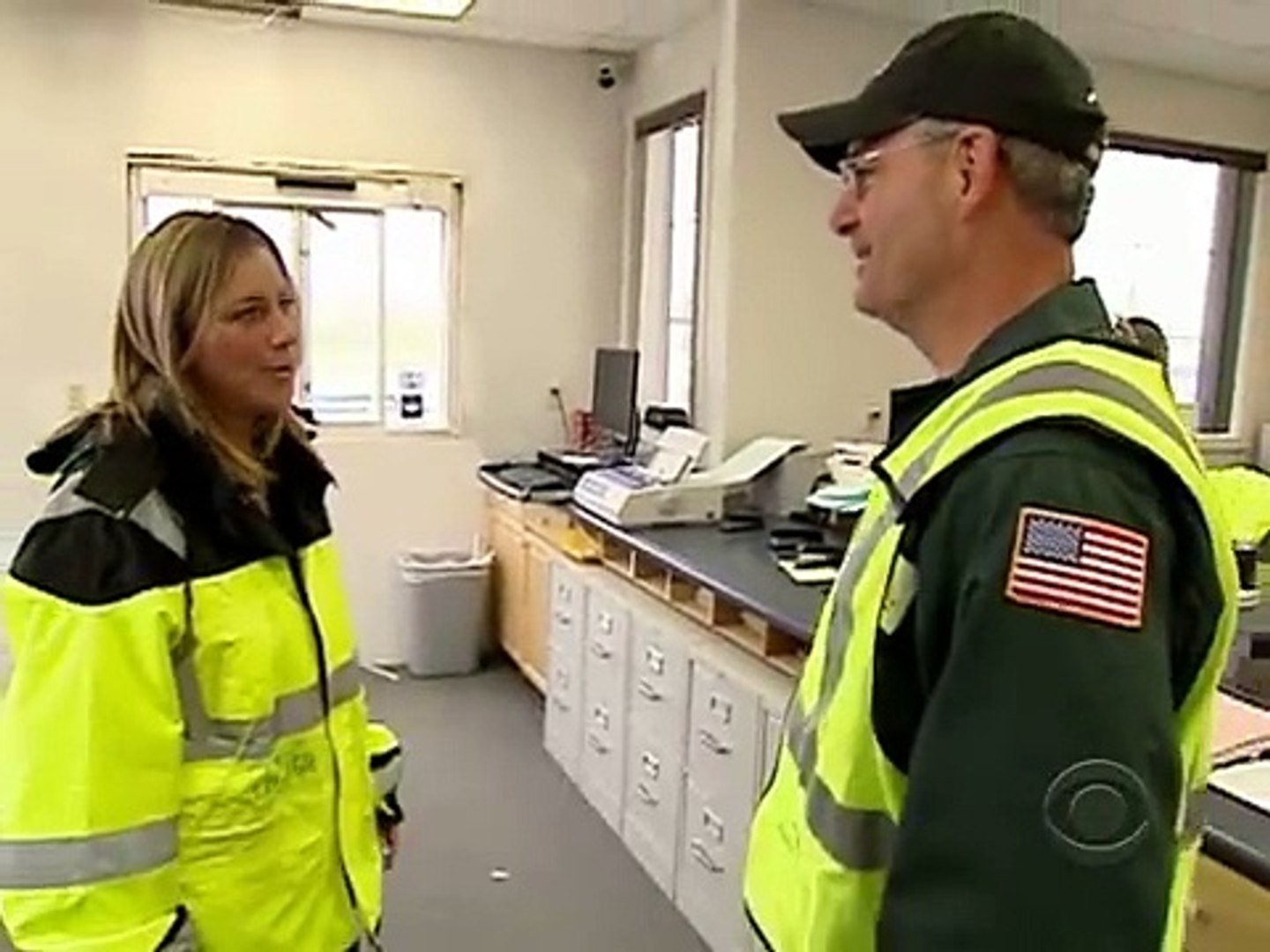
Given the state of the American economy in 2010, “Undercover Boss” proved undeniably well-timed. A reality show where the CEO of a major company got to know what it was really like doing the grunt work (and following the draconian policies) required to keep operations going? Sign me up!
In actuality, “Undercover Boss” is one of the more disingenuous shows I’ve ever seen. Yes, in this premiere episode, COO Larry O’Donnell goes undercover as works at various Waste Management job sites throughout the country. Yes, it’s funny to see him get yelled at for not picking up enough trash. Yes, it’s heartwarming to see him tear up in response to an overworked employee’s family struggles. Yes, it’s humanizing to see him relate the story of his daughter, who herself deals with various health issues. Hell, I’d even say the number one thing I liked about this episode is that they chose the employees he shadows very well. They all reminded me of the kind of people I used to work with in my manual labor days. They’re funny, gruff, overwhelmed, and blunt. It’s fun to see them succeed.
But there’s an inescapable feeling that “Undercover Boss” is designed to let CEOs off the hook, as well as provide their companies a big, fat hour-long plug. Did any of you ever even hear of Waste Management before this? Well, now that you have, isn’t it cool how sweet and open-hearted their big boss is? He rewarded four employees with some benefits. Go, America! The show knows enough that workplaces all across the country are riddled with issues, but it’s also content to put the blame squarely on middle management, represented here by Kevin, a guy who is very clearly being given the shaft by a vengeful editor. Sure, middle managers tend to be pedantic dorks, but they’re also very rarely imposing policies unilaterally. Let’s just say that I don’t buy the presented perspective here that Larry had never heard of the “docked two minutes for every minute you’re late to clock back in” policy before.
By the way, the “undercover” aspect of this has always kind of mystified me. As people point out in this very episode, most of the frontline people have never seen him before. Not one person knows who he is during the “big reveal” moment. Hell, his “going undercover” outfit is just, like, a hat, and maybe some facial hair? What’s the point of all this? I remember in a later episode featuring Subway, the CEO deferred the assignment to the CDO, on the basis that he was too well known. Buddy, I think most people thought at the time that Jared was the CEO.
Anyway, I thought this was a corny let-down after a long stretch of fairly decent Super Bowl lead-out programs. Hopefully this doesn’t become a trend.
SUPER BOWL XLV
Show: “Glee”
Episode: “The Sue Sylvester Shuffle” (Season 2, Episode 11)
Aired: February 6, 2011
Network: FOX
Special Guest Star(s): Katie Couric

For the uninitiated, “Glee” is just as unhinged as you’ve likely heard. I’m willing to go to bat for its initial batch of episodes, however. When it first premiered with a significant amount of hype behind it (the pilot was released for free earlier that summer and it was HUGE), I actually found it to be a fairly accurate (if broad) satire of what being in a high school choir felt like. Lea Michele’s portrayal of a Type-A “theatre lead” felt revelatory at the time, and Matthew Morrison’s Will Schuester was a pretty spot-on depiction of a dorky choir teacher. The songs were okay, the kids were fun, and Jane Lynch’s villanous cheerleading coach Sue Sylvester was one of the great television inventions of its time. “Glee” was never my favorite show or anything, but for about half a season or so, it was hitting a very specific mark for me.
As its first season and beyond went on, though, you could feel it responding to what people liked about it and Moneyball-ing the show in real time. You all liked Sue? Let’s give her more screen time (I sometimes feel the response to a fan favorite is to put them in less…make us treasure the time we get with them). You’re buying the songs on iTunes? Let’s double or triple the amount of songs we cram into a single episode! You like weird guest stars? Bring in Gwyneth Paltrow! “Glee” fell out of balance really quickly, and it didn’t take long for me to turn my back on it.
“The Sue Sylvester Shuffle” is a pretty good microcosm of what the show quickly became. The story is a never-ending criss-cross of kids either joining or leaving the glee club (New Directions), the cheer squad (the Cheerios), or the football team (the, uh…Titans). The title suggests Sue is the main thrust of the conflict, and she indeed gets a lot to do. Feeling a ton of ennui about putting together another cheer routine in order to defend her seven-year winning streak at regionals, she procures a cannon and volunteers cheerleader Brittany to be launched out of it.
But the main problem to be solved in this mega-sized episode is actually football player Dave Karofsky (Max Adler), who gets enrolled in glee club (along with the rest of the team), in an attempt to quell bullying in advance of the championship game. As the Cheerios end up having to pull out from the halftime show, due to Sue getting the cheer regionals scheduled on the same day, it’s decided that the football team and the glee club will work together to perform the halftime show! Neat, huh? Will Karofsky quit the club and turn his back on his team? Does it matter? Does any of this feel even slightly realistic?
Oh, the songs. They’re fine. Mr. Schue quickly decides the halftime show will be a mashup of Michael Jackson’s “Thriller” and the Yeah Yeah Yeah’s “Heads Will Roll”. The club puts on professional-grade zombie makeup for the occasion, but not before running a rehearsal, where they perform “She’s Not There” by the Zombies. Because, naturally, you rehearse a number by singing something else completely different. I know this happened because the show didn’t want to blow the big finale halfway through and saw an opportunity to add another song to upload, but it’s very weird. They also cram in an arbitrary Destiny’s Child number, as well as a big Katy Perry opening (“California Gurls”) and a Lady A interlude (“Need You Now”), presumably because those songs were popular at the time. Hope you like acapella music!
The main thing to note about “The Sue Sylvester Shuffle” is that it is an unabashedly queer-centric episode of television, featuring numerous LGBT characters and a gender-fluid football coach, that aired on the FOX network directly following the Super Bowl. At the time, the biggest controversy that got generated from the episode was from a fairly tepid joke from cameo-ing Katie Couric at Dina Lohan’s expense right at the end. As overall lame and frustrating as “The Sue Sylvester Shuffle” ultimately is, I cannot imagine what would happen just a mere decade and change later if some network dared to air it in such a timeslot in 2025. What this says about the state of things, I’ll leave you to decide, but it’s striking nonetheless.
The worst sin of all in this musical comedy show: save a Sue tantrum about midway through (that unexpectedly picks back up in the next scene), nothing was all that funny. The thing that made me laugh the hardest was when Disney Plus asked me if I wanted to skip the two-second intro.
SUPER BOWL XLVI
Show: “The Voice”
Episode: “The Blind Auditions, Part 1” (Season 2, Episode 1)
Aired: February 5, 2012
Network: NBC

I have always had a strong, immediate distaste for “The Voice”’s particularly flavoring. I’m sure anyone reading this is familiar with its broad strokes: four celebrity singers sit in on several rounds of blind auditions (their chairs are turned around, forcing them to evaluate on just…The Voice), with the intent of building competing teams, all with the goal of coaching the eventual champion, as voted on by America. It’s probably the second-most popular music competition show (behind “America’s Got Talent”) to be birthed in the wake of “American Idol”’s early-21st century dominance.
HERE, the supposed extra novelty is the fact that the celebrity judges (in this season, Adam Levine, Christina Aguilera, Cee-Lo Green and Blake Shelton) are encouraged to tease and banter with each other. This seems to be a direct rebuke of the most famous ingredient “American Idol” had in its stew: Simon Cowell’s honest (but venomous) critiques of auditioners he sees to be subpar. What if, instead, the judges aimed their ire at each other, instead of at the prospective contestants?
Well, I’ll tell you what if. It fucking sucks.
Look, I have a lot of issues with how “American Idol” conducted itself: when FOX realized early on that audiences liked to watch Simon, Randy and Paula laugh their asses off at losers more than anything else, the game was on. The constant shoveling of freaks into the audition room so that Simon could say he wished he could kill himself was superficially funny, but it was actively a waste of everybody’s time, up to and including yours. However, although he was often goaded into being, uh, colorful, Simon rarely offered criticism to anybody who didn’t on some level need to hear it. There was probably no point in him telling a vaguely mentally ill person they couldn’t sing, but it was also usually true.
I’d argue the format of “The Voice” isn’t actively kinder to its contestants. Due to its focus on auditioners who have at least some experience, what happens most of the time is that at least one judge will turn their chair around. Usually, at least two will, and the active recruitment begins (more on that in a second). BUT, every once in a while, the blind audition will yield no takers, which leads to this really awkward minute or so where the judges will have to explain why they didn’t turn their chairs, all without ever articulating a tangible piece of criticism (because that would be mean). It usually ends up being some variation of “don’t get discouraged, you’re great, I would work on your pitch”. Thanks for the tip! By the way, have I mentioned that this all takes place in front of a live audience, doubling the pressure to not be too pointed, lest the crowd turn on you?
Thankfully, because this show is semi-cooked, this doesn’t happen too often. Usually, we get two to four celebrity judges all fighting to get an auditioner on their team and, boy, is this stuff funny. You see, Adam, Blake, Christina, and Cee-Lo will do or say anything to throw the other judges under the bus, such as…uh, Blake is a hick! Or, um, hey, Adam and Christina, are you fighting or are you flirting? Burn! Or, uh, Cee-Lo is…too smooth, I guess? The “fighting” never really moves beyond light ribbing, and I suspect this is because by 2012, the era of celebrity personas becoming commodities on the Internet was in its early days. If Blake said something too mean to Christina, he might not be “daddy” anymore, or if Adam got weird about Cee-Lo, he might become “problematic”*.
*Thank god Adam Levine never became problematic.
Going back to “American Idol” really quickly, the key to its magic (insomuch as it had any) was that, every once in a while, the judges got genuinely hostile with each other; there was legitimate reason to suspect Simon and Paula didn’t really like each other very much. Whether true or not, you got this feeling that they and Randy had simply spent too much time together, and their unique personalities started getting irritating. Compare this to “The Voice”, where it seemed like the first time Adam, Blake, Christina and Cee-Lo interacted since Season One wrapped was two seconds before cameras started rolling. The show’s very gimmick is rendered completely inert as a result.
Seriously, what are we doing here? “The Voice” is clearly popular, as it’s been running for almost a decade and a half. But I have a hard time imagining the type of person that genuinely finds the lifeblood of the show (the fake celebrity judge “fighting”) amusing or entertaining for that long. Surely, less discriminating parents would eventually move on to like, “This is Us” or “Yellowstone” eventually? Life is too fucking short for stuff like this.
SUPER BOWL XLVII
Show: “Elementary”
Episode: “The Deductionist” (Season 1, Episode 14)
Aired: February 3, 2013
Network: CBS

Whether it meant to be or not, “Elementary” appeared to be the American response to the success of BBC’s “Sherlock”, which introduced America to Benedict Cumberbatch, in the biggest act of war from the UK against the US since 1812. From my very limited experience with either, both shows operate from the same premise of “what if Sherlock Holmes…but MODERN?”
I’d argue the original Victorian setting is half of what’s fun about a Sherlock Holmes story, but fine. My biggest barrier to enjoying this episode (which I kind of didn’t) is that it’s stuffing the characters of Holmes and Watson into the skeleton of a standard-issue crime procedural, a genre that had been done to death by 2013. Holmes (Johnny Lee Miller) isn’t a detective, he’s a police consultant (exciting!). Watson (Lucy Liu) isn’t just his friend, she’s his sober companion (gritty!). The show is admittedly a little lighter on its feet than, say, “Criminal Minds”, but it’s a shame to see Sherlock Holmes become just another “prickly malcontent whose deduction skills border on magic” character, like, say, Gregory House or…whatever the Mentalist’s name is. Men Talist.
It’s difficult to know what to say about “The Deductionist” beyond that. If you’re into this kind of thing, this seemed to be popular enough, enjoying a seven year run. You’ll probably have a good time. I didn’t really get anything out of it, though. I thought Miller was kind of annoying, and not in a lovable way like Hugh Laurie in the aforementioned House. It’s always nice to see Lucy Liu, but as presented in this episode, her take on Watson felt like nothing special. Alas, my dear Watson!
SUPER BOWL XLVIII
Show: “New Girl”
Episode: “Prince” (Season 3, Episode 14)
Aired: February 2, 2014
Network: FOX
Special Guest Star: Prince

Another sitcom two-fer! First up, a show that started off as an awkward star vehicle and became a beloved ensemble hang-out show.
Or at least, apparently. I kinda got fed up with “New Girl” early on, as it was apparent that the premise of “Zooey Deschanel acts weird, and the people around her react” wasn’t working for me. Naturally, as soon as I ditched it, it kept working away at itself and eventually found its audience. Part of that audience, apparently, included Prince, who reached out to the show to express his interest in guest-starring on the show, “New Girl” being one of the few television shows he watched.
Look, Prince is a jaw-dropping get for a show like “New Girl”. Yeah, I know Taylor Swift also cameoed on this show in its first season back in 2012, but she wasn’t quite the monolithic figure then that she is now, and she certainly doesn’t have the hermetic reputation Prince had. Although he released something like 40 albums, he only made two appearances on TV. The other one besides “New Girl” was a 1997 episode of “Muppets Tonight”. He may be the single most impressive booking within this entire project.
I focus on this because I thought the episode itself was just fine. There’s plenty I laughed at, with the biggest ones being Jessica responding to Prince’s whispered advice in her ear by admitting, “I didn’t hear any of that”, as well as Schmidt and Nick attempting their own version of “Fire and Ice”. It’s clear that the dynamics between the six leads have tightened over the years, and the joke writing had absolutely improved since I dumped the show. This is all normal for sitcoms! They traditionally take a little bit to find themselves!
But its preferred sense of humor is just something that I can get from other places, primarily its brother-in-arms (and, in my opinion, superior) “Brooklyn Nine-Nine”. But then again, my evaluation’s sample size is fairly small; a handful of early episodes and an event episode hardly feel like the best ones to judge an entire seven-year run. Alas, that’s all I have to go off of and, although “Prince” was comfortable and familiar, it also didn’t inspire me to drop everything and start the show anew either.
Show: Brooklyn Nine-Nine
Episode: “Operation: Broken Feather”
Aired: February 2, 2014 (Season 1, Episode 15)
Network: FOX
Guest Stars: Adam Sandler, Joe Thiessman

The network sitcom bang-bang concludes with this mid-Season One outing for America’s favorite cops, if only by default.
It’s funny, I always forget that this is the episode that aired after the Super Bowl (I always think it’s the one that Marhsawn Lynch guested in). It’s a fairly nondescript episode for the most part; Amy Santiago (Melissa Fumero) is about to interview with Major Crimes and work under the Vulture (Dean Winters), and Jake Peralta (Andy Samberg) is taking it upon himself to convince her of everything she would miss as a detective. It’s the classic “reintroduce both the characters and the basic setup of the show” kind of Super Bowl episode. They work very hard to re-establish who the Vulture is, they heighten everybody’s quirks, they even replay the theme song at the end like it’s a pilot. But it’s overall a fairly standard episode of “Brooklyn Nine-Nine”, although it should be noted that half a season in, the entire cast is already clicking like they’ve been doing it for years. The subplot involving Sergeant Terry (Terry Crews) and Captain Holt (Andre Braugher)’s quest for an efficient office set-up is goofy, but completely believable because their characters are so well-defined; the revelation that Holt teared up at the efficiency on display in MONEYBALL is a perfect joke.
What makes the episode feel like an event, besides the football-themed cold open (the 99 takes on Patton Oswalt’s Fire Department), is the big Adam Sandler cameo, which is pretty funny. The other big cameo is by Joe Thiessman, and it’s so awkward (they have to say out loud, “Hey! Is that Joe Thiessman?”) that it might have ended up being equally as funny, even as it’s absolutely the worst part of the episode. Yet, “Brooklyn Nine-Nine” was never a show that needed to feel like an event. Even in its inaugural season, it felt like a sitcom on the rise. Over the years, it became a streaming darling off the development of its own internal language and logic, not necessarily flashy one-off guest stars. So, yeah, this episode feels a little awkward in a watch-through. But, maybe you can forgive it and accept “Operation: Broken Feather” for the compliment that it was. FOX already had a lot of confidence in “Brooklyn Nine-Nine” only fourteen episodes in, and that confidence paid off.
SUPER BOWL XLIX
Show: “The Blacklist”
Episode: “Luther Braxton (Part 1)” (Season 2, Episode 9)
Aired: February 1, 2015
Network: NBC
Special Guest Star: Ron Perlman

Believe it or not, my wife and I were pretty avid followers of “The Blacklist” for its first four seasons or so. It’s an absolutely ridiculous premise; Raymond “Red” Reddington (James Spader) is a Most Wanted criminal who cuts a deal with the FBI that goes as such: in exchange for details on everybody on his criminal Rolodex (the titular Blacklist), he will be granted “imprisonment” that essentially resembles five-star hotel accommodation: steak dinners and the ability to come and go as he pleases. Oh, and he will only work directly with rookie agent Elizabeth Keene (Megan Boone), who he has seemingly no connection to.
If you’ve never seen the show, I’m sure your first thought was, “Oh so Red is her father?”, and that was the thought everybody initially had the second the first promo dropped. I’ll never know for sure, but it seems to me that was the initial thought creator Jon Blokenkamp had, too, and the show had to work itself into knots to either pivot to another secret connection or keep delaying the inevitable. As far as I can tell from some Googling, “The Blacklist” came and went without ever really making it clear what Red’s connection was to Elizabeth? This, to me, was the funniest choice the show could have made. It ran for a decade! And they just never clarified who our two leads were to each other! It’s fantastic!
Anyway, the big get here is Ron Perlman, who plays the titular Luther Braxton, a super-evil brawler who is able to take down the maximum-security secret prison he’s held in essentially by himself. Perlman is a perfect fit for a show like this (and it helps that the hour is directed by action guy Joe Carnahan); he doesn’t say a word throughout the first act or so, yet he’s still terrifying in a way “Blacklist” aren’t always. It’s all fun, if not exactly nutritious. The two stars here, as you might imagine, are Perlman and Spader, who’s in his prime “I guess I’m a bored comedy guy now?” mode. Half the moments that pop here are Red flipping some vaguely disinterested bon mot, treating life-and-death stakes as if they’re minor inconveniences. Oh, and he gets to rock a sawed-off shotgun near the episode’s conclusion. Get you a guy who can do brains and brawn!
SUPER BOWL L
Show: “The Late Show with Stephen Colbert”
Aired: February 7, 2016
Network: CBS
Special Guest Star(s): Scott Kelly, Barack and Michelle Obama, Tina Fey, Margot Robbie, Jim Nantz, Von Miller, Will Ferrell, Keegan-Michael Key and Jordan Peele, Megyn Kelly

It’s a little surprising this marks the only time a late night show ever aired after the Super Bowl and, considering the format’s slow and steady sundowning, it’s equally surprising that it happened within the last ten years. It would seem a natural fit for the setting: you have instant star power, most major network late night shows were fairly beloved back in the day…I have to imagine it simply came down to Colbert being the first host willing to work on a Sunday.
Speaking of Colbert…if I may. It seems to me his shift in personas over my lifetime effectively illustrates the shift in the shape of popular liberal-minded comedy. His conservative pundit character that headlined “The Colbert Report” was one of the most precise pieces of satire of the 00’s, to such a degree that his conservative guests often seemed to not be in on the joke. It was vicious without ever seeming uninviting. The late night version of Colbert, on the other hand, seems to align more with his actual personality: cozy, warm and witty, not unlike an uncle you look forward to seeing at family gatherings. It’s nice.
Nice, unfortunately, doesn’t always blend well with a late-night comedy show that also wants to dabble in political commentary. I’m trying to be really careful here, because this particular well has been so poisoned over the past decade that I think it’s really easy to overread someone's intentions when they state that something like this wasn’t funny to them but…a lot of this wasn’t funny to me.
I should state here that, in all fairness, I only had about half of this 45-minute program available to me, a full upload seemingly unavailable anywhere (I’ll save this rant for later, but I found this concerning). From the six or so clips uploaded to the official “Late Show with Stephen Colbert” YouTube channel, I was able to piece together a show that was heavy on star wattage and an easygoing nature (truly not out of step with other programs in the lead-out timeslot) but light on actual genuine laughs. There are things you’re supposed to find funny; the early pre taped cameo from the Obamas is charming due to their natural ease on camera, but it’s not actually funny. But they’re on our side, so we clap. The only clip from the Megyn Kelly interview is her and Colbert debating things they would never call Donald Trump, both evoking a horrible tweet from him about her, as well as reminding me of how badly this kind of “isn’t President Cheeto a dum-dum” stuff has aged, and also a reminder that, just like the tweet itself, it’s not funny. But the Fox News lady is now on our side, so we cheer.
There are some parts I liked. The Margot Robbie and Tina Fey interview is genuinely fun, and I got a lot out of the pre-taped sketch from Key and Peele skewering touchdown celebrations, a well-worn topic that they nevertheless find new angles of attack towards. But an animal segment from Will Ferrell, who is normally fairly reliable in this kind of setting, just kind of sits there (and isn’t as funny as either he or Colbert, who is beside himself the whole time, seem to think).
Anyway, still love ya, Colbert, you seem like a kind man. Your view of things will probably prevail when all is said and done. Just wish this particular episode was funnier!
SUPER BOWL LI
Show: “24: Legacy”
Episode: “12:00 PM - 1:00 PM” (Season 1, Episode 1)
Aired: February 5, 2017
Network: FOX

I never really thought about it until it was pointed out to me, but it’s a little shocking that the original “24” series never got the post-Super Bowl slot. It’s tailor-made for the moment: an adrenaline-soaked actioner that feels tangibly conservative in spirit* and also always knew how to front-load its seasons to make premieres feel like real Events. Hungover Super Bowl viewers would love “24”, if they didn’t already. If I could go back in time, I would absolutely give “The Simpsons” and “American Dad!” the boot back in 2005 and give the Season Four two-hour premiere the slot instead.
*Mostly because of the copious amounts of torture, its “shoot first, ask questions later” ethos, and fear-mongering of Middle-Easterners, although I’d argue it gets balanced out in other weird ways. For instance, I feel like half the time, the ultimate Big Bad winds up being some pasty white British guy. For another instance, Democratic presidents on 24 tend to be noble and upstanding, burdened with the responsibility of morality, while Republican presidents tend to be blustery, craven, and opportunistic.
Yet, it wasn’t to be. Its sequel series “24: Legacy” would be the closest the franchise ever got. It’s an odd watch, it being exactly like the old “24” series in form and style, but missing the centerpiece character that made it an eventual phenomenon: Kiefer Sutherland’s Jack Bauer. In his place, we get Eric Carter (Corey Hawkins), a former Army Ranger whose past comes back to haunt him for one…hell of a day! To be honest, I never thought swapping out casts would be that crippling for “24”. Its unique, signature format (each episode of the season covering one hour of a day in real time) is so perfectly built to be exciting and hooky, provided the writing is up to par, that I felt like any halfway-decent actor could flourish at its center.
I was wrong. “24”, it turns out, is not “24” without Jack Bauer. It seems that Kiefer’s gravelly, world-weary Emmy-winning turn as the rogue CTU agent was holding the whole thing together the entire time. Without him, “24: Legacy” actually paradoxically feels a little tired. It plays the hits: initially innocuous characters turn out to be evil, suspicion is cast over new government bosses, the overall mission turns out to be a strain for our lead and his family. Corey Hawkins does his best to infuse all of this with some gravitas and meaning, but he actually seems too young to be the “24” guy (Jack Bauer has a teenage daughter when we first meet him). Hawkins is a skilled performer, but this feels like a poor fit.
There are reasons for optimism, mostly via the casting of consummate television character actor Jimmy Smits, as a Senator, and Mirando Otto, as his wife and former director of CTU. And it’s not like the format doesn’t work or anything; I still get a charge after every return from break, with that oppressive beeping clock sound. But, just like every other legacy sequel not called “Twin Peaks: The Return”, this felt like too little, too late. As of this writing, it seems like “24”s time has….run out!!!
SUPER BOWL LII
Show: “This is Us”
Episode: “Super Bowl Sunday” (Season 2, Episode 14)
Aired: February 4, 2018
Network: NBC
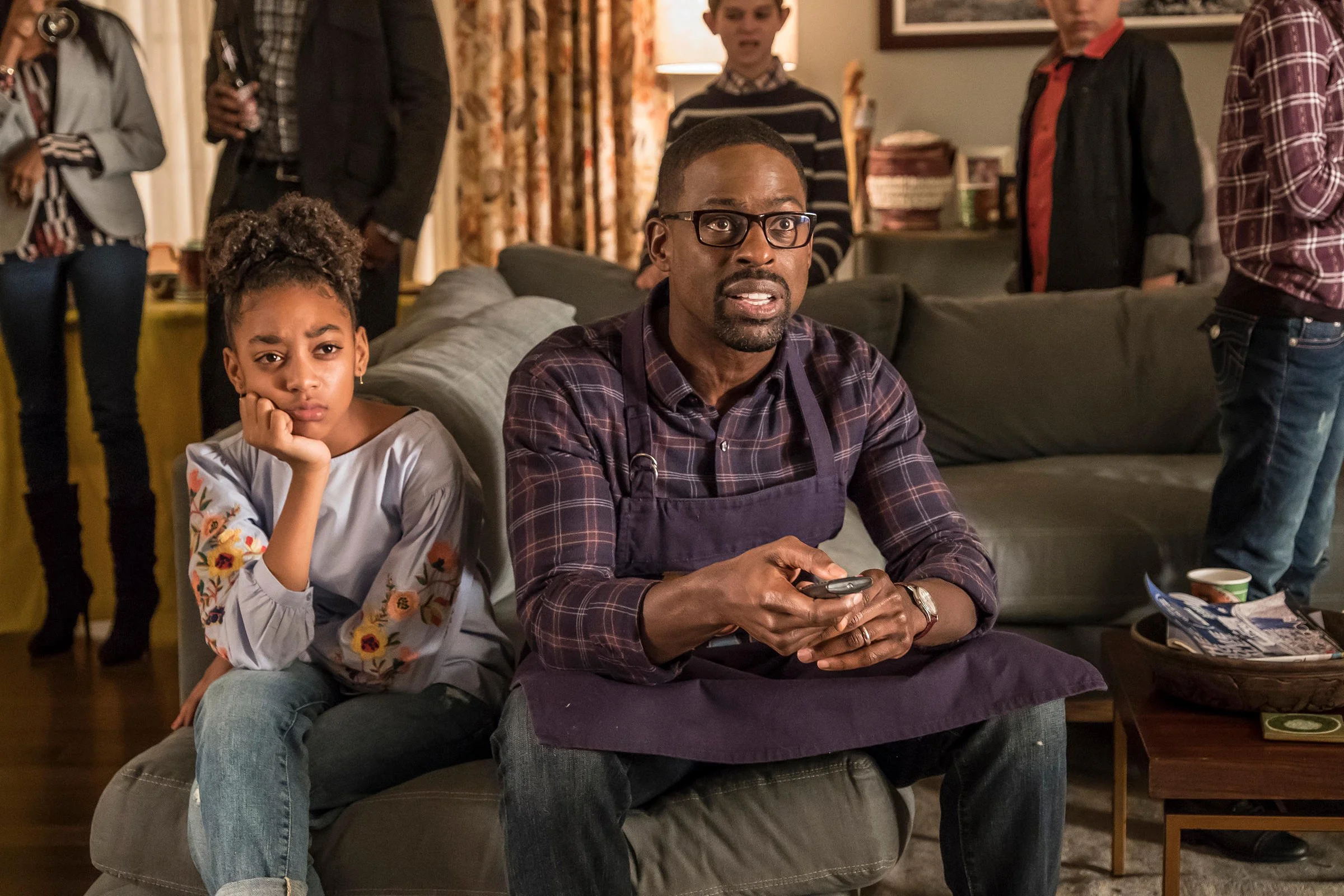
Based just off this one episode, I think I admire “This is Us” more than I genuinely like it.
With respect to the fact that I’m stepping into the middle of a serialized story, having never seen another episode, there are many elements to “This is Us” that aren't all that appealing to me personally. It’s essentially a tender primetime soap opera, which is not in and of itself a bad thing. But it is Deadly Serious at almost all times, with every character on the verge of performing the kind of monologue that eventually gets used in a theatre program audition. Big emotions! People telling stories from their past! It got exhausting just in this one hour; I can’t imagine subjecting myself to six years worth of it.
But I will give it up to “This is Us” on a couple of different fronts. First of all, it becomes very clear why this became Sterling K. Brown’s breakout moment. He immediately pops in a way no other cast member does; he’s engaging, he’s funny, he’s warm, and more than anything, he has an ability to take these weepy monologues and make you believe them. If there were one thing that would make me do the “This is Us” deep dive, it would be him. He’s amazing.
Second, I think “Super Bowl Sunday” as an episode is remarkably well-constructed. I have gathered just through pop culture osmosis that one of the central mysteries of “This is Us” is how Jack Pearson (Milo Ventimiglia), the father of the central three characters, died. The show makes the decision to use their Super Bowl spotlight to reveal their hand. So when it opens with an enormous, terrifying house fire set piece, it seems clear this is how Jack goes down. But then, in a twist that should have been obvious but wasn’t, he makes it out unscathed. No, “Super Bowl Sunday” makes the better, and more devastating, decision to have him die of a sudden smoke-induced heart attack at the hospital. It leads to my single favorite choice of the whole thing: as his wife Rebecca (Mandy Moore) is told of the unexpected horrible news, her first move is to blankly take a huge bite of her candy bar. It’s a shame, then, that the show has Rebecca monologue about that moment later, just in case you missed it.
Okay, that was another swipe at a show that otherwise clearly has its heart and spirit in the right place, so I’ll end with this. “This is Us” may be the last of its kind: a big network show that launched and rekindled several careers, and one that was able to live off of aching sincerity and find a place in the cultural zeitgeist. It didn’t need to attach itself to the Dick Wolf universe in order to make its mark. I think that’s actually really cool, even if “This is Us” isn’t ultimately for me.
SUPER BOWL LIII
Show: “The World’s Best”
Episode: “Auditions 1” (Season 1, Episode 1)
Aired: February 3, 2019
Network: CBS

“The World’s Best” is another run-of-the-mill talent show, along the lines of an “America’s Got Talent” or “American Idol”, except the twist here seems to be that, along with our celebrity judges Drew Barrymore, Ru Paul, and Faith Hill, contestants are also evaluated by a 50-person panel referred to as “The Wall of the World” which consists of entertainment experts from around the world. It sounds a little overwhelming, to be honest.
I have to say “sounds” because “The World’s Best” doesn’t appear to be available to view anywhere, despite being only six years old. To some degree, I get it. Nobody seemed to like this show, with nary a good review to be found. Some of this assuredly is residual Internet pile-on hate for James Corden, the man who hosts this show (because why not). Otherwise, there’s no apparent difference between this and “The Voice” or “The Masked Singer” in terms of empty calories. But I understand. If there’s no audience for something, why keep it around?
But it is a little disturbing that a program can just be removed. I understand this was a stupid show that added little of value, but people still worked on it. It existed. More to the point, we tend to associate the concept of “lost media” with a time long ago, where stupid film and television executives valued their product so little that they would just throw them away, or tape over them. Most of the silent films that ever existed, good or bad, are now gone forever because of practices like this. So it’s a little strange that this seems to be back in vogue. I hate Corden, too, and this show sounds like it sucks shit, but it’s weirdly not a good thing that “The World’s Best” has been deleted from existence.
SUPER BOWL LIV
Show: “The Masked Singer”
Episode: “The Season Kick Off Mask Off Group A” (Season 3, Episode 1)
Aired: February 2, 2020
Network: FOX

If I thought I didn’t understand “The Voice”, I really, really don’t get “The Masked Singer”. Here, they’ve seemingly cut out civilians altogether. Now, we have celebrities doing a talent show for a panel of celebrities, all to an audience of…non-celebrities? Well, there’s my first note! Get those non-celebs outta that theatre! I need more celebrities!
I know this one isn’t an American invention. Unbelievably, this game show where celebrities make themselves anonymous by wearing increasingly elaborate and loud costumes before doing karaoke on live TV originated in Japan. However, “The Masked Singer” came along at the perfect time for an America that stopped demanding much from the things that entertain us. Really, if you strip away the “banter” (which mostly consists of people calling Ken Jeong “weird”) and the novelty of “notable stars” potentially being on your screen, there’s no real game here. People sing in masks, and panelists just make random guesses as to who it might be, with no penalty for being wrong or right. At the end of the episode, one masked singer is eliminated by an arbitrary audience vote, and their identity is revealed. That’s it! Besides host Nick Cannon constantly hawking other FOX shows, nothing else happens.
I truly, truly don’t understand “The Masked Singer”. Most of the celebrities are singers in their own right, but not all (previous masked singers include Dr. Drew, Rob Gronkowski, Mickey Rourke, Kermit the Frog, Adam Carolla, and Larry the Cable Guy). A scan of all previous winners and runners-up reveals…pretty much all singers! So why the weird non-singers in the lineup? On the off-hand chance Rob Schneider or Caitlin Jenner wins it all? They won’t! Who is this all for??
My guess: “The Masked Singer” is a TV show meant to just have on in the background while you’re doing other things. This is probably (debatably) the first of these in this project, but it absolutely is not going to be the last.
SUPER BOWL LV
Show: “The Equalizer”
Episode: “The Equalizer” (Season 1, Episode 1)
Aired: February 7, 2021
Network: CBS

I think at this point, network television firmly hit the modern “competent slop” era, one that will likely eventually end (all eras do) but not in the foreseeable future. “The Equalizer” isn’t bad by any quantifiable measure; the premise mostly works (although it helps that it’s based on a pre-existing property), and the cast is fine. Queen Latifah is such an odd-ball choice for something like this that it all kind of gets by on the novelty alone.
But it also is unequivocally a show that goes into one ear and out the other (or, I guess, in both eyeballs and out the back of the head?). Latifah plays an ex-CIA agent who splits her time trying to raise a family as a single mother and using her skills to fight street crime, vigilante style. In her initial outing, she’s helping a young woman who’s being framed for an execution she didn’t commit. This is another one of those television episodes that shows you how a crime plays out (said girl watches it happen), then tries to pull a second act twist with a revelation that makes no sense (the security footage shows that the girl…is actually the shooter!). Since we already saw an objective account of what happened, this twist can only mean the footage is manipulated, so why does the episode spend so much time casting doubt on the falsely-accused suspect? Does this not bother anybody else?
Anyway, I don’t have a lot to say about “The Equalizer”. I think my brain is turning into mush at this point. Only a few more to go!
SUPER BOWL LVI
Show: “The 2022 Winter Olympics”
Episode: “Woman’s Monobob and Ice Dance”
Aired: February 13, 2022
Network: NBC
Like the other miscellaneous sporting events that served as Super Bowl lead out programs, this one isn’t really available or archived anywhere, so I can’t really formally review this. For some reason, I find this more acceptable than scripted shows being tossed down the drain; maybe it’s because the results of the Olympics are accessible in some form or another. Or I’m a hypocrite. That’s also possible.
The only thing I don’t really like about this is that it looks, to me, like NBC has officially cashed out of the lead-out program game entirely. Their television contract was renegotiated around this time to have their Super Bowl broadcast always coincide with the Winter Olympics. Their 2026 lead-out is all but confirmed to be Winter Olympics coverage. Although this makes a certain amount of sense, I also find it incredibly boring. Sensible but boring! A pattern seems to be emerging.
SUPER BOWL LVII
Show: “Next Level Chef”
Episode: “A Next Level Welcome” (Season 2, Episode 1)
Aired: February 12, 2023
Network: FOX

“Next Level Chef”, an otherwise too-busy, too heavily edited cooking competition, has a couple of things going for it, at least to this viewer. First, I generally enjoy watching Richard Blais. Second, this show has the good, UK version of Gordon Ramsey, the version of him that is brutally honest, but generally supportive and rant-free (as opposed to the more popular, US version that calls people idiot sandwiches or whatever). Third, and this may be controversial, but…I think the goofy initial premise kind of works. Admittedly, the idea of a three-level set, each containing increasingly inadequate kitchens (and ingredients) as you descend, feels a little bit like the setup for an “I Think You Should Leave” sketch or something. But you do legitimately start rooting for people pulling something gourmet out of their asses with, like, black cod. It’s super-gimmicky but it works.
What I didn’t like so much is how poorly they explain how the game even works. You sort of understand that all eighteen chefs (broken up into three teams headed by Blais, Ramsey and Nyesha Arrington) are all competing against each other, but I found it odd that the three celebrity chef team leaders are also the judges? No way for the game to get cooked there. It also wasn’t immediately clear what anybody gets for winning (which is that the week’s winner gets their entire team moved up to the top kitchen). I don’t know, it felt like it was working so hard to keep things moving that they just assumed their weird game would just make intuitive sense. It does not.
Anyway, it’s still competent sludge, but at least there were people on screen that I liked watching. That’s not nothing.
SUPER BOWL LVIII
Show: “Tracker”
Episode: “Klamath Falls, Oregon” (Season 1, Episode 1)
Aired: February 11, 2024
Network: CBS

An amalgam of a million “white guy magically has every skill and piece of knowledge in the world” shows just like it. This time, Colter Shaw* (Justin Hartley) is a skilled tracker who picks up missing person cases and rescue missions in order to assist law enforcement. Like all shows like this, he has a troubled past and fractured relationship with his family, some of which gets fleshed out in flashbacks, and some of which gets teased out for future storylines (at least, presumably; you’ll never guess it, but I’ve never seen this before).
*Why the lead’s name isn’t John Tracker, I’ll never know.
“Tracker” is one of those shows where the less you think about it, the better. Colter is the type of super genius who’s able to calculate the odds of success for different options in order to make the best decision possible, but has to go into a fast food restaurant in order to ask them what time they open instead of just, like, Googling it. Hartley is a fine lead, but nothing special (and looks a little bit like “we have Glen Powell at home”). Colter just isn’t an interesting character to me. He has no real perceived flaw, at least not one that generates any genuine conflict. Sure, his past appears rough, but that’s not really a flaw, that’s just some stuff that happened to him.
I will commend the pilot, however, for at least finding a way to split the difference between opening with an action-heavy bang, and trying to give us some character exposition. We open in media res with Tracker rescuing a lost hiker, and he’s able to negotiate with her to stay calm, and helps her make the correct decisions by describing everything that could go wrong or right with each step (this is where they establish the “odds” thing). You get everything you need to know about him in just a couple of minutes. It’s nifty without feeling obvious, a good sign for your info dumping.
Otherwise, though, I didn’t find this notable in any way. Except, of course, an appearance at the end by Wendy Crewson, one of the leads of 1987’s post Super Bowl program “Hard Copy”! Time! It’s a flat circle!
SUPER BOWL LVIX
Show: “The Floor”
Episode: “Season 3 Premiere” (Season 3, Episode 1)
Aired: February 9, 2025
Network: FOX

I hesitate to spend too much time trying to work my way through “The Floor”, a show that seems not entirely unlike a fake NBC show you’d see depicted on “30 Rock”. Rob Lowe hosts a massive quiz show with 100 experts in different fields facing head-to-head for spots on the titular floor. He’s fine, but the show takes great pains to make him seem profoundly uncurious. One contestant tells Rob she owns a wedding shop, and he replies, “you must have such stories!”. The show then moves on without any story being provided. Oh well!
Couple of things to keep in mind: the word “fields” is being used extremely loosely. Some folks are experts in European history, some are experts in classic films, some are experts in…pantry items. One girl is an airport code expert. I suspect what’s going on here is that the show had its 100 topics already picked out and the chosen contestants had to pick one they felt the best about.
Two, the quizzes are not exactly intellectually stimulating. They’re all image-based; if the topic were “house decor”, a contestant would look at a picture of a sofa, and would need to say “sofa”* in order to get a point. It feels a little baby-ish to me, and a far cry from the GE College Bowl, where complicated questions about geography were being flung from the stage and answered with feverish aplomb. Now, we got people going, “uhhhhh…a chair?”
*And when I say “sofa”, I mean “sofa”, not “couch”. The game is incredibly picky.
Anyway, it's a competent pile of slop of the highest order and a sad comment on where we are with the post-Super Bowl time slot, after a couple of decades of exciting Event television. And here is where the article was supposed to end. But then something interesting happened over on Tubi…
Show: “The Z-Suite”
Episode: “Pilot” (Season 1, Episode 1)
Aired: February 9, 2025
Network: Tubi

As it happens, for the first time since 1967*, the very first Super Bowl, we have two networks broadcasting two different post-Super Bowl programs on the same night. And, from the very brisk, very informal Reddit browsing I did on Monday morning, it sure seemed to me like “The Z-Suite” captured more people’s attention than “The Floor”. So...let’s talk about it!
*I am heavily discounting last year’s novelty simul-broadcast of the Super Bowl on Nickelodeon, which provided a second 2024 lead-out program, the pilot of a show called “Rock Paper Scissors”. For several reasons, that feels like a different thing from the Tubi broadcast this weekend.
“The Z-Suite” details the impending crisis within Atelier Advertising, a New York ad agency (as if there’s ever another kind in media). Monica (Lauren Graham) and Doug (Nico Santos) are the head members of the C-Suite, where the old way of thinking, the Gen X/Millenial ethos, has carried them this far. Kriska (Madison Shamoun) leads the “Z-Suite”, a group of twenty-something social media managers who yearn for something more. The comedy in the pilot is generated from the clash between age groups and, to the show’s credit, it aims its ire at the unique flaws inherent to all three generations on display, as opposed to just dumping on young people the entire time.
I can’t say I loved this episode. The problem with the actual jokes is that they mostly feel like first drafts, the kind of generational observations that are already well-worn if you’ve spent even ten minutes online. They’re all a little broad; Gen Z focuses too much on performative inclusion, Millenials are cringe, Gen X is just trying to stay relevant. You’ve heard it all before. If “The Z-Suite” is going to continue, they may want to shed this style of comedy over the course of time.
Because I do think the premise of the show is a solid one. Ad agencies make for a good setting for a television series, because a new situation (i.e. client) presents itself every week. Also, I think “The Z-Suite” is largely well-cast. Lauren Graham hasn’t missed a beat after all these years, and Nico Santos provided me my one legitimate audible laugh, when he describes being in a hit-and-run (“Oh, I’m okay. I ran.”). There’s potential here on the page.
Off the page, “The Z-Suite” also presents an opportunity. An opportunity for the post-Super Bowl show to get better. The time slot as currently utilized by the networks is in a death spiral; shit like “The Masked Singer” and “The Floor” isn’t going to cut it. But, the pilot to a genuine scripted comedy on a rival platform getting buzz? A little competition might just inspire some creativity from FOX, CBS, NBC and ABC. Or the spot can die for good. Either option seems preferable to what we have now.
I Watched (Nearly) Every Post Super Bowl Show IV: The 2000’s!
Today, we work our way through the post Super Bowl programs of the 2000’s, a surprisingly strong eleven show lineup! From “The Practice” to “The Office”, with legendary episodes of “Alias” and “House” in between, this one is a real murderer’s row! But the biggest surprise of all for me was that I watched an episode of “Grey’s Anatomy” and…really liked it??? Read along for more!
I’ve made my stance on the inaugural decade of the 21st century fairly clear, both in this space and in real life. On the whole, the 2000’s were a fairly uninspiring and creatively bankrupt ten years: trashy, cheap reality television really got cooking , and party girl celebrity culture was in vogue, thanks to an increasingly out-of-control tabloid media that was too happy to pass cruelty off as entertainment. Oh, and I guess there was that 9/11 thing, a devastating event that fueled the desire for cheap entertainment in the first place. Yes, there were plenty of cultural milestones to go around; the LORD OF THE RINGS trilogy and “Mad Men” seem to get better with age. But we have all memory-holed a lot of bleak shit.
I get to say this because I was there. The 2000’s were probably my formative decade, starting it as a preteen and ended it as an official young adult. I should have a lot of nostalgia for everything I grew up with. But I’m not sure that I do. I tell you this so that you understand I am not a 00’s apologist.
That said, the eleven Super Bowl lead-out programs that aired between 2000 and 2009 are actually fairly strong, proving that maybe there’s a lot of good stuff we tend to forget about. Okay, maybe I tend to forget about them. I’m kind of a cynical person. I’m…I’m working on it.
Alright, here we go! Post-Super Bowl shows of the 2000’s!
SUPER BOWL XXXIV
Show: “The Practice”
Episode: “New Evidence (Part 1)” (Season 4, Episode 12)
Aired: January 30, 2000
Network: ABC
Special Guest Stars: Anthony Heald, Clancy Brown*
*Maybe neither of them are really big names, but they’re both special to me, dammit!

Although I had never seen an episode of “The Practice” before this project, I was familiar with the show it eventually became. There was a period of about a year and a half when spin-off “Boston Legal” was in my regular television rotation. I was always curious to know what its original incarnation was like, but seven extra seasons worth of a blind watch always felt a little much. Yet the urge always remained.
Based on this episode, I can see myself maybe making good on that promise one day. “New Evidence” isn’t the most brilliant hour of television ever made, and it’s not exactly subtle (this is a David E. Kelley joint, after all), but it’s satisfying in an old-school kind of way. Our team of Boston lawyers, led by Bobby Donnell (Dylan McDermott), are headed to California to help defend a murder suspect who is facing the death penalty. They are saddled with his defense mostly off of a gut feeling Lindsay (Kellie Williams) has about his innocence, much to the chagrin of everybody involved. It’s an uphill battle the entire way for our leads, as witnesses get nervous, stories change, and new evidence emerges.
I think the funniest thing about the episode is how hilariously hostile it is to the state of California. The entire theme of “New Evidence” is how everyone in Los Angeles is a rude and unhelpful asshole, as if somehow courtrooms in Boston are magnanimous and noble tributes to teamwork. Anthony Heald’s judge talks on and on about how “maybe this is how you do things in Massachusetts”, like California is some swamp bayou hamlet. I’m not offended, per se, it’s just such a buck-wild point of view. Like, David E. Kelley is telling us how he really feels on this one.
This does actually lead to one of the hour’s bigger flaws: the judge is so over-the-top irrationally evil that he quickly goes from a character you love to hate to just an annoying cheap source of conflict. He forces people to be on the jury that should obviously be disqualified, he forces the Practice team to defend this man even when they end up having pretty good reason at that point to drop the case. Also, it’s vaguely subpar work from Heald, a guy I normally like! He keeps hitting the word “Massachusetts” the same slimy way, which has a ton of impact the first time, but loses its power with each repetition.
That said, I had a good time watching this and I was sad I didn’t have time to move on to see how this story would resolve itself. Luckily, the next episode’s plot description on Amazon took care of that for me: “Lindsay gets [her] client freed when she determines that the defendant’s wife and the victim’s husband were having an affair and conspired to kill the victim.” Gotcha!
SUPER BOWL XXXV
Show: “Survivor: The Australian Outback”
Episode: “Stranded” (Season 2, Episode 1)
Aired: January 28, 2001
Network: CBS

I missed the boat entirely on the still-ongoing “Survivor” craze, but at its peak, it was completely unavoidable even if you weren’t watching. As I proceeded to not watch the first season, I still managed to find myself abreast of all the dastardly naked machinations of Richard Hatch, and was aware of the intense speech given by Sue Hawk in the finale. I even somehow found myself browsing the premier “Survivor” fan site in the world, a website called SurvivorSucks (an early harbinger of how 21st century fandom would conduct itself, perhaps). So, yes, when the next season got slated to premiere after the Super Bowl, I knew this was a big deal. Continued to not watch it! But I knew it was a big deal.
Watching “Survivor” now, nearly twenty-five years later, it becomes immediately apparent why the show was such a hit, and forever altered the landscape of reality competition: it’s one of the all-time great premises in television. I don’t know that I really need to pore over the famous set-up of “everyone is formed into tribes and play challenges; winning team gets supplies, losing team votes somebody out. Last person standing gets a million bucks.” The format is simultaneously tribalistic and individualistic, forcing all contestants to have genuine social skills as well as an elite poker face. It’s instantly compelling television.
Of course, the perils inherent to the format of this project is that I have to just watch the one episode then move on. It’s double-rough because it’s the first episode of the season. These types of things get more fun as you have folks to root for or against; the first episode of any reality game show is usually tough because there are so many people, you don’t know who to focus on yet. The closest I came to bonding with a contestant was the guy who threw up on the plane getting in and is physically ill the entire time (he’s just like me frfr). Naturally, he comes very close to going home in the first week, which is real “me” type of shit. As much as I’d like to see when he actually gets the ax, I must move on. The tribe has spoken!
SUPER BOWL XXXVI
Show: “Malcolm in the Middle”
Episode: “Company Picnic” (Season 3, Episodes 11 & 12)
Aired: February 3, 2002
Network: FOX

Special Guest Stars: Terry Bradshaw, Howie Long, Stephen Root, Tom Green, Cristina Ricci, Susan Sarandon, Patrick Warburton, Heidi Klum, Magic Johnson, Bradley Whitford
Like all millennials, I definitely had a “Malcolm in the Middle” phase, although mine didn’t last as long as others. I think I probably faithfully watched, like a season and a half? Anyway, I hadn’t seen it in ages, and I was eager to revisit the show that first launched Bryan Cranston into the bigger pop culture conversation.
So the good news is that, even at a full hour’s length, “Company Picnic” is pretty funny all the way through. I had forgotten how well Cranston and Jane Kaczmarek play off of each other, and I had especially forgotten how well Cranston does with physical comedy (he’s crouching down, running around and freaking out like a goddamn pro the whole time). But the three main kids are the real revelation. Obviously Frankie Muniz holds everything together as the titular Malcolm (the middle child), but I was stunned at how polished Justin Berfield (as oldest child Reese) and Erik Per Sullivan (youngest Dewey) are in their roles. Per Sullivan in particular provided me my biggest laugh (his sugar-induced freakout).
The…not bad news, necessarily, but definitely the thing most out of step with how I remembered “Malcolm in the Middle”: just look at that guest star list! How the fuck did they land Susan fucking Sarandon? More importantly, and I don’t say this lightly….did they need to get Susan Sarandon? Did we need Magic Johnson in the most half-assed drag I’ve seen in a while? I completely understand that this is a post-Super Bowl ep, and that means snagging big guest stars. But “Company Picnic” has no fewer than ten, a number I have to imagine won’t be beaten anytime soon. At best, it’s distracting and at worst, it’s madness-inducing.
At least it made me want to go through “Malcolm in the Middle” again some time, especially sincere…ah yes, there’s a Disney Plus revival on the way. Better cram it in now before its value is lessened!
SUPER BOWL XXXVII
Show: “Alias”
Episode: ”Phase One” (Season 2, Episode 13)
Aired: January 26, 2003
Network: ABC
Special Guest Star: Rutger Hauer

You would think that being such a big “LOST” guy would have made me an equally big “Alias” guy. Alas, “Alias” is a show I got burned out on relatively quickly. At its best, its twisty, espionage-driven narrative was loopy genre fun. After a couple of seasons, though, it became clear that the show was too willing to throw any sort of established character or plot truths in the trash can in order to pull the rug out from under you. After the millionth reveal that X character was actually Y and working for Z, it just got exhausting. If anybody can be anything at any time, you question what the point is in getting invested at all.
“Phase One”, though, captures “Alias” in its absolute prime, and illustrates what made it special. It is an absolutely buck-wild choice for a Super Bowl episode, though. I’ve always been curious how this would have played to a completely neutral, first-time audience. After all, this is the one where, right in the middle of Season Two, “Alias” decides to just take its arm and slide every piece off of its elaborate chess board onto the cold floor. By the end of the hour, Sydney Bristow (Jennifer Garner) and her father Jack (Victor Garber) are finally revealed to their enemies as double agents. The dastardly Syndicate, run from the inside of SD-6 by the equally dastardly Arvin Sloane (Ron Rifkin) has been defeated, or so it seems. It really is a finale-level of plot, the impact of which presumably only holds weight if you’ve watched the season and a half that came before. I had a hard time imagining a half-drunk audience walking into this cold and being super into this.
Here’s the thing: I think “Phase One” actually weirdly works for a newcomer? For all of the show’s narrative knots, the stakes are usually pretty clearly communicated: here are the good guys pretending to be bad guys, here are bad guys pretending to be good guys. Sydney and her coworker Vaughn (Michael Vartan) are in love, but can’t show it. Sydney has friends, and one of them is a young Bradley Cooper. And…go! To some degree, having no prior investment in the Bristow clan or her compatriots at either SD-6 or the CIA probably plays to your advantage on this. Admittedly, the Syndicate suddenly being completely crushed kinda comes out of nowhere when watching this in conjunction with what came before and after. But here? You’re kinda just watching a successful mission playing out.
Yeah, there are some fairly obvious “this is for a wider audience” plays, none more famous than the opening “Back in Black” slow-mo shot of Garner in lingerie (funnily, it may be the most famous moment in all of “Alias”, a show that to my recollection didn’t really revel in sleaze otherwise). You also get more “characters explaining who they are and what their relationship is to others” kind of talk than you would usually get. We also get a big ol’ guest star in Rutger Hauer, who’s great as newcomer SD-6 head Geiger. It’s clearly not a normal episode.
But “Phase One” ultimately succeeds through its performances, none better than the one we get from Carl Lumbly as Marcus Dixon, Sydney’s SD-6 co-worker who gets blindsided by the news that he’s been working for the very bad guy he thought he was working against. As he silently decides whether he wants to blow his entire life up by submitting to Sydney crucial information that will bring everything crashing down, you can almost literally see every thought run through his mind. It’s an astounding, quiet, character-focused moment that sells the whole hour, in my opinion. For all its glitz and adrenaline, when “Alias” succeeded, it was off the back of its characters and cast. “Phase One” is a plot-heavy episode that still manages to prove that.
Unfortunately, due to some bad luck with the broadcast (including a too-long trophy and post-game ceremony that included, for some reason, a performance by Bon Jovi), “Phase One” didn’t begin until after 11:00 pm on the East Coast. Many viewers simply went to bed, and the ratings were the lowest the spot had ever pulled since the NBC Nightly News in 1975. Not “Alias”’ fault, but other networks took notice all the same.
SUPER BOWL XXXVIII
Show: “Survivor: All-Stars”
Episode: “They’re Back!” (Season 8, Episode 1)
Aired: February 1, 2004
Network: CBS

My initial instinct is that potentially jumping blindly into an All-Stars season of any competition series is setting yourself up to fail; the novelty of returning favorites falters if you’ve never seen them before. On the other hand, the second full season of “Top Chef” I ever watched was their All-Star year and I loved it, so I don’t really know what I’m talking about, I guess.
What stuck out to me immediately about this kick-off episode of “Survivor: All-Stars” is how quickly the game shifted. With everyone having played before and (for the most part) gone pretty far in their initial seasons, there are no obvious weaklings for more savvy players to feast on. I also thought it was smart for the show to ask back several winners, potential Survivor Hall-of-Famers who have to operate with targets on their backs. Because all of these contestants are playing an elevated game, I found it more intriguing than the first episode of the Australia season we covered just a little bit ago.
As a “Survivor” newcomer, this also felt like a quick way to catch up on these iconic names and figures from the show’s early canon, when (again) you really truly couldn’t avoid chatter about it if you were clued into pop culture at all. I finally got to see the villainous Richard Hatch in action, and I got to fall in love with Rupert Boneham twenty years after everyone else in America already did. Oh, look, there’s Sue Hawk! And that brick shithouse Rudy! And Boston Rob (I could tell which one he was, because his name was Rob and he had a Red Sox hat on)! Reality is not a genre I dabble in too much, so this felt like dipping into a completely different universe. It’s fun enough that I would consider diving deeper into “Survivor” if there weren’t forty-eight fucking seasons worth of it. Vote me out!
SUPER BOWL XXXIX
Show: “The Simpsons”
Episode: “Homer and Ned’s Hail Mary Pass” (Season 16, Episode 8)
Aired: February 6, 2005
Network: FOX
Special Guest Stars: LeBron James, Yao Ming, Tom Brady, Michelle Kwon, Warren Sapp

Where 1999’s “Sunday, Cruddy Sunday” was a snapshot of “The Simpsons” at the end of its prime, “Homer and Ned’s Hail Mary Pass” captures the show fully out of it. It’s mostly concerned with quadrupling up on celebrity cameos, which is perhaps befitting an episode airing after the Super Bowl. But would it be too much to ask for the cameos to at least be functional? The whole crux of the episode is Homer developing a career in training athletes in the art of elaborate celebrations. This sort of makes sense with football, a sport that was really having a moment with showboating in the 00’s (Randy Moss had fake-mooned the Green Bay crowd one year prior). But basketball doesn’t make as much sense, especially not with Yao Ming, who to my knowledge wasn’t that much of an asshole on the court. I suppose they could have gone with fight choreographers; after all, Ron Artest was available for V.O. work in 2005. For the record, figure skating makes even less sense in this context. What is a celebration dance in figure skating, exactly?
Still, it’s not all a wash. I think the made-up touchdown dances are all pretty funny; I especially like the one where the ball is cooked on a barbecue griddle. And Yao gave us one of the most hilarious half-assed voice performances I’ve ever heard on a professional broadcast (I think “shut up….kid. I gotta good thing. GOING. Here.” to myself more often than I’d care to admit). But, this episode from twenty years ago served as a sign that the “Simpsons” heyday was firmly in the past.
Show: “American Dad!”
Episode: “Pilot” (Season 1, Episode 1)
Aired: February 6, 2005
Network: FOX
Special Guest Star: Carmen Electra

At the time of its release, I sort of felt like Seth MacFarlane’s follow-up project to “Family Guy” was doomed to fail. Its hyper-specific jabs at Bush-era politics and paranoia seemed like it would get old fast, especially since it aired IN THE MIDDLE of Bush-era politics; I was sick of it in real life, why would I run to go watch it in fiction? I also wasn’t sure the various characters in the Smithe household made a lot of sense together; I know that adding an alien and a talking fish were there to kind of replicate the template of the Griffin family, but there’s a cohesion in Quahog with the “talking baby” and “talking dog” at least being members of a typical nuclear family. Roger and Klaus being results of CIA experiments and missions always felt like a bit of a stretch.
Naturally, “American Dad” became the superior show to “Family Guy” over time. As always, I know nothing.
Still, the pilot is fairly rough, with very little of what would make the show special visible there. This isn’t to say it isn’t funny, just one-note. Stan is an alpha male! The son is a horny teenage boy! The daughter is a liberal! Imagine the trouble her and her dad will get into, eh? It even relies fairly heavily on the famous “Family Guy”-style cutaway gag, something it moves off of fairly quickly, to my recollection. Not terrible, but also not terribly indicative of the show to come, either.
SUPER BOWL XL
Show: “Grey’s Anatomy”
Episode: “It’s the End of the World” (Season 2, Episode 16)
Aired: February 5, 2006
Network: ABC
Special Guest Stars: Christina Ricci, Kyle Chandler

I’ve always kind of had a chip on my shoulder about “Grey’s Anatomy”. Although it was the third to arrive of the trifecta of megahits in the 2004-05 season that turned ABC from a joke to the dominant American network (the other two being “Desperate Housewives” and “LOST”), it was the only one I didn’t watch. Naturally, it was easily the most popular amongst my high school campus. I also think “Grey’s Anatomy” being tapped for the big post-Super Bowl time slot felt like a slap in the face to “LOST”, my then-favorite show AND one that would have absolutely crushed the occasion, had the opportunity been provided to them (although the relative failure of the “Alias” post-Super Bowl episode probably spurred this decision more than anything else).
I also always got the impression that it was a heavily soap-ified version of “ER”; the constant references to a guy called “McDreamy” just kind of made my back teeth hurt. Couple all of this with the fact that I was a teenage/early-twenties guy in its heyday and there likely could not have been a show more specifically created to be my enemy.
So I watched “It’s the End of the World” with no real context to anything before or after with no real intention of having a good time and…um, it’s terrific? Like, it’s one of the best episodes I’ve gotten to watch in this project? I know, I’m devastated, too.
It’s not that this particular episode showcases the most unique and tightly drawn characters I’ve ever seen on TV. Everyone is young, quirky and horny, and they frequently talk in what I can only describe as “quirky millennial speak”, Meredith Grey herself being the worst offender (“she’s got my McDreamy, she’s got my McDog….she’s got my McLife!”). You often wonder why everyone has enough downtime to be sleeping with each other so much (it’s not clear from this episode what Izzie Stevens actually does around here). The medical cases on display here are not terribly grounded to anything resembling reality. The main thrust: a WWII reenactor has accidentally blasted himself with a bazooka, and the only thing keeping the shell from blowing him (and the entire hospital) up is the inserted hand of a very green EMT (Ricci, in her second Super Bowl episode in five years). You know, that old story. Also buzzing around Seattle Grace is a very-pregnant Dr. Bailey and, unbeknownst to her, her husband, who has suffered a car accident and is currently having surgery performed on his brain. It’s all a lot, the horrible day that Meredith predicted at the top of the episode.
But. But. BUT. The power of this episode (and I sincerely hope for peak “Grey” in general) is its elite ability to steadily work all these different plotlines and stitch them together in the exact right way at the exact right times to make “It’s the End of the World” such a fun hour. And it seems fairly evident that the show understands what both their main and guest cast can do so well, and tailor the material to maximize them. Katherine Heigl’s exasperation and TJ Knight’s anxiety flies perfectly against Isaiah Washington’s stoic coolness and Patrick Dempsey’s aloof heroism. Ricci is wildly affecting as a girl who’s in far too deep, both literally and metaphorically. By the time Kyle Chandler shows up with ten minutes to go as the bomb squad guy, I think I literally hollered. It all just kinda works.
I know, I know, I’m stunned. I don’t know that it’s going to inspire me to watch the 437* episodes I’ve missed, but I’m more than willing to extend an olive branch to one of the longest-running shows in American history. I now fully understand why all the girls I knew in high school were addicted to this fucking thing. Sorry for being a dick. Kinda. “LOST” still better, tho. I think.
*That sounds like a sarcastically huge number, but that really is the episode count minus one as of this writing.
SUPER BOWL XLI
Show: “Criminal Minds”
Episode: “The Big Game” (Season 2, Episode 14)
Aired: February 4, 2007
Network: CBS
Special Guest Star: James Van Der Beek

At the time of “Criminal Minds”’ premiere, I remember there being quite a bit of hand-wringing in the media about its constant violence and depressing criminal situations. And, look, I’d be a hypocrite if I were to take any swipes at the show for that; after all, I was deep in the thralls of “24” at that time, and there, Kiefer Sutherland was fucking pulling knives into people’s eye sockets. But I do get how watching a bleak serial killer get caught in the nick of time every week could start to affect your mental health, even if it’s fictional.
“Criminal Minds” clearly won the argument, though, almost certainly due to it tapping into the same large audience that would eventually migrate over to true-crime podcasts. Accounting for a two-year hiatus in 2021 and 2022, it’s still on the fucking air, having aired its 344th episode last summer. It may appear to now be a Paramount Plus exclusive, and is technically a revival called “Criminal Minds: Evolution”, but Wikipedia has kept up the season count, so I am forced to consider this all one big run. For those who are curious, Zach Gilford (Matt Saracen from “Friday Night Lights”) plays the current Big Bad. (Sort of) broadcast television, everyone!
Needless to say, I had never seen an episode until now, and “The Big Game” seems to serve as a decent introduction. If you’ve ever seen a criminal procedural before, you know all the beats of this thing. A deranged killer played by a recognizable guest star (in this case, James Van Der Beek) commits a brutal murder, and it’s up to our FBI squad to find him before he strikes again. Our team consists of a beleaguered lead agent (Mandy Patinkin), a handsome man of action (Shemar Moore), a cool woman in a suit (Paget Brewster), a brilliant young autistic guy (Matthew Gray Gubler), and a brassy tech gal who knows everything (Kirsten Vangness). Together, they will almost save the day until you realize, oh fuck, this is a two-parter.
The plot will also be familiar if you’ve ever seen the movie SE7EN, although there is a nice twist towards the end that I probably should have seen coming, but didn’t. The cast is comfortable with each other, although I was surprised that Brewster had just joined the cast a mere five episodes prior (she was great; Paget Brewster is always great). Gubler is probably best left to the tumblr contingent to fawn over, and I was shocked at how checked out Patinkin seemed to be. But the episode’s script serves as a functional nasty mystery. I give points to its totally arbitrary Super Bowl connection right at the beginning; the first pair of victims were watching it on TV. Cool promotion!
“Criminal Minds” is the type of big, broad, slightly bullshitty, but undeniably slick and competent style of network television that was already starting in 2007 to look a little out of date to people my age. Most of my contemporaries were starting to flock to the exciting stuff happening on cable; this was the same calendar year where “Mad Men” would premiere and “The Sopranos” would conclude. “Breaking Bad” was a mere year away. Yet, “Criminal Minds” was a massive hit anyway essentially from the jump. It was a Top 20 show in America throughout Obama’s two terms. I’m certain this is the beginning of the schism between CBS and anyone under Social Security age. They’re the old-man network now, but it pulls outrageous numbers off the back of that. Really makes you think.
SUPER BOWL XLII
Show: “House”
Episode: “Frozen” (Season 4, Episode 11)
Aired: February 3, 2008
Network: FOX

At this point in the project, it’s worth asking if FOX overall has done the best with the “post Super Bowl show” assignment. Admittedly, they didn’t start broadcasting Super Bowls until 1997, completely sidestepping the “flashy pilot” era that is fucking up every other network’s average here. But, every show they’ve aired up to this point have been extremely popular, generally well-made television programs: “The X-Files”, “The Simpsons”, “Family Guy”, “American Dad”, “Malcolm in the Middle”, and now, “House”. Not bad! They’re no “MacGruder and Loud”, but still not bad at all.
Speaking of “House”, it was a treat to revisit it! It was always a show that was secretly just a star performance and winning formula that pretended to be a prestige medical drama, but it’s worth nothing that both the performance and formula are really fucking good. Hugh Laurie was heavily nominated for his portrayal of Dr. Gregory House over its eight-year run, yet he still somehow seems underrated. There’s flat-out no show without his grumpy, foul-mouthed, deeply wounded lead role here. And the format of “House” (House and his differential diagnosis team must help solve a series of mystery symptoms from a patient, typically a major guest star) can sometimes make it a bear to binge, since every episode is the same. But, when taken in small doses, “House” is soooo fucking satisfying. Watching brilliant, but abrasive, characters bounce off each other to solve a mystery is what television is all about.
In “Frozen”, our major guest star is Mira Sorvino, with the added gimmick of her not actually being treated in House’s hospital. She’s stranded in the North Pole, and must get treated for what appears to be a mysterious auto-immune disease via telecommunication. “House” predicts the future! At first, you worry this saps the show of its unique advantage: letting Laurie spar with another major celebrity. Yet, somehow, he and Sorvino manage to develop chemistry without ever even being in the same room together. The added twist of Sorvino being a psychiatrist, aka the exact kind of person House wants nothing to do with, adds a lot of back-and-forth between them.
No worries, “House” also contains all the grody details seemingly necessary for any big network show in the 21st century. Drills get put into people’s heads, urine is drunk, major broken bones get gruesomely reset. However, all of this is offset with a hilariously low-stakes subplot of House doing everything he can to get cable reinstituted in the hospital. The moment of the night for me was his decision to, in response to hearing how much money cutting the cord has saved the hospital, find a way to waste the exact same money to even it out (he begins by dumping a container of tongue depressors on the ground).
It should be said, too, that I don’t think I ever got all the way to Season Four on my initial watch, so it was fun to see the cast now include Kal Penn and baby Olivia Wilde. The whole running arc of House trying to put together a new team is the only aspect of this that feels a little unexplained to a prospective new audience. There’s an end-episode twist where Robert Sean Leonard is now dating a recently fired candidate, and I had no clue who it was supposed to be. Still, I think it can all be forgiven when the stand-alone aspects of the hour were otherwise strong.
SUPER BOWL XLIII
Show: “The Office”
Episode: “Stress Relief” (Season 5, Episodes 14 & 15)
Aired: February 1, 2009
Network: NBC
Special Guest Stars: Jack Black, Jessica Alba, Cloris Leachman

I got on with the American version of “The Office” late.
I was a fairly serious devotee of the UK original, and I was one of the many who thought the US version was a cheap faxed copy of the initial paper-company-set original. I assumed the truncated Season One would be the end of it, and I promptly stopped paying attention. By the time I realized, “hey wait a lot of people I know really like this…did ‘The Office’ get its act together?” it was already a couple of seasons in and I just stubbornly refused to jump on board, fretting that I’d be two years behind on the story.
Then, Super Bowl XLIII happened, and I noticed the episode afterwards was “The Office”. And, I dunno, something came over me. “Stop being weird!” I thought. “It’s a network sitcom, not the fucking ‘Wire’. How much continuity do you think there’s going to be?” So I watched “Stress Relief” and had a blast. Then the previews for next week ran, and the episode was all about Michael reconnecting with someone named Holly, someone we had met a season or two prior. “Blasted continuity!” I panicked to myself before continuing to not watch it week to week. And there my “Office” story would have ended, had I not ended up dating an Office superfan that I could binge the show with. Sometimes, things work out.
Anyway, “Stress Relief” is certainly in the running for “Best Super Bowl Lead Out Episode” in terms of pure laughs. It alone contains three signature Office centerpieces: the fire safety cold open, the CPR training, and the Michael Scott roast (as well as his belated responses the next day). For a sitcom episode double the length of a regular comedy, it contains something like 25 of the best Office moments, a feat no doubt helped by its relative stand-alone status. There’s a subtle, but very real, “introduce the characters again” feel, with a heartfelt Jim-and-Pam subplot in order to show off to potential new viewers everything that fans loved about the show.
The only downside to it is that Jim-Pam storyline, where watching an illegally downloaded film with Andy somehow serves as a metaphor for issues Pam’s parents are having. The plot itself isn’t so bad, although it forces us to believe Jim might have said something nasty to her dad, which is a little silly. It’s the film they’re watching, MRS. ALBERT HANNADAY, which is supposed to be a parody of a typical Oscar-bait film. The problem is that it doesn’t really feel like one; in fact, it doesn’t seem like any movie anybody’s ever seen.
Oh yeah, this is also how they incorporate their special guest stars. I suppose the reason for this is that they wanted to preserve the grounded reality of ‘The Office’ by not bogging it down with celebrities playing characters. What makes that funnier is the direction the show would eventually take, with Will Ferrell, Kathy Bates and James Spader all playing characters down the line. Alas!
Still, we’ll always have ‘Staying Alive’. “Staying Alive.’ Ah-ah-ah-ah…

I Watched (Nearly) Every Post-Super Bowl Show Part I: The 60’s and 70’s
This week, a new series is launched, this time a chronological look at the Super Bowl lead-out program. Yes, the time slot after the biggest football game of the year has been the home of many things: famous pilots, major celebrity cameos, horrible pilots, and major flops. But in the 60’s and 70’s, it was mostly home to whatever was going to be on TV at that time anyway. Lassie! The Wonderful World of Disney! Perry Mason (the new one)! All of this and more explored in today’s first installment.
The Super Bowl has become this all-consuming thing in American media.
Of course, the NFL itself has become this unstoppable monolith, surviving endless amounts of scandals and health issues to reach continuing rating highs. Hell, I’m watching more football these days, even though I don’t have a team. If you live in this country long enough, you end up just kinda watching NFL broadcasts eventually. But, even if you don’t care about the 17+ weeks of regular season coverage, most people at least casually check out the Super Bowl, the final game of the season that determines the new champion.
The NFL and its various broadcast partners know it, too. It’s why the game itself feels almost secondary to everything else around it. Celebrities singing the national anthem! Celebrities in the stands! Celebrities doing the halftime performance! Celebrities in unfunny commercials hawking embarrassing products! You sometimes forget there’s a very serious football game going on. But it all seems to work; on the list of the most watched American broadcasts of all time, the top ten are all Super Bowls. Only one non-Super Bowl is even in the top twenty (the “M*A*S*H” finale, of course).
Because of these otherwise-unprecedented numbers, the party doesn’t stop after the game concludes anymore. No, celebrities are now often in the next show after the Super Bowl is over, too. Yes, the famous “Super Bowl lead-out program”, also referred to interchangeably (at least in this article) as the “post-Super Bowl show”. It’s the time slot later in the night where networks are doing everything they can to retain their temporarily massive audience, and maybe even persuade them to tune in again later that week.
At their best, the post-Super Bowl show can actually be pretty exciting, especially if you happen to be a fan of the selected program. Imagine being a big “Office” guy and realizing your favorite sitcom is about to get promoted to the big time, provided the opportunity for major guest stars, and viewed by your extended family members who otherwise had managed to never hear of it up until now. The lead-out program can also be cultural events in and of themselves; who can forget the classic “Wonder Years” pilot? Or the star-studded “Friends” event? Or that infamous Bill and Hillary interview on 60 Minutes?
At their worst, the post-Super Bowl show can be…surprisingly leaden and weird! Just as an example, the 80’s are littered with bizarre pilots that barely got their shows off the ground, let alone to cruising altitude. And the spot has been losing ground in recent years, with glitzy game shows and reality competitions burning up time as networks determine what a “broadcast show” even is anymore.
Anyway, I’ve always been fascinated by the Super Bowl lead-out program, if only because you can sort of get a sense of major American television history and business practices through them. When did networks start eschewing expensive pilots and spending their money on celebrity cameos? When did they start giving up on the spot altogether? When did they even realize it was a time slot they could even do something with? I’ve always been curious.
So, I worked my way through them! Well, at least most of them. Some are hard to find, but we’ll talk about them when we get there. To keep this from getting unwieldy for you all, I decided to break these articles out into decades. We start with the 60’s and 70’s, where the Super Bowl had yet to become the unbeatable juggernaut, and the game was followed by…whatever was going to be on TV that night anyway! Interestingly enough, though, you can sort of pinpoint when a network decides, “we might be able to do something fun with this”.
Alright, let’s get started! For the most part, I’m going off of the lead-out program Wikipedia article unless I have reason to believe it’s incorrect.
SUPER BOWL I
Show: Lassie
Episode: “Crisis at Devil’s Gorge” (Season 13, Episode 17)
Aired: January 15th, 1967
Network: CBS

I have reason to believe the Wikipedia article is incorrect.
The entry for Super Bowl I does indeed list an episode of Lassie, in this case “Lassie’s Litter Bit”. Googling the name of the episode even pulls up a few other articles related to other post-Super Bowl programming. For all intents and purposes, this is the generally accepted first Super Bowl lead-out program. This is an incredible legacy for a half-hour of TV that first aired a week after the initial Super Bowl.
Yes, “Lassie’s Litter Bit” aired January 22nd, 1967, exactly seven days after Super Bowl I. I know this primarily by just looking at the “Lassie” Wikipedia page. However, I confirmed this by pulling up the TV Guide from that week, which shows in plain English that the episode that aired after the CBS broadcast of the 1967 Super Bowl was in fact a Lassie episode titled “Crisis at Devil’s Gorge”. I don’t know who the fuck you’re trying to fool, post-Super Bowl lead-out program Wikipedia page, but it’s not me, bitch.
(I know this is a victory that manages to make me look like the insane one, but let it be known that my capacity to waste my own time in order to prove a point is nearly infinite.)
Anyway. Lassie.
If you ever want to get completely and instantly overwhelmed, pull up a Lassie episode guide sometime. A movie star that made the leap to television, the world’s most famous border collie managed to stay on the air for nineteen years and almost 600 episodes, an astounding accomplishment considering the average lifespan of a border collie is about a decade and a half.
Much like Taylor Swift, the “Lassie” TV show is generally viewed through a series of eras. I don’t possibly have the bandwidth to research the eras in detail (although this impeccable Pop Arena video should give you everything you’d ever want to know), but “Crisis at Devil’s Gorge” lands firmly in her “Ranger era” (Lassie, I mean. Not Taylor Swift). Lassie’s owner is a U.S. Forestry Service ranger Corey Stuart (Robert Bray). In this particular episode, Corey is out in the forest with Lassie putting, like, stakes in the ground for forestry reasons until he gets bitten by a rattlesnake. Will Lassie be able to get help in time, or will Corey die a miserable death on primetime television?
I’m teasing a little bit, and I don’t want to categorize this particular episode as “nothing happens”, if only because I find that kind of characterization reductive; after all, if nothing ever happened on “Lassie”, it wouldn’t have run for twenty years. But it’s definitely charmingly lo-fi, where the stakes feel very small, even though they are literally life-and-death. It’s also notable for playing out in nearly complete silence; there’s a couple of lines here and there just establishing what everyone is doing and why, but it otherwise plays out visually. It’s silly, and definitely not what one would expect as a post-football game comedown. But! “Crisis at Devil’s Gorge” goes down ridiculously easy. I get why someone could binge on 500+ episodes of this stuff without even blinking.
Show: Walt Disney’s The Wonderful World of Color
Episode: “Willie and the Yank (Part 2)”
Aired: January 15, 1967
Network: NBC

Yep! We’re still in 1967. Turns out the first Super Bowl was simulcast on both CBS and NBC, the kind of teamwork you will absolutely never see again*. Thus, Super Bowl I actually has two lead-out programs! Let’s go to DisneyLand!
*At least not until 2027, when the Big Game airs on both ABC and ESPN. But even that is kind of a corporate synergy move.
“The Wonderful World of Color” was the sixties title of a loooong-running Disney anthology series. Millennials probably know it better as “The Wonderful World of Disney”, the Sunday night program where they played theatrical successes like TOY STORY, BABE and THE LION KING, alongside less-than-theatrical stuff like the third HONEY I SHRUNK THE KID and the Kevin Nealon vehicle PRINCIPAL TAKES A HOLIDAY. The show’s history goes way further back than the nineties, however. It started life in the mid-fifties, and its episode list is maybe the only one more overwhelming than “Lassie”.
All you really need to know is that, at the time, “The Wonderful World of Color” was typically broadcasting original television movies cut up into hour-long episodes and shown over the course of several weeks. This week, Disney presented the second installment of a three-part Civil War movie entitled “Willie and the Yank” (which would later be edited down to about 80 minutes and released internationally as THE MOSBY RAIDERS). Kurt Russell stars as Willie, a teenage confederate who deserts his post after accidentally shooting an officer, later revealed to be John Mosby (Jack Ging). He escapes with the help of Henry Jenkins (James MacArthur), a Yankee soldier who will eventually fall in love with Willie’s cousin, Oralee (Peggy Lipton). Everything comes to a head on Henry and Oralee’s wedding day, as true alliances are revealed.
“Willie and the Yank” is a story about hidden identities and shifting loyalties, themes befitting a Civil War drama. I imagine this movie has deepening appeal the more of a Civil War buff you happen to be. John Mosby was a real Confederate leader (who would eventually become the United States consul to Hong Kong!), and his signature raid plays a crucial role in Episode 2, so if that interests you...there you go! This installment also happens to be the most action-heavy, so it’s a shame the YouTube upload I watched is in such poor shape. Much of the battle happens at night, and for as much as I could see, I may as well have had my screen turned off. Alas!
Still, it’s fascinating to watch 15-year-old Russell carry much of this on his back (he’s in almost every scene), and it’s always fun to see Lipton in anything, here just a year away from landing THE MOD SQUAD. The most fun of all, though, is the signature intro from Walt Disney himself. As it happens, he had just died the month before, giving his appearance here extra resonance. Disney ends up having twice the charisma and screen presence as future host Michael Eisner, although his intro also ends up being much less funny as a result.
SUPER BOWL II
Show: Lassie
Episode: “The Foundling” (Season 14, Episode 18)
Aired: January 14, 1968
Network: CBS

Another year, another Lassie episode. This time, Lassie takes it upon herself to bring home a lost doe whose mother may not accept her after interacting with a well-meaning human couple. It’s just as low-stakes and serene as “Crisis at Devil’s Gorge” the year before, but this time, it’s paired with some nice food for thought. Ranger Corey wants to open up a new campsite in the forest, but Ranger Bill is hesitant to increase the number of tourists walking in and out of this natural habitat. When this lost doe gets accidentally “marked”, Bill’s point seems to be made. Corey seems to be pretty cocky when Lassie saves the day, but I don’t know that this is a good argument against restricting the forest. A dog isn’t going to be able to bail out every conflict that a tourist causes, you know?
I will say, though, the empathy in which this story is told is pretty impressive. The tourists that cause all the trouble in the first place aren’t necessarily condemned; they take the doe back to the rangers out of a desire to help, not out of a desire to be malicious. They genuinely just didn’t know the consequences! I feel like this is the kind of thing I would have held onto as a kid, which would seem to make this a successful outing. There’s even a nice little action sequence where Lassie takes on a bobcat! Overall, I liked this a little better than “Crisis at Devil’s Gorge”.
SUPER BOWL III
Show: General Electric College Bowl
Aired: January 12, 1969
Network: NBC

Although it sounds like the title of a football game, the G.E. College Bowl is a student-driven quiz show, as teams from two different colleges face off against each other in order to win grant and scholarship money. It had a nice big fat run from the fifties through the eighties, and has been revived numerous times since, the most recent being a Peyton Manning-hosted affair that wrapped up just a couple of years ago.
This is the first episode in this series I wasn’t able to locate by the deadline and, unlike other missing entries, I feel fairly comfortable calling this true lost media. It just doesn’t feel like the kind of thing anybody would feel the need to preserve. It’s not an indictment on the presumed quality of the program; there are a handful of episodes that exist on YouTube and the Internet Archive for you to enjoy and they all manage to stay engaging in a scholarly, dry way. The secret to the College Bowl, it seems to me, is that it matches the depth of knowledge required to compete on your average episode of JEOPARDY with the unbridled (and vaguely unearned) enthusiasm that comes with attending an Ivy League school. Students from schools like Bradley or Rutgers are asked rapid-fire questions about the phylum of beetles or whatever and you can palpably feel the ecstasy from the panel and the audience with each correct answer (or, alternately, the agony that comes with each miss). In some ways, it’s the same joy people get from watching college sports in general; non-professionals doing something because they love it (but also secretly because there’s the potential for a payout later on down the line).
As of right now, I wasn’t able to specifically review the 1/12/69 episode of the College Bowl, though I have no reason to believe it would be any different from any other episode you could pull up on YouTube. That said, if there’s an immense archive of G.E. College Bowl episodes out there that I managed to just completely miss, please let me know! I’d love to see it.
SUPER BOWL IV
Show: Lassie
Episode: “The Road Back (Part 2)” (Season 16, Episode 15)
Aired: January 11, 1970
Network: CBS

We enter the seventies with the second installment of a four-part epic event in the Lassie-verse, “The Road Back”. Unfolding over the month of January, the entire thing feels like the “Lassie” writers’ room traveled through the future to hear my light jabs at its relatively stakes-free existence broadcast, then returned to their own time in order to put me in my place. Over the course of eighty minutes or so, Lassie travels with Ranger Cory to San Francisco to open up a school in Chinatown, stops a little girl from running into traffic, gets hit by a car, runs away from the animal hospital after it catches on fire, saves a seaman in Sausalito, plays matchmaker for a despondent student and a kindly soldier, then dodges the cops like she believes ACAB with all her heart. They certainly showed me!
As these things often go, the actual episode that led out Super Bowl IV (Episode 2) is the least exciting of the quartet, although there’s plenty of footage of Lassie just walking through Fisherman’s Wharf; the entire four-part story in general recognizes the novelty it has to offer and takes great advantage of its location shooting. This is also the episode that introduces the frankly completely insane narrative convention of Lassie having flashbacks. She sees a man riding on a horse and starts flashing back to previous footage of Corey riding on a horse, re-establishing the stakes of her being lost in a major city. So Episode 2 isn’t a total loss. But, would Lassie get home? You’d have to watch for two more weeks to find out! But, also, yes.
SUPER BOWL V
Show: Bing Crosby Pro-Am Golf Tournament
Aired: January 17, 1971
Network: NBC
Like all the other occasional sports-related Super Bowl lead-out programs, I hold the possibility that this has been archived somewhere; you can find loose clips here and there of broadcasts from other years. However, I was unable to locate any footage of the 1971 iteration of the Bing Crosby Pro-Am Golf Tournament (which is now known as the AT&T Pebble Beach Pro-Am) by the time of this writing. It’s probably for the best; I’m not much of a golf guy, and if I had managed to get a hold of even some of the ninety-minute broadcast, I can only imagine how quickly my wife would be packing an overnight bag as I watched and pretended to enjoy it.
For those who are keeping score, though, the winner of the purse in 1971 was Tom Shaw, who defeated Arnold Palmer by two strokes. I suspect this was a major defeat! But I’m not the guy to confirm that!
SUPER BOWL VI
Show: 60 Minutes
Episode: “Will The Real Howard Hughes…When In Rome/Can anybody Here Beat Muskie?”
Aired: January 16, 1972
Network: CBS

Infuriatingly, 60 MINUTES, maybe the most important documentation of current events that America has, does not appear to really have an accessible archive. Thus, all I was able to dig up from this particular evening’s installment was a brief three minute clip of the first segment, which details the controversy surrounding the then-recent Howard Hughes autobiography as supposedly dictated to by Clifford Irving.
Even in the short clip, you can feel a real skepticism from 60 Minutes host Morley Safer regarding Irving’s truthfulness. Turns out Safer was correct in his misgivings; less than two weeks after this airing (and a fat lawsuit from Hughes himself), Irving confessed to the autobiography being bogus, and he ended up going to prison for about a year and a half. Yay, journalism!
SUPER BOWL VII
Show: The Wonderful World of Disney
Episode: “The Mystery in Dracula’s Castle (Part 2)”
Aired: January 14, 1973
Network: NBC

We return to the wonderful world of Disney with “The Wonderful World of Disney”. Tonight, we get the second installment of a two-part TV movie “The Mystery in Dracula’s Castle”. Now, given that title and that title alone, what would you imagine this movie to be like? One might hold the anticipation of this being a haunted house caper, with fog machines running akimbo, some moving portraits hung on the wall, likely even an appearance from the Dark Lord himself, maybe played by a beloved character actor. Could one hope for Vincent Price? Is this a Vincent Price-starring family horror flick?
That’s exactly what this movie is! No, just kidding, it’s a silly seaside summer adventure, where the two children of a mystery novel writer run around the vacation town they’re residing in. Her oldest son, Alfie, is an aspiring filmmaker, and is determined to make the next great Dracula film, presumably because the creators of “The Mystery in Dracula’s Castle” came up with the title first, then had to work backwards. His younger brother, Leonard, has been cast as Count Dracula himself, but would rather be developing his skills as a master sleuth. The titular castle turns out to be an old lighthouse, which Alfie for some reason scouts as the perfect shooting location. It’s unfortunate, then, that it ends up being the hideout for a pair of amateur jewel thieves. Oh, and there’s a rascally, kleptomaniac dog! What a sticky situation.
The second installment is much more focused on the concept of a “mystery”, as Leonard asks his novelist mother, Marsha, for some advice on how to solve this case of the missing jewels. Her thoughts are all kind of meta-commentaries on the functions of mystery novels (“it’s always the person you least expect”, “if there’s a butler, he did it”, etc.), and it would all have been fun had the list of suspects in this movie not been so shallow. As far as who stole the jewels, that’s not much of a brain-stumper: it’s the two thieves we’ve already met who told us they did it in Part One. As far as who they were stolen for, it turns out it’s the only other prominently featured character, the seemingly-kindly store owner, played by John Fiedler, the voice of Piglet. The one you least suspected!!! Oh, spoilers, I guess.
Anyway, it turns out the screenwriter, Sue Milburn, was the winner of a 1971 Walt Disney Filmwriting Award, and was inspired by her own love of horror movies, including the Hammer horrors coming out of the UK. She would go on to do some television writing here and there throughout the 70’s, an episode of “Charlie’s Angels” here, an episode of “The Bionic Woman” there. Good for her!
SUPER BOWL VIII
Show: “The New Perry Mason”
Episode: “The Case of the Tortured Titan”
Aired: January 13, 1974
Network: CBS

Post-Super Bowl programming is usually known for either being high-profile pilots or, more recently, major episodes of already-popular programs. Super Bowl VIII, then, is notable for being followed by one of the last episodes of a lesser-known program. As many football players are known to say, “c’est la vie”!
Unfortunately, the original Perry Mason is not a show I’m super-familiar with, although I can tell you it ran for almost ten years and close to 300 episodes through the late-50’s/early-60’s. I am exactly one episode more familiar with “The New Perry Mason”, which ran for 15 episodes in 1972/73 before being completely forgotten about. “The Case of the Tortured Titan” is episode 13 of its shortened run, and it feels like a show that would have been on its last legs had it ever been walking upright at all. The production feels a little on the cheap side, with several scenes seemingly completely unscored. One of our prominent guest stars, Elaine Giftos, stumbles on her lines and just keeps going, like a 60’s episode of “Doctor Who”. The case itself, about the disappearance of a prominent and secluded architect, is a little stilted and lifeless.
The biggest issue with “The New Perry Mason”, though, is at the top. You can tell you have an issue with a television show if, going into it completely cold, you have no instinct as to which actor is supposed to be your lead. Anyone can watch one contextless scene of “Mad Men” with the sound off and know, essentially intuitively, that Jon Hamm is the main focal point. So it goes, I imagine with Steve Carrell in “The Office” or Kiefer Sutherland in “24”. The original Perry Mason starred Raymond Burr and, while I can’t evaluate his performance as Mason, I know his work well enough in other movies that I have no doubt he would pass this test. Our new Perry Mason, Monte Markham, fails this test for me constantly. It’s not that Markham is not an accomplished actor himself; he is! But he is so bland and uncharismatic as Perry Mason, and it’s a crippling blow for this outing.
All of this does inspire me to check out the original “Perry Mason”, though! The basic premise of “talky legal procedural that requires patience and attention” is sort of refreshing in a century so far dominated by hot-shot forensic and police shows. But “The New Perry Mason” just didn’t satisfy. Maybe the Old can get it done.
SUPER BOWL IX
Show: NBC Nightly News
Aired: January 12, 1975
Network: CBS. Just kidding, NBC.
Oh boy, the news!
It won’t shock you that I wasn’t able to track this down, although there’s always the possibility that it exists on some VHS upload on the Internet Archive somewhere. It’s probably for the best; I barely watch the news now, and I can’t imagine justifying blowing thirty minutes on a rerun of the news. I might have actually been upset had I found this.
I wanted to at least postulate as to what could have been covered on the news that night. Onthatday.com indicates it may have been a slow news day; besides the results of the Super Bowl, it only lists the announcement of the first car rebates, this time by the Chrysler Corp. The New York Times indicates such exciting stuff as the Prime Minister of Pakistan hitting up the U.S. for armaments, the rise of trance music, and the murder of a man in Riverside Park. Any and all of those could have been discussed on the NBC Nightly News! Imagine any of those stories being delivered to you by everyone’s favorite news man Floyd “The Big Tuna” Kalber! Having fun yet?
SUPER BOWL X
Show: The Phoenix Open Golf Tournament
Aired: January 18, 1976
Network: CBS
Another golf tournament likely lost to time, much to the relief of my very patient wife.
This time, the winner is Bob Gilder, who snagged the purse over Roger Maltbie. The only other thing of note here is that, since 1973, the Phoenix Open has always been scheduled for the same weekend as the Super Bowl. It should be noted that this is the one and only time a single network was able to broadcast both (the 1976 broadcast of the Phoenix Open had to start in media res). To avoid this going forward, there is now a labyrinthine rotation of television rights so that both events are never broadcast at the same time by the same network. I think that barely qualifies as “interesting” so I’ll move on to 1977.
SUPER BOWL XI
Show: The Wonderful World of Disney
Episode: “Kit Carson and the Mountain Men (Part 1)”
Aired: January 9, 1977
Network: NBC

Another year, another Disney TV movie, this time the first installment of a two-part story detailing the adventures of Kit Carson, a fictionalized version of a real American frontiersman (although actor Christopher Connelly is much better looking than the actual Carson).
Up to this point, watching the movies for this article have felt somewhat like homework. I gotta say, though, the first part of “Kit Carson and the Mountain Men” was fairly rousing! Maybe it’s the relatively quick pace; the story moves at a good clip, with conflicts and stakes firmly established. It was also a treat to see Robert Reed, the much beleaguered paterfamilias of “The Brady Bunch”, pop up in something he actually seemed to enjoy doing. “Kit Carson” also gets a lot of mileage out of the running thread of a kid sidekick who appears starstruck by Carson due to all the penny novels he’s read about him. I love it when heroes are already legends in the universe of a show or movie! I wouldn’t call this hour (nor its concluding second hour) perfect by any means, but it beat “The Mystery of Dracula’s Castle”, if only in terms of honesty. Is Kit Carson in it? Check! Are there mountain men? You bet! See? It’s not that hard!
(It should be noted that this entry constitutes somewhat of a “best guess” for me; the Wikipedia entry states that the lead-out program for Super Bowl XI was an episode of something called “The Big Event”. The episode title? “Kit Carson”. It seems at first glance to be a reasonable guess on Wikipedia’ part: “The Big Event” was a reskinned version of the NBC Sunday Night Movie, made to expand the potential offerings to include mini-series and sporting events. The only issue with that is that any sort of listing archive I can find (including the NBC Archive) indicates that “The Wonderful World of Disney” aired that night, not “The Big Event”. Given the otherwise-remarkable coincidence that TTWD aired a Kit Carson movie that night, I feel I’m once again more right than the Wikipedia page. Anyway.)
SUPER BOWL XII
Show: “All in the Family”
Episode: “Super Bowl Sunday” (Season 8, Episode 16)
Aired: January 15, 1978
Network: CBS

A milestone moment in the history of the Super Bowl broadcast, in that this appears to be the first lead-out program specifically designed to take advantage of its spot after the Big Game. This late-stage episode of “All in the Family” is allll about the Super Bowl, establishing a tradition that many lead-out programs in the decades to come would keep alive.
I’m pretty well-versed in prime “All in the Family”, which this deep Season Eight episode decidedly is not. Where the first few years of the program was unafraid to dig into the deep-rooted bigotry of Archie Bunker in order to fuel crisply-written (and very funny) heated discussion and arguments amongst the household, Carroll O’Connor’s defining role here is mostly just a jerk (although still decidedly homophobic). He also owns a bar now, which the show would eventually go all in on a couple years later as it transitioned into “Archie Bunker’s Place”. It’s exceedingly difficult for any show to keep its finger on the pulse of America for very long, but it’s weird to see something like “All in the Family” begin transforming into a workplace comedy.
Anyway, it’s a big day for Archie Bunker’s place; it’s Super Bowl Sunday, and he’s selling sandwiches for $2.00 a pop. He’s also intent on taking 10% of the gambling pool going around. All of this greed at the expense of his friends and patrons will come to a head when two robbers come in to take the money along with any valuables. Oddly, the robbers insist on everyone pulling their pants down before they leave, and I know that kinda sounds like a weak joke premise on my part but I promise it really happened. Because of this, I think we may learn that Meathead has a small dick? I think this was meant to be humorously humiliating rather than resembling a sinister kink porn.
All in all, it’s still a decent sitcom episode! But it’s no longer the daring revelation “All in the Family” used to be. But then, what is?
SUPER BOWL XIII
Show: “Brothers and Sisters”
Episode: “Pilot” (Season 1, Episode 1)
Aired: January 21, 1979
Network: NBC

I thought I had the first episode of this frat house sitcom in hand. Alas, I quickly realized the YouTube upload I had found was in fact the second episode. Weirdly, there are a handful of easily findable episodes of “Brothers and Sisters” floating around out there (no mean feat considering they only ever made twelve), but the pilot doesn’t appear to be one of them. It doesn’t help that there are multiple other shows and movies with the name “Brothers and Sisters”.
It’s probably for the best. While I recognize the continued popularity of the “horny college campus” style of comedy, it’s maybe my least favorite genre. I don’t know if you’ve seen ANIMAL HOUSE lately, but it hasn’t aged particularly well for me, and I can’t imagine this LAMPOON-inspired show would have fared any better. So it’s probably best I just come to a soft landing with the 70’s and get ready for the next decade.
I’ll end with this. Interestingly enough, this was one of three network frat house sitcoms to premiere in the 78-79 TV season. America had ANIMAL HOUSE fever, baby! The other two: ABC’s “Delta House” (which had the distinction of actually being an official spinoff of ANIMAL HOUSE) which ran for 13 episodes and CBS’ “Co-Ed Fever”, which aired for only 6 weeks. I guess that ANIMAL HOUSE fever broke, baby!