Breaking Down Cartoon Network’s THE BIG GAME!
My relationship with football has always been a little complicated.
I have no problem with the sport, to be clear; although my growth spurt hit at just the right time in childhood to make P.E. classes a logistical nightmare, I was never thrown into any trash cans by varsity linebackers or anything. My issue is more that, living in Sacramento, California, I never had a local team to root for, nor parents who actively cared about one in order to baptise me into a fandom (this is why, unlike everyone else around here, I don’t really have a rooting interest in the San Francisco 49ers).
For a very long time, that lack of a team that played in my actual zip code was a major barrier to entry into the sport. It was only really recently (like in the last two or three years) that that lack of rooting interest has actually become a great relief. As a fan of the Sacramento Kings basketball club for 25 years (a solid 20 of those being actively miserable experiences), sometimes it’s nice to just watch a game knowing that your mood the next day isn’t going to be affected by the outcome.
That said, as mentioned in this space every year around this time, I’ve always enjoyed the trappings of football. In particular, I’ve always found the hoopla around the Super Bowl to be giddy fun, especially since there’s so much offshoot culture that stems out from it; as an example, people sure seem invested in who is doing the halftime show (up to and including watching the whole thing from start to finish despite having spent months talking about how much they hate it and how it sucks every year). I think a lot of this love I have for it all comes from the fact that it remains maybe the last unifying thing we have as Americans. Even those of us that only engage with it in the sense that we make snarky “gO sPoRtS bAlL!” posts on Facebook still care enough to at least mark the occasion. In a time where the country is so intensely divided, the Super Bowl can still become one of the most-watched broadcasts of all time, every year. Maybe that’s what I like about it.
Ah, who am I kidding? The reason I love the Super Bowl is because of a series of marathon blocks that aired on the Cartoon Network in the late 90s/early 00’s.
Let’s talk THE BIG GAME.
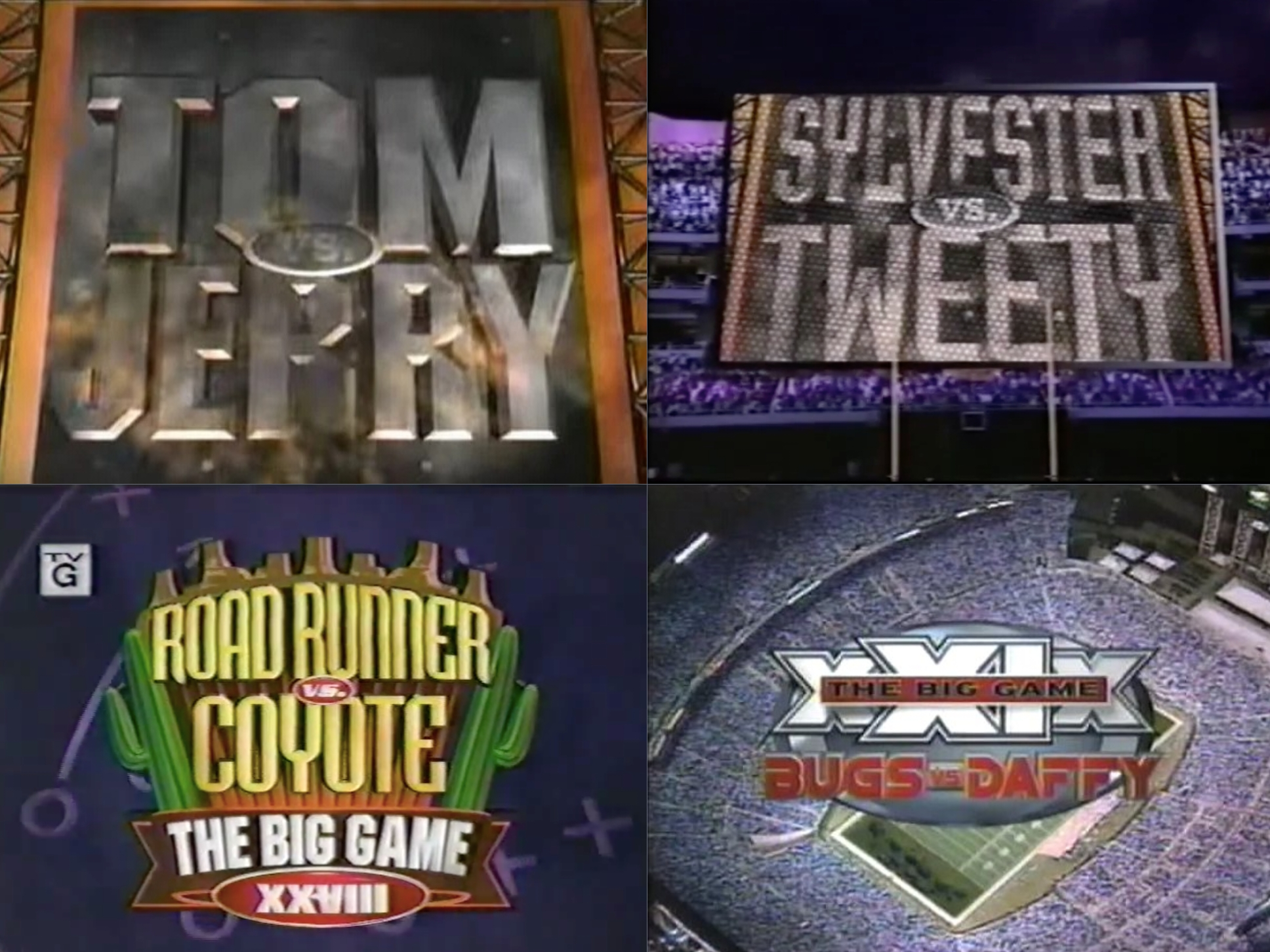
Behind the scenes information on Cartoon Network’s THE BIG GAME broadcasts are sparse, bordering on non-existent. What I can confirm is that, from 1998 to 2001, the first cable channel fully dedicated to animation would run what were essentially glorified themed marathons in late January. What set these apart from other marathon blocks? It strived to emulate the feeling of your typical Super Bowl broadcast, often down to including pre-and post-game commentary by actual football analysts, as well as fake commercials and halftime shows. THE BIG GAME dared to ask…what if the classic Looney Tunes cartoons were actually football matches between the main characters? What if there was a whole league of these cartoon characters? What if, every year, a Big Game was needed to decide once and for all who the champion cartoon character was?
Yeah, they eventually developed a whole mythology around THE BIG GAME, a monumental amount of effort considering that, again, these were basically just marathon programming centered around a theme (and, in a way, corporate advertising, but we’ll get there). But, what could you expect from a channel that had, by 1998, built up a reputation for creativity stemming from an unusual love for its genre? In my youth, Cartoon Network had always had a lot of fun imagining that their roster of acquired IPs were all part of its own world, with its own democratic elections and hierarchies. They were also totally willing to make parodies of things that might only be of interest to their child audiences’ parents, like their bleak Scooby-Doo-starring spoof of THE BLAIR WITCH PROJECT. The end result, at least for me, was a channel that always delighted me while never talking down to me; in a lot of ways, it actually encouraged my curiosity, if only so that I knew what they were making fun of.
So it went with THE BIG GAME. The day tended to go like this: there would be ads for a couple of weeks prior establishing what the “big matchup” was going to be, always centering around famous cartoon rivals. “Bugs vs. Daffy”, the game might feature one year. Or “Tom vs. Jerry”, perhaps. Cartoons starring that year’s rivals would run under the guise of being “previous game film”. Intercutting all this was usually some pre-game analysis from the Cartoon Network Sports Studio. Then, it was time for The Big Game, a series of additional cartoons that now had commentary overlaid on them from John Madden and Pat Summerall. Oh, and to add to the “football” feel, the dialogue in the cartoons are replaced with “football sounds” (“hut-hut-HIKE” or general grunting, that sort of thing). All in all, it was great fun from a bygone era.
THE BIG GAME has also been relatively well-preserved. It was never released on home video or anything (I doubt that they would even have been able to, even if they wanted to), but three of the four broadcasts (at least the pregame and “game” parts) have been available on YouTube for years. The only one that appeared to be lost to time was the first: Tom vs. Jerry. At least, this was the case the first time I wrote a giant BIG GAME tribute article, back in 2017.
However, in the years since, Tom vs. Jerry has resurfaced, and it’s essentially the whole thing, commercials and all! It can be found on the Internet Archive, as can the other three. For this reason, along with the fact that my old article has unfortunately been wiped from the Internet (as well as the fact that I don’t have any other Super Bowl content in mind this year), I thought it’d be time to break down THE BIG GAME one more time, the way it actually aired.
So, let’s go! Omaha! Let’s go through THE BIG GAME!
THE BIG GAME XXVI: TOM VS. JERRY
Aired: January 24, 1998
(The whole dang thing can be found in full on the Internet Archive)
Right from the jump, we have implied (if fictional) history; despite this being the first iteration of THE BIG GAME, it’s numbered as the 26th. What illustrious match-ups might have taken place in the prior quarter of a century? Well, we’ll actually get some of that mythology filled in later on down the road. Just, like, not right now. For the moment, let’s focus on Tom vs. Jerry!
(Fun fact: I had never actually seen this one, as I missed it when it was actually on the first time around. New thing!)
Regardless of its distinction as the 26th BIG GAME, it’s fairly obvious this is Cartoon Network’s first go-around with the format. It’s a fairly bare-bones affair, with a two-hour marathon of Tom and Jerry cartoons, followed by a really brief BIG GAME segment. We’ll dig into how the actual “game” was in a second, but first, let’s dig into the marathon itself.
We got 11 T&J cartoons this time time around. The shorts included in the marathon were:
“Puss Gets the Boot” (1940) - the very first Tom and Jerry cartoon! Several things feel off about it, starting with the fact that Tom’s name here is apparently Jasper. He also has a little bit more of a mean spirit to him than he would later develop; he actually has the upper hand over Jerry in the beginning. This initial outing has a simple conceit: if Tom, er, Jasper knocks over one more thing, he’s sleeping outside. Thus, the entire thing is Jerry throwing crap off the furniture trying to get Jasper in trouble. You’d feel bad, but Jasper really is a bit of an asshole here. He paints a fake mouse hole into the wall, causing Jerry to bash his own head in! So, yeah, fuck Jasper. Does he get the boot? Keep watching to find out.
“Tennis Chumps” (1949) - notable both because of its sports theme (which is why I think this one was included), as well as for its inclusion of a third character, Butch, a fellow cat that Tom both fights and teams up with during the course of eight or so minutes.
“The Bowling-Alley Cat” (1942) - this is the short that really reminded me how strong and endearing the core premise of a Tom & Jerry cartoon (a mouse enacts ruthless violence on a vaguely deserving cat) really is. Not once do you ever really question why Tom or Jerry are in a fully operational, but seemingly abandoned, bowling alley. They just are! Lotta things in there to hit each other with!
“Johann Mouse” (1953) - a fun, atypical change of pace that supposes Tom and Jerry resided in the home of Johann Strauss. Jerry loves to dance, and Tom subsequently learns to play piano in order to get Jerry to waltz around the house (with his guard presumably down). Instead, they rightly become a town sensation. This one is cute, and well deserving of its 1952 Oscar for Best Animated Short Subject.
“Jerry’s Cousin” (1951) - another stone cold classic, this one establishing that Jerry in fact has a mouse cousin. This cousin’s name is Muscles, and he seems to speak English, and appears to maybe hail from Chicago? Anyway, he rolls into town to beat the shit out of Tom. Frankly, Tom deserves it this time around. We first see him in this short chucking firecrackers into Jerry’s mousehole, which is just degenerate behavior. Thank you for re-establishing the rule of law, Muscles the Mouse.
“Tee for Two” (1945) - a benign golf-themed short that ends with Tom swallowing something like a thousand bees. Another one where Tom is the aggressor the entire time; I get the sense he’s one of those who’s riled up by golf rather than relaxed. He’s smacking Jerry in the face with a club, hitting him in the head with golf balls and, most unforgivably, cheating on his stroke count. He also doesn’t appear to be that avid of a golfer, taking 33 strokes to finish one particular hole. Let this be a lesson, kids: be a good sport, or swallow bees.
“Mouse Trouble” (1944) - a short I remember vividly from childhood. Tom orders a book called “How to Catch a Mouse” and with sage advice like “Locate the Mouse” and “Mice Are Suckers For Dames”, it’s no wonder that Tom eventually ends up severed in two and the top of his head blown off. Sometimes, you just can’t learn everything from a book, Thomas. Bonus points for giving us a classic “DON’T. YOU. BELIEVE IT!” cry from Tom.
“The A-Tom-inable Snowman” (1966) - the sole Chuck Jones-produced Tom & Jerry short represented in this marathon. I can’t speak to how the average T&J fan feels about this era, but I always loved these as a kid. The animation style is vibrant, the music is a tad jazzy…the Chuck Jones ones always put me in a good mood. Anyway, I thought this was going to be the one where they meet the abominable snowman (who hugs and squeezes things and calls them George), but then I remembered, no that’s Bugs and Daffy. No, this is one where Tom gets wasted after several rounds of a rescue dog reviving the frozen cat with a faceful of scotch.
“The Two Mouseketeers” (1952) - starts off as a rather cute and charming tribute to THE THREE MUSKETEERS, and ends with Tom being beheaded. Things escalate fast in T&J-land.
“Dr. Jekyll and Mr. Mouse” (1947) - another one I remember vividly from my youth, where Jerry keeps stealing Tom’s bowl of cream. Tom plots his revenge by replacing the bowl with one full of poison. Unfortunately, the poison only makes Jerry stronger, leading to Tom getting pummeled and his cream pilfered. Bad day all around for the cat. Fun fact: this short was briefly shown in the 1983 vampire flick THE HUNGER!
“Jerry and the Goldfish” (1951) - another one where Tom fully deserves the ass-whooping that he gets. Here, he decides he wants to eat the pet goldfish as a snack, and he doesn’t appear to be particularly concerned how the fish is prepared. He starts off with a full recipe he hears on the radio, but he eventually settles for lightly toasting the alive fish and putting it between two pieces of plain bread. Anyway, it’s Jerry to the rescue, and thank god. Tom, I love ya, buddy, but this one’s completely on you.
The Jerry dance sequence in ANCHORS AWEIGH (1945) - I’m delighted they included this, as it’s one of the greatest movie musical clips of all time. A scene that speaks for itself.
In between each cartoons, we get brief commentary from Harry Kalas on what just happened, breaking down “memorable plays”. If Jerry brains Tom with a bowling pin or something, they might talk about “what a hit he took!”. That kind of thing. It doesn’t beat the actual presence of a pre-game show, and none of it is anywhere near as creative as stuff to come, but the idea of “treating classic cartoons like football games” was already there.
Then, it’s time for the Big Game itself and….honestly, it’s a bit of a disappointment! At least, relative to what was to come, this felt a little half-baked, a good premise lacking in details. For one, The Big Game only comprises one short, as opposed to the four (one for each quarter) we would get in later installments. For two, the scoring system is completely overthought; instead of simply doing a numerical score, Tom and Jerry were assigned visual pictures for each play, correlating with something a cat or mouse would enjoy (Tom could earn a dead roach or a little bird, while Jerry might score himself a piece of cheese or some seeds). Finally, there’s a running gag with Shaggy Rogers…er, Shaggy Butkus* as the sideline reporter who doesn’t get how an earpiece works. This whole thing just didn’t work for me: was Shaggy supposed to be stoned? Maybe the idea is that he’s stupid, which he can be, but I’d like to think that, even in a marijauna haze, he could figure out where an earpiece goes.
*Why is his name Shaggy Butkus? Besides it possibly being a strange reference to Dick Butkus, your guess is as good as mine.
On the good side, Pat Summerall and John Madden’s commentary is as good as it would ever be, a perfect mix of calling the “game” seriously, while still knowing that their job is to be funny. Madden at one point muses on why Spike the Dog is talking, before clarifying “not that animals can’t talk, they just make different noises”. Good stuff! Even in the early stages, the writing and general ideas were there. Cartoon Network just needed a little confidence that the Big Game could work as a fun marathon framework.
They got their confidence, and the next year’s match-up was even better…
THE BIG GAME XXVII: SYLVESTER VS. TWEETY
Released: January 30, 1999
Pre-Game: Len Dawson, Jerry Glanville, Nick Buoniconti
Halftime Show: Owl Jolson
(This YouTube video probably represents the most “complete” viewing experience.)
The second year of the Big Game project takes a big step up from the first, with several key additions that would become staples for the next two installments.
First: the addition of an actual, bonafide pre-game show! Yes, this is the first year we see Len Dawson, Nick Buoniconti and Jerry Glanville, the then-hosts of HBO’s Inside the NFL, get in on the action. And, man, it adds so much to the proceedings to see three bonafide football guys sitting around a desk having genuine-sounding discussions and film breakdown about a Sylvester and Tweety cartoon. Their ability to play along with the central joke is infectious; I’m not an Inside the NFL connoisseur or anything, but fire up the BIG GAME pre-show and compare it against any random 90s episode of the HBO series. I defy you to tell me they feel anything beyond exactly alike. Also, this on ebgins the long tradition of Jerry playing the goofy heel, which immediately made him my favorite.
Now, those who are familiar with late-90s broadcasting corporate structure have likely already noted that this was not a purely artistic move on Cartoon Network’s part; in a way, the trio’s presence causes THE BIG GAME to now serve as one long ad for a premium cable program. This could be looked at cynically, but…to be honest, I don’t care. If this is the price to pay in order to get this type of preshow (instead of one anchored by people playing fake NFL broadcasters, with obvious jokes and punchlines), then sell away. Joke was on them; at the time, I was 11. Couldn’t afford HBO anyway!
Second: sprinkled throughout some actual commercials* were some spoof ads, emulating some real ad campaigns of the time. There are a pair of CAT commercials, GAP spoofs starring, respectively, Tom (of Tom and Jerry fame) and Josie and the Pussycats. There are also two fake car ads, one featuring the famous Flintstones vehicle, as well as the Jetsons family spaceship. The “fake ad” aspect will only escalate in the next installment, but even if this was all we got, the effort would be appreciated.
*The upload I watched included ads for Cartoon Network originals Dexter’s Laboratory and Cow & Chicken, as well as a creative spot for the channel as a whole, highlighting its roster of “sidekick” characters.
Oddly, this one is now the least archived of the four Big Game marathons. It’s relatively complete; the entire “Game” is viewable on YouTube, as well as most of the pregame. However, there appear to be a handful of pregame segments that are missing, including a promised look back at last year’s winner (Jerry) and loser (Tom). There also does not appear to be any written record of what Sylvester and Tweety cartoons were aired as part of the marathon. Len Dawson and the gang keep throwing to the shorts, but I have no idea what they were. Alas! At least it spared (you from) me from having to come up with something insightful for another couple dozen cartoons.
As for the actual Big Game, it’s another big leap from last year. We get all four quarters this time (filled out with two cartoons: “Bad Ol’ Putty Tat” and “Tweety’s S.O.S.”), as well as an actual numerical score. More great commentary from Madden and Summerall, this time with more of a tangential nature than last year; at one point, Summerall takes some time to bring down the dramatic arc of a story. It’s here that I wondered if THE BIG GAME came from the same surreal kiln that eventually forged Adult Swim, which was still a few years away for the channel. There are also a lot of great and inspired infographics presented throughout, many of whose punchlines would have gone right over the head of any twelve-year old. As an example, one infographic shows the stat line of Tweety with feathers (undefeated) and without feathers (Woody Allen).
Overall, a great showing for THE BIG GAME, and the first one I remember watching as it happened on TV. From there, they had a fan for life. And my fandom was rewarded the very next year, when Cartoon Network went all out for BIG GAME XXVIII….
THE BIG GAME XXVIII: ROAD RUNNER VS. COYOTE
Aired: Saturday, January 29, 2000
Pre-Game: Len Dawson, Jerry Glanville, Nick Buoniconti, Cris Collinsworth
Halftime: The Spacely Sprockets Halftime Show Spectacular
(You can watch most of it at this Internet Archive link, but the rest of it can be found here.)
Of the four BIG GAME marathon blocks, this one stands head and shoulders above the rest. This was the one where it felt like Cartoon Network had the most confidence in the product, with ideas oozing out of their pores. The pre-game guys are locked the fuck in, the halftime show is the most thought out it’ll ever be, they double up on the amount of fake commercials…it sounds kind of silly, but it barely feels like a glorified Road Runner cartoon marathon. There are moments where you sort of feel like you’re watching an actual fake football game between cartoon characters. It’s the pinnacle of Cartoon Network creativity. At least, in my opinion.
This was absolutely one of my favorite things that ever aired on television when I was a kid, and in the one or two times I revisited it as an adult, I always get nervous its shine will be somewhat blunted, now that I’m 37 and thus too old and busted to believe in magic anymore. But, it still lives up. I’m hoping it always will.
We actually have to take this breakdown in sections, because there’s a lot to THE BIG GAME XXVIII, starting with a full-on fake documentary…
THE BIG GAME: A LOOK BACK
Yeah, that’s right! This whole thing kicks off with a fake retrospective on the fake history of THE BIG GAME, hosted by none other than Jim Huber. Over the course of thirty minutes (with commercials), Huber walks us through the history of cartoon competition, the leadership of Foghorn Leghorn that led to the various leagues combining to play a championship game, and the lows (an extended strike led the Big Game to once have to open for Eddie Money) and the highs (the present day, apparently) of the game’s history. All throughout, we get talking heads from various Big Game “historians” and “fans”, as well as insight from people “who were there”.
I’ve always found this all very impressive, both then and now, for a few reasons. One: they didn’t have to create a whole mythology for THE BIG GAME at all. They didn’t have to make any of this! I think many corporations would have been happy to just run the old cartoons they had access to, interrupted only by commercials for other old cartoons they also had access to. I suspect in 2026, a lot of this would be considered by a boardroom to be “too expensive” and “a waste of time”; why bother getting Jim Huber to do fake narration I have to hire somebody to write, when kids would just be happy to see the coyote fall down in a cartoon they’ve seen a thousand times already?
But they did, and honestly, it vaguely altered my brain chemistry. The effort didn’t go unappreciated, at least not by this particular 11-year old. The idea that adults could still find the playfulness and creativity inherent to the Looney Tunes, or Hanna -Barbera, or King Features or whatever, meant a lot to me at eleven. Hell, it means a lot to me now.
Second, it’s actually pretty funny, and the humor is willing to go to slightly darker areas than you might expect from mainline Cartoon Network. There’s a whole section about Squiddly-Diddly “breaking the octopus barrier” (before he started playing, no Big Game participant had ever had more than four legs) and, look, I certainly think it’s bold for a kid’s program to satirize Woody Strode and Kenny Washington, but it’s just goofy enough that you laugh instead of wince. Sure, not every joke is an A+; there’s an extended runner with the chyrons where every line an author talking head says ends up being the title of one of his books, and it gets old after a while. But most of the script here is pretty sharp. And it’s all facilitated by Huber, who’s so perfectly dry the whole time, even when coming back from commercial with shit like “for those of you just tuning in, shame on you.” Full marks.
PAST MATCHUPS MARATHON
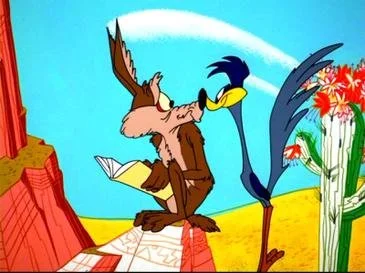
In a break from tradition, Cartoon Network decided this time around to air all of the “past matchup” in one block, rather than airing them throughout the preshow block. In principle, this makes sense, especially since the preshow had become a comedy act all on its own at this point. But, this might be the one tactical error that THE BIG GAME XXVIII makes the whole evening. Because even though this section is only an hour, what you quickly discover watching seven Road Runner cartoons in a row is that they’re all pretty much the same.
This is mostly by design. Firstly, Road Runner cartoons are inherently bound to the same space and dimensions. Tom and Jerry can theoretically appear anywhere: a bowling alley, a golf course, an ornate mansion. Sylvester and Tweety can run around on a boat, or a house. Hell, they can even solve mysteries with Granny. Wile E. Coyote and Road Runner, however, have to be in the desert. This was literally a rule straight from Chuck Jones himself. Second, as a result of these rules, the structure doesn’t change. Every single one of them is just the latest collection of “Coyote uses gadget to catch Road Runner, but it backfires”. It’s why they work! Hell, that structure is why these were probably my favorite cartoon as a kid. But…breaking these up throughout the pregame might have helped each short stand out on its own. All in a row? They mostly run together.
As a result, I’m not going to give each one its own blurb. What is there to say about one that couldn’t equally apply to the others? So, instead, I’m just going to highlight the most insane plan Coyote unleashes in each one:
Fast and Furry-ous (1949) - first Road Runner cartoon ever made! Anyway, although I applaud the creativity of the Coyote’s refrigerator-meat grinder contraption that, through Rube Goldberg engineering, allows him to ski on sand, I have to highlight the Acme Super Outfit. It appears to be a bootleg Superman costume with no other gadgetry. He puts it on, leaps off a cliff, and immediately falls. I’m unsure what Coyote thought was going to happen there.
Ready…Set…Zoom! (1955) - At the very end of this, Coyote dons the Acme Female Road-Runner costume. All this really yields for Wile E. is a cadre of other coyotes that begin to chase him, presumably to…sexually assault him, I guess? Why does Acme even have a female road-runner outfit?
Hip-Hip-Hurry! (1958) - Wile E. attempts to use a slingshot to fling a stick of dynamite at Road Runner, but just kinda stands there too long without slinging, and the dynamite blows up in his face. Skill issue.
Zipping Along (1953) - Wile E. gets a book on hypnotism, with the end goal of inducing the Road Runner to jump off a cliff. This feels a little desperate to me, and it’s all rendered moot when Road Runner shows up with a mirror, bouncing the hypnotism back into Wile E.’s eyes.
Zoom and Bored (1957) - One of Wile E.’s big moves in this one is to distract Road Runner with bird-seed while he unleashes a jar full of bumblebees. You’re never going to believe this, but the only guy who gets stung here is the Coyote.
Gee Whiz-z-z-z-z-z-z (1956) - The winner for “strangest plan” here by a country mile is the Coyote’s fucking ridiculous green “Bat-Man” costume. I get the sense that ACME has a Spirit Halloween vibe to their repertoire, and I understand they’ve always been a disreputable company. But you have to really start questioning Wile E. Coyote’s judgment on this one at a certain point (although I must point out he does manage to fly in this one).
There They Go-Go-Go! (1956) - gotta say, I love the move of hiding a gun on a spring in a trapdoor. It doesn’t work, but I always wish this one did. Imagine if the Road Runner got shot in the face and that’s how the Coyote finally got him.
PRE-SHOW
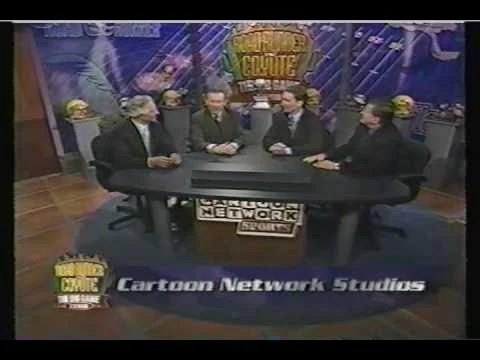
Nick Buonoconti, Len Dawson, and Jerry Glanville all return to the Cartoon Network Sports desk for the Slate Rock and Quarry Pre-Game Show. This time, they’re joined by broadcasting legend Cris Collinsworth, who fits right in. He kind of plays a vague “smug guy who thinks he’s smarter than he is” role in the interview portions, including a sadly now-missing segment where he thinks he’s interviewing Joe Montana (despite the many protestations that he’s actually actor Joe Mantegna). However, he mostly serves as yet another anchor razzing poor Jerry Glanville. Once again, the cadences amongst the crew is so natural, you’d think they were coming up with their analyses on the spot (even though the whole thing is almost certainly rigidly scripted).
The pre-game segment this year helps set the foundation for two of THE BIG GAME XXVIII’s running gags. The first one is the mystique being built around the Halftime Show, this time being helmed by producer wunderkind Helumt Spassmacher*. We get a long sequence with Helmut at his home in Germany, as he goes through all the upcoming details of his halftime spectacular, with potential guest stars like Tom Jones. The segment spends a long time, a conspicuously long time, going over how fucking cool this thing is going to be and how much you shouldn’t miss it. Hmmmm….
*Played by Michael Kohler, who would go on to have a long, still-going musical composition career with Cartoon Network and its spinoff, Adult Swim.
Okay, time for the second running joke that the pre-game seeds. The overwhelming theme of THE BIG GAME XXVIII is “Wile E. Coyote is a big loser with no fanbase and absolutely no shot of ever being anything else”. Like, obviously, THE BIG GAME has always been a show that sucks up to the heroes. Tom gets fairly trounced by Jerry, and Tweety curb-stomps Sylvester 57-3. In both instances, the coverage before-hand made it very clear: there’s no love for the underdogs.
This year, though, that ethos goes into overdrive. At least in the “Sylvester vs. Tweety” BIG GAME, coverage of each team’s fan tailgate felt fairly even. There were just as many cat fans in the parking lot as there were bird fans. This year? The Road Runner tailgate party is a loud, boisterous affair. There are hundreds of people crammed into a restaurant, dressed in purple, chanting “Road Runner” chants, whooping it up, having a grand old time. Wile E.’s tailgate? It’s two sad guys at a dingy bar. Not even enough of a quorum for them to spell “COYOTE” on their chests. What the fuck? Why is there such a concerted effort to paint Wile E. Coyote as this total sad sack? Did he make a pass at Ted Turner’s wife or something? Did he say something racist at a writer’s meeting? This has always driven me insane.
Anyway, at the end of the pregame, Jerry Glanville is the only one brave enough to predict Wile E. Coyote as the ultimate winner of THE BIG GAME XXVIII. Cris, Len and Nick all choose Road Runner like the suck-ups that they are, afraid to stand on their own two feet like Jerry. Anyway, it sure feels like the deck is stacked against poor Wile. E. Surely, this is all building to some kind of comedic turn by the end of all this.
THE BIG GAME XXVIII
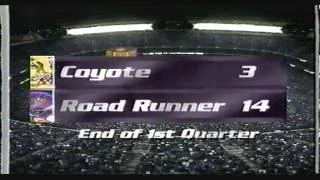
Well, Road Runner beats Wile E. Coyote 59 to -12. -12. Coyote somehow manages to owe points by the end of all this. I don’t know what Cartoon Network’s problem with Coyote was, precisely, but it was clear that they wanted him to suffer. There’s something very Germanic, and kind of poetic, about this whole affair. A born loser somehow manages to get onto the biggest stage of his career, only to suffer the biggest humiliation of his entire existence. Such is life.
Ah, well. At least the actual broadcast is fun. Madden and Summerall are as fun and lively and game as ever, and this time, they’re joined by sideline reporters Bubba Smith and…Scott Hamilton? Bubba, unfortunately, isn’t as adept as everyone else, with some flat line readings all throughout. Hamilton fares better, but…you know, it’s Scott Hamilton. I’m not even sure why he’s here.
Oh, and the payoff on the halftime show is a good one. You knew from the jump that something was going to go wrong to cause us to not see this thing play out to its fullest extent. But I’ve always loved the punchline of the camera accidentally cutting to the sound booth, manned by Fred Jones and Moltar. What I really liked about it was its insistence in making us sit with this joke, as Moltar and Fred have a long, realistic-sounding conversation about the day-to-day of Cartoon Network Studios. It’s all pretty good stuff; at one point, Moltar asks if there’s something going on between Fred and Daphne (Fred declines to answer). What I really thought was interesting was when this scene dropped a conversational reference to THE SCOOBY-DOO PROJECT, the Scooby-Doo-themed The Blair Witch Project collection of shorts the network had ran a few months before, where it appeared that the Mystery Machine gang had all been slaughtered (Fred busts this rumor fairly definitively).
Also, as a result of this halftime show, we get to hear John Madden try to wrap his lips around the name “Helmut Spassmacher” a dozen times, and I think that’s beautiful.
Oh, I should mention that they also introduce a whole new cadre of fake commercials based off of famous campaigns, past and present. There’s another GAP spoof, this one lampooning the Depeche Mode sing-along ad from around that same time. We get a pretty funny Victoria’s Secret parody, with Olive Oyl answering the question “what is desire?” And of course, there’s the parody of the “hey, kid, catch!” ad, with Johnny Bravo in place of Mean Joe Greene. It’s another example of the extreme effort being put into this whole thing. They didn’t have to do a new batch of commercials. But they did! And I love them for it.
Anyway, despite the broadcast’s extreme bias for the Road Runner, this whole four-hour block was a fucking blast to revisit. By the time we got to the end credits, with its faux-sports inspirational music score, I got a little misty-eyed. Possibly because I knew there was only one more BIG GAME left to go…
THE BIG GAME XXVIX: BUGS VS. DAFFY
Aired: January 27, 2001
Pre-Game: Len Dawson, Jerry Glanville, Nick Buoniconti, Cris Collinsworth, Dan Marino
Halftime: Cow from Cow & Chicken
(The whole damn thing can be found on the Internet Archive.)
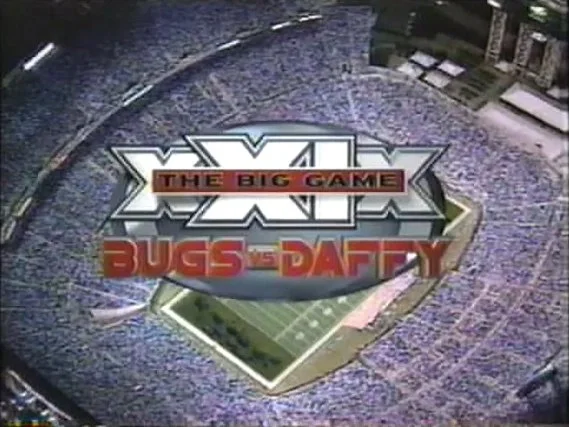
The fourth, and ultimately final, BIG GAME marathon represents both a bit of a step forward from the previous installment, as well as a step back. The elements on its side include perhaps the best list of shorts of the quartet, a massive (and, for me, satisfying) twist at the very end, and some really, really solid running sponsor jokes. Working against it is some imbalance in the chemistry amongst the pre-game crew, and a weird overreliance on “list humor” for Madden and Summerall. It just doesn’t feel as grand of an event as the previous installment.
Anyway, let’s break it down. First up, the preshow! Len, Nick, Cris and Jerry all return, and this time they’re joined by the then-recently-retired, soon-to-be-Hall-of-Famer Miami Dolphins quarterback Dan Marino. And, look, I got no beef with Marino. But, to be blunt, I don’t think he adds anything comedically to the pre-show crew. The already-established quartet were already doing fine with the central conceit of “everybody piles onto Jerry”, with Cris adding a little confident smugness to the proceedings. Marino’s main bit seems to be “dumb guy who’s a step behind”, almost like he’s lampshading the very conceit of “pretending the cartoons are football games” that THE BIG GAME is built off of. He’s doing his best, it just doesn’t work for me.
My bigger issue with the pre-game this time is that it feels too self-consciously jokey. What made the last two so great was that it was written and performed straight, as if they really were analyzing and arguing over a football game being played by Slyvester and Tweety. This time around, there are a couple of self-conscious “ba-tum-tisch” kind of punchlines that wouldn’t exist in a real pre-game. As an example, Cris Collinsworth opens one segment by saying “It’s often been said that behind every great man is a great woman, behind every great player is a great coach and behind Jerry Glanville is a pile of Nilla Wafers this high”. Glanville pops into frame and says “Hey!” like it’s a Christmas pantomime or something. It’s just trying too hard by five percent, but it’s enough to make it feel “off”.
The good news is that, this year, they go back to threading the cartoon marathon through the pre-show to keep things lively. Not that this year’s schedule needed it: the Bugs and Daffy cartoons the network chose to air constitute a fairly comprehensive Best Of in the Looney Tunes canon. It’s so strong that the pre-show ends up feeling like a bit of an afterthought (which may be why it’s got forceful Punchlines this time around).
The cartoons are, as follows:
Show Biz Bugs (1957) - A cartoon that does as much as any other to establish Bugs and Daffy’s central dynamic. Both are showmen, and can sing and dance. Only Daffy actually thirsts for approval from the audience. And this is why he’ll never get it; audiences can sense a try-hard from a mile away. Sorry, Daffy, you’ll never be Bugs.
Bully for Bugs (1953) - one of the greats! It’s got everything you need: Bugs taking a “wrong turn at Albuquerque", declaring to a bull “of course you know, this means war”, and doing slapstick synchronized to a piece of recognizable music. Also, I’ll just say it: I think the bull is kind of cute.
Robin Hood Daffy (1958) - another favorite, with Daffy Duck’s Robin Hood trying his best to convince Porky Pig’s Friar Tuck, that he is in fact the outlaw of legend. He’s unsuccessful. Maybe he shouldn’t have lied about the size of his quarterstaff.
People Are Bunny (1959) - a cartoon that I didn’t recognize, lightly parodying an Art Linkletter TV show I had never heard of (People Are Funny).
Rabbit of Seville (1950) - One of the most famous Bugs Bunny cartoons ever made, and, between this and What’s Opera, Doc? (which I’m genuinely surprised didn’t make the cut in this marathon) it’s one of the primary reasons I have even a perfunctory knowledge of opera. The masterful syncopation between the slapstick and the Barber of Seville overture is the kind of comedy I think we’re really used to today, which belies the fact that it’s really, really fucking hard. There are so many jokes crammed in here. Beyond that, I’ve always thought the fruit salad Bugs makes on Elmer’s head looked good.
What Makes Daffy Duck? (1948) - In which Daffy takes Elmer Fudd and a fox named Fortescue and, over the course of seven minutes, gets them to go from hunting Daffy to hunting each other. Daffy could be just as masterful a manipulator as Bugs in his prime.
Duck Amuck (1953) - Probably the most influential Looney Tunes cartoons of all time, and the short that introduced me to “fourth-wall breaking” in comedy. It’s also probably the cartoon that best cuts to the tragedy of Daffy Duck. His life is consistently being written and revised by a cruel and uncaring god, and that god is his supposed friend Bugs Bunny. Cold shit.
The Daffy Doc (1938) - Daffy at his most unruly and unhinged. The iron lung joke and subsequent animation has always been really satisfying to me, both as a kid and as an adult.
Rabbit Fire (1951) - also known as the one with the “Duck Season!/Rabbit Season!/Rabbit Season!/Duck Season” running joke. Perfection in simplicity.
Beanstalk Bunny (1955) - A fairy tale adaptation where Daffy Duck plays Jack, Elmer Fudd plays the giant at the top of the beanstalk and Bugs plays…Bugs. I guess he was always too cool to be a character actor.
Bugs’ Bonnets (1956) - another cartoon that I really feel like I’ve never seen before. The conceit is simple and creative: after establishing that a creature’s very essence can be altered merely by wearing a hat, Elmer and Bugs constantly change personalities after an Acme Theatrical Hat Co. truck accidentally scatters its wares in the air. It’s important to note that Elmer and Bugs end up getting married by the conclusion of this.
Duck Dodgers in the 241/2th Century (1953) - my personal favorite Looney Tunes cartoon, a belief fueled mostly by the fact that this was the one that constantly played in chunks inside that “Marvin’s Rocket” playroom in the now-defunct Warner Bros. Studio Store at my local mall. Besides it revealing itself as a sly and hilarious commentary on the futility of turf wars, I think this rewatch also confirmed for me that Marvin the Martian might be the most slept-on Looney Tunes character of them all. His opening delivery of “I declare this planet in the name of Mars! Isn’t that lovely?” made me laugh out loud. He’s just so genuine!
Operation: Rabbit (1952) - a very strange one where Bugs faces off against a fully English-speaking Wile E. Coyote. The coyote is weirdly confident, introducing himself as a super-genius, then proceeding to do not one single smart thing before becoming a toasted corpse at the end. Coyote should have probably stayed in his lane, and not come across a buzzsaw like Bugs.
As for the pre-show segments themselves, they’re not bad. My favorite section was a visit to the Daffy Duck tailgate (which at least is nice and full, unlike Coyote’s the year before), which gets crashed by a low-rent Bugs Bunny impersonator; instead of “What’s up, Doc?”, his big catchphrase is “Sup, dude?” Not bad! Oh, and there’s a medical update segment with special guest star Dr. Drew. This may seem like an obvious joke setup in 2026 (since he’s now been revealed to be kind of a dummy), but you have to remember that, in 2001, Dr. Drew was vaguely cool thanks to his work on Loveline*. Before Drs. Phil & Oz, he was just the celebrity doctor one turned to in media. Anyway, he’s just as charmingly stiff as you might remember.
*A monumentally important radio show from the 90s/00s that has aged like milk in the decades since. But perhaps that’s an article for another time.
Oh, and when it comes to prediction time, the entire pre-game crew goes with Bugs Bunny, save for Jerry Glanville, who once again rides with the underdog. Once again, in a world of Goliath nut-riders, I greatly admire Glanville’s admiration for David.
We have a new set of fake commercials this year, scattered amongst reruns of the fake ads of years past (the Gap and “Mean Joe Greene” parodies, the “I Just Can’t Get Enough” sing-along, etc.). These new ones are notable for them obviously being send-ups of real ads, but I have no idea what. There’s one with I.M. Weasel giving an impassioned speech on a stage, there’s one with youthful versions of famous characters (Fred Flintstone and Velma Dinkley among them) talking about what they’d like to be one day. I know these are parodies of something, but the actual answer eludes me. There’s a particularly melancholy one which features the Mystery Machine gang heading to a party, before I. R. Baboon jumps on a car and shows them his butt. The credits reveal its name to be “Baboon Moon”, and I’m telling you, there’s a guitar melody playing throughout that makes me genuinely wistful.
Funnier are the various sponsors of the game, most prominently the Carrot Board and the Spinach Farmers of America, two groups that end up feuding via taglines, with the Carrot Board winning (and being sore winners at that; their last tagline is “you saw what we did to the Spinach farmers. Got Carrot?”). I also liked the constant plugs for Brak Chews, each one coming with an increasingly longer and asinine ramble from Brak himself.
Then, there’s the Big Game itself, with John Madden and Pat Summerall again in the booth. However, after last year, where we often got to see the two on camera, the decision was made to make them voiceover-only. This is presumably because they weren’t available to actually film anything in a studio, but it’s too bad; it feels like we’re getting half the experience again. Also, their bits are relegated to “list graphic” humor; as an example, after a blizzard takes Bugs and Daffy by surprise, Madden and Summerall start listing other big surprises that happened that day. A graphic appears onscreen listing “John forgetting his pants” and “complimentary waffles”. It’s all okay, albeit not really that funny, and to be fair, they had done this kind of thing before. The problem is that there’s way too many of them, almost as if they were running out of any other type of joke. It provides a little too obvious structure to the humor, which takes a little of the fun out of it.
The halftime show, which is briefly hyped up to feature the biggest pop star in the entire world, only to end up starring Cow in a Britney Spears getup. It’s not a bad joke, but I found the actual song (a lazy parody of “Oops, I Did It Again!” called “Oops, I Spilled the Milk”) to be kind of annoying, albeit short. It’s hard to top the epic rug pull from last year, but this one felt like it was barely trying.
This gets us to the big twist of THE BIG GAME XXIX: Daffy Duck ends up winning. Yes, for the first and only time in BIG GAME broadcast history, the underdog secures the victory. At the time, I remember feeling like they were going to buy this twist back, and when you watch it now, it really does feel like they’re ramping up to something. Even after the game is over, they keep cutting back to the field, seeing if Bugs had one more trick of his sleeve. As the credits start rolling, the analyst crew jump back on to warn Bugs that he’s running out of time.
But, no, the final score stands and Daffy is the winner! This was satisfying to me, personally: after three years of everyone dumping on Jerry Glanville for not predicting the overwhelming favorite to win, it was cathartic to see him get to gloat and talk shit for once. But, I’ve always been curious why Cartoon Network decided to go with the “upset” ending this time around.
Yes, technically there’s one final reveal at the very end; it turns out Bugs just decided to forfeit and retire right before the end of the game, which doesn’t really make a lot of sense, and feels tacked on to make sure we understand that the face of the franchise can never really lose. But it feels for all the world like they kind of knew this was the last BIG GAME they were ever going to do. Having this massive twist (at least, relative to a fake football program) gives a feeling of finality, like the franchise has done everything they can possibly do.
And, lo, it was the last one. Cartoon Network would sort of replace it the next year with a fake Oscars broadcast (The 1st 13th Annual Fancy Anvil Awards Show Program Special: Live in Stereo), but that ended up being a one-off: there would never be a 2nd 13th Annual Fancy Anvil Awards Show Program Special, nor would there be another BIG GAME. I can’t speak to whether the network did anything similar over the last two decades, as I had pretty much aged out of it by 2002.
But, I kind of hope they did! Or at least some other network did something similar to engage the creative minds and spirits of the next generations after mine. There’s a certain beauty about a program like THE BIG GAME, where just a little extra effort (okay, admittedly a lot extra effort) transformed a normal cartoon marathon into something I keep thinking about twenty-five years after it stopped airing.
So, yeah, as an adult, I still have the real big game to watch (and all I’ll say about next weekend’s game is fuck the Patriots) and that’s a lot of fun. But, it’ll never hit the same as watching Len Dawson and Cris Collinsworth get into arguments about Sylvester the Cat’s running game. Or getting caught up at the bravery of Squiddly-Diddly. Or getting a little choked up at a fake commercial where a baboon moons Scooby-Doo.
What could?