Recent Articles



The Well-Meaning Failures of AMISTAD
Long from the glow of his triumphant SCHINDLER’S LIST, Steven Spielberg’s return to the historical epic is a well-meaning step down. AMISTAD tells a story that deserves to be told, but does it in the most streamlined, Hollywood-safe way that it feels more like a history lesson than a dramatic film. Djimon Honsou good, tho.
Sequels are really hard for any filmmaker, and Steven Spielberg.
I speak not of his INDIANA JONES sequels, a set of three films that all have their virtues (yes, even KINGDOM OF THE CRYSTAL SKULL) but none of which can match the charm and zippy thrill of the original. I also am not quite speaking of THE LOST WORLD: JURASSIC PARK, a movie that was discussed in this space just last week, in all of its “diminishing returns” glory.
No, I speak specifically of the year 1997, a pale imitation of the year 1993, at least in terms of Spielberg’s filmography.
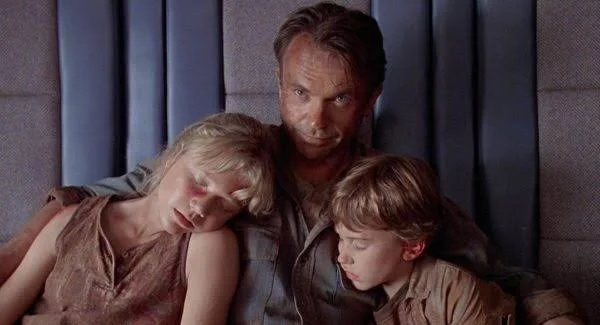
1993, of course, was known as a monumental year for the already wildly successful director. It began with one of his biggest hits of his life, JURASSIC PARK, a damn-near miraculous blockbuster where everything (premise, source material, cast, visual effects, directorial vision) all came together in just the right way. It ended with the release of SCHINDLER’S LIST, an intensely personal movie telling a story that more people ought to have known about (Oskar Schindler saving a thousand Jewish people at the height of The Holocaust) that earned Spielberg his first Best Director win. After a couple of shaky entries, Spielberg both reinforced his “master of the populist crowdpleaser” status AND proved he could find a second gear as, for lack of a better term, a “grown-up” artist.
Then, Spielberg fell off the map for a bit, hard at work launching the film studio that would become DreamWorks. By 1997, though, he was ready to make a return to the director’s chair. And he did so with two movies: another JURASSIC PARK tale, an example of a sequel where all those major elements (premise, source material, cast, visual effects, directorial vision) didn’t quite come together the way the first one did and, despite major box-office success, left the audience a little wanting.
He concluded the year with the historical epic AMISTAD, telling a story that more people ought to know about (that of a rebellion on the titular slave ship, as well as the subsequent arrest and trial of the slaves involved). This time, however, that second gear that Spielberg found with the mostly-magnificent SCHINDLER’S LIST seems to have disappeared. It’s actually…well, it’s a bit of a dud, I’m afraid.
If anything, it comes off like a parody of an Important Steven Spielberg Movie.
Let’s dive in.
AMISTAD (1997)
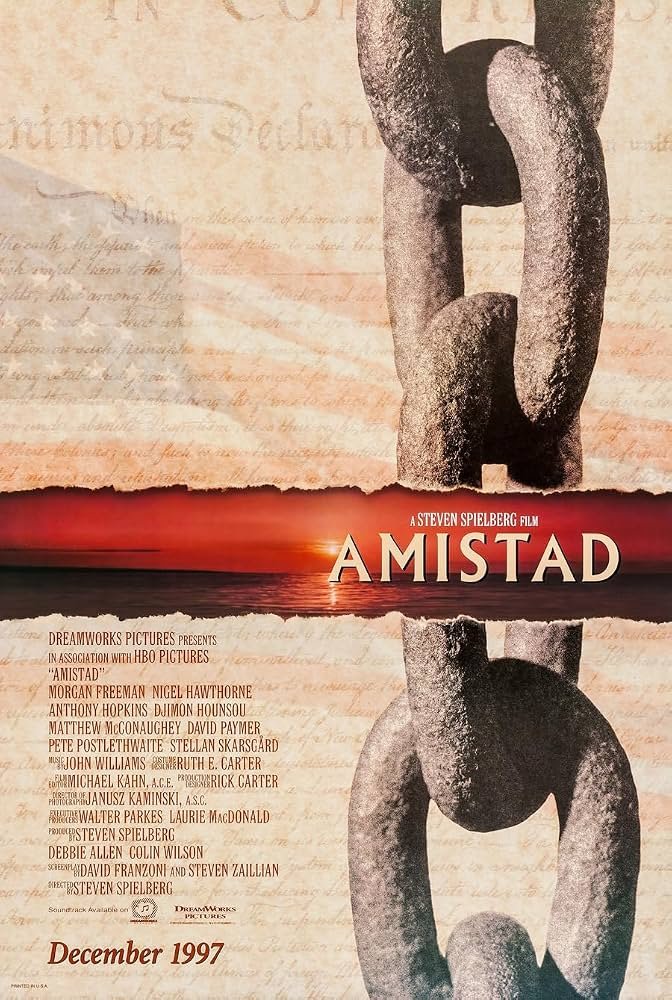
Directed by: Steven Spielberg
Starring: Morgan Freeman, Nigel Hawthorne, Anthony Hopkins, Djimon Hounsou, Matthew McConaughey, Stellan Skarsgard, many others
Written by: David Franzoni
Released: December 10, 1997
Length: 154 minutes
AMISTAD tells the true story of a Mende slave revolt against their Spaniard captors, which is depicted right in the first scene, and in harrowing fashion; Cinque (Honsou) is able to break out of his brutal bonds and lead a violent overthrow of the ship. It’s a scene that would have felt damn near cathartic had it not been a) shot like a horror scene (unintentionally putting Cinque in the position of a horror villain) and b) the very first moment out of the gate, before we are able to get to know any of the characters involved, be they slave or slaveowner.
To some degree, starting with the overthrow makes sense once the movie reveals itself for what it is a few minutes later: a courtroom procedural. As the rest of AMISTAD is almost exclusively dedicated to the litigation of the slaves’ action, I suppose there’s no reason not to start the movie with the “crime”, Law & Order style. But it does immediately speak to AMISTAD’s problem: none of the characters are really characters, so much as they’re representations of ideas. We are meant to root for the slaves simply because they are humans in bondage, and we are meant to cheer for the murder of their enslavers simply because it’s wrong to enslave people. And, like, please, I am begging you to not misunderstand me: the owning of humans was, and is, one of the most profound human rights violations out there. As far as an understanding of history goes, there shouldn’t be any other information needed in order to determine heroes and villains than “which one owned the other?”
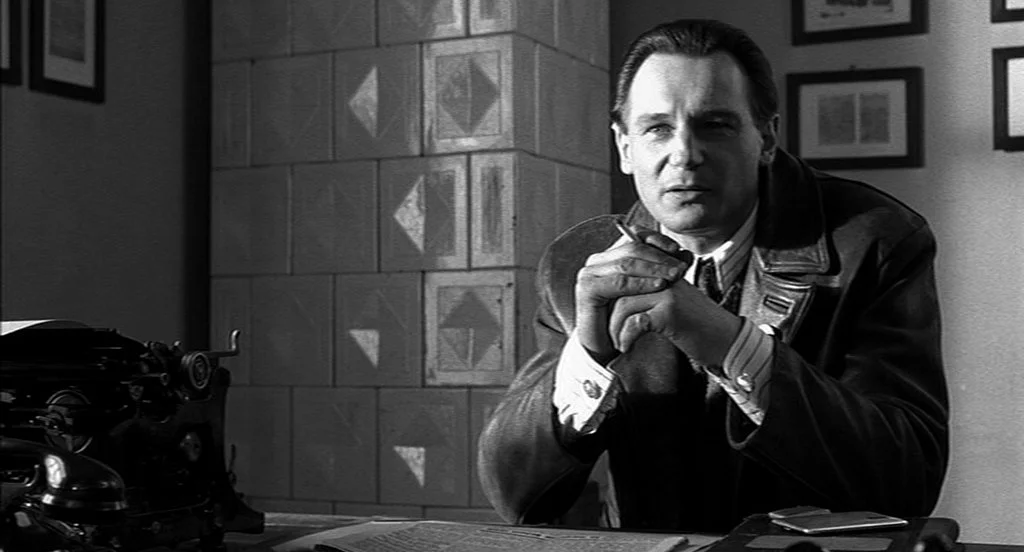
But, AMISTAD is theoretically not a history lecture, it’s a dramatic film. The kind of thing that requires characters with wants and needs, even the villains. To draw a direct comparison, SCHINDLER’S LIST spends a lot of time with Ralph Fiennes’ Amon Goeth throughout its three and a half hours, and you get to know him as a result (even if he’s a guy you desperately want to avoid). He’s vain, petulant, unfathomably racist, and calculating. Because of how full he seems, it’s all the more cathartic when Schindler is able to play to his baser instincts and “trade” lives for money.
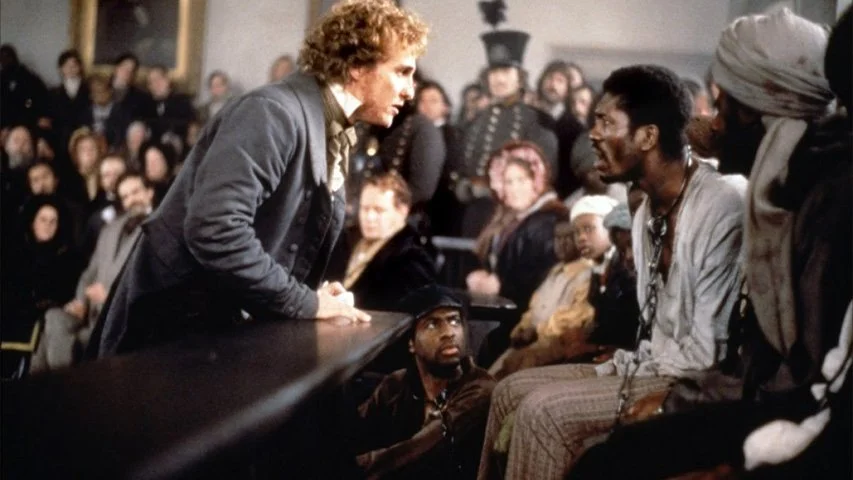
Here, we get a set of Spanish slavetraders, who are just kind of stand-ins for the evils of racism. On the flipside of things, besides Cinque and a couple of other key Mendes, we also get a handful of abolitionists, including McConaughey’s lawyer Roger Sherman Baldwin and Freeman’s Thomas Joadson, as well as Skarsgard’s Lewis Tappan and Hopkins’ former President John Quincy Adams, who gets the whole last act devoted to him (we’ll talk about it a little bit). Baldwin serves as the Mendes’ main point of defense against the federal case being worked against them.
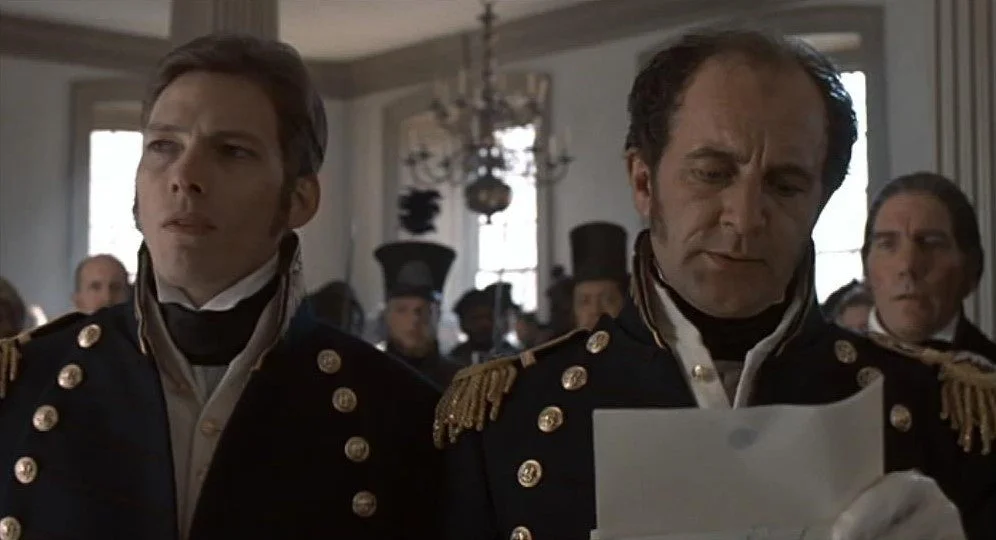
The terms of the prosecution: are the Africans aboard the Amistad property of the Spanish? Queen Isabella II appears to think so, and intervenes on behalf of our two primary slaveholders Montes and Ruiz. POTUS Martin van Buren, who is running for reelection, indicates compliance, and instructs his Secretary of State to accept the Spanish Queen’s terms. On the other hand, Baldwin and Joadson are able to find evidence on the ship that indicates the Africans were not property, but instead kidnapped peoples who were transported as part of the (crucially) already-banned international slave trade. Once it becomes clear that the judge on the case is going to side with the Africans, Van Buren panickedly replaces the judge with someone younger and (presumably) more favorable.
So, what we have here is a courtroom drama where the good guys are constantly being put through the ringer by the bad guys. Again, there’s nothing inherently wrong with any of this: the fact that abolitionist legal minds came together to help fight for a human right is a potent tale, and an important one to tell. But, as told in AMISTAD, this does end up being a story where the main characters are all already Obviously Right, and the only hurdle from the jump (besides convincing an elderly Qunicy Adams to return to the fray) is to figure out how to win the minds of those who are Obviously Wrong. It’s compelling in the sense that it’s frustrating; the replacement of judges is a gut-punch, as is the last act where the decision to free the slaves is appealed to the Supreme Court.
But…I can’t help but think about what made SCHINDLER’S LIST so dramatic and memorable, that beautiful arc that Oskar Schindler goes through. Now here is a guy who ends his journey having done an amazing public (and human) good, and still regrets not having done more. But it’s crucial to remember that Schindler starts the film as a fairly opportunistic business man who arrives in Krakow to gladhand with the elite and acquire cheap labor. It’s only with the girl in the red coat that his conscience awakens. As amazing as it may seem, by the end of the movie, you fully understand how a man can go from Nazi to Jewish savior.
But, instead of going like this with its characters (imagine me making an arc in the air with my finger), AMISTAD kinda goes like this (okay, now imagine me drawing a straight line with my finger). Hell, the most compelling character in this regard ends up being the young replacement judge, who ends up going against the Fed’s wishes and affirms the freedom of the Mende Africans (spoilers). That takes a lot of guts given the circumstances, and I can’t help but wonder what a movie from his perspective might have been like.
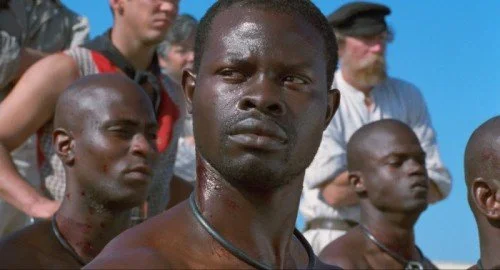
Now, something that AMISTAD arguably has over SCHINDLER’S LIST is a deep-dive into its oppressed class. It’s hard to over-articulate how dominant Djimon Hounsou is in this movie, undoubtedly helped by the fact that the David Frazoni-penned script makes Cinque a relatively full character, and not solely a subject of suffering. Yes, we get copious flashbacks of his enslavement, as well as the journey on the Amistad leading up to the revolution, all of which are portrayed in stark realism (the scene where slaves are being thrown off the side of the ship like so much ballast is maybe the bleakest thing I’ve seen in a Spielberg movie, and that’s really saying something). But we also see scenes of Cinque learning and discussing, whether it be about religion, law, or pushing back against the inherent contradictions of the American legal system. It helps, too, that Hounsou has such a commanding screen presence, the type that just makes you want to lean in and listen to him. Ironically, even if we hadn’t gotten a shred of Cinque’s outer and inner life, you imagine Honsou would be able to make his humanity speak for itself. AMISTAD is lucky to have him.
And, look, it’s not like he’s surrounded by a bunch of lamewads. AMISTAD’s cast sheet is chock full of some of the most recognizable names and faces of the past thirty years. Matthew McConaughey. David Paymer. Stellan Skarsgard. Chiwetel Ejiofor. Pete Postlethwaite. Nigel Hawthorne*. Morgan Freeman.Anthony Hopkins. Hell, even Anna Paquin gets a little drive-by moment as the Queen of Spain. It’s not like the cast isn’t supremely qualified, the type you get to have when you win a Best Director Oscar.
*Who, in his portrayal of Martin van Buren, I admit thought was Mel Brooks for, like, the first two hours of this movie. Pull up a picture of Hawthorne in AMISTAD and tell me I’m wrong.
But…nobody besides Hounsou really stands out. When they’re not spouting legalese, most of them get dialogue and monologues about how people aren’t property (or, conversely, how people are property). Hopkins in particular gets a movie-stopping* speech to the Supreme Court about how America is a place for freedom and not a forum for the Queen of Spain to have her way, and how we must look to our own ancestors (Washington, Hamilton, Franklin) the same way the Mende people do in times of crisis. Yes, it’s seven pages, and yes, it’s technically impressive that Hopkins knocked it all out in one go, and of course he was nominated for an Academy Award for his trouble. Besides the fact that it goes on for ten minutes, there’s nothing wrong or objectionable about the content of the speech on the page, or in performance.
*I don’t mean that as a compliment.
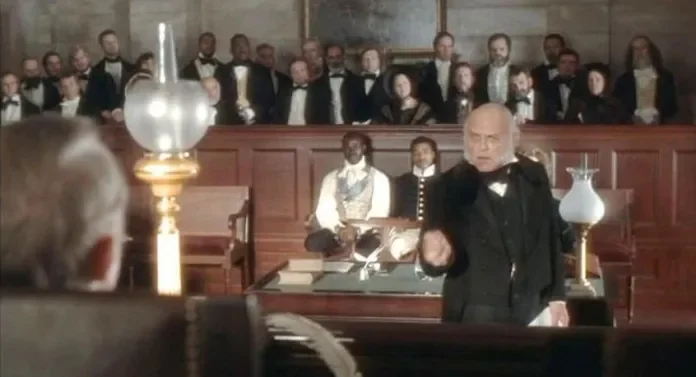
But when taken as the big finale of a nearly-three hour package, where the same two tones are hit over and over (saccharine scenes of white people Doing The Right Thing, followed by brutal depictions of black subjugation), it all gets to be rather aggravating, resulting in a movie one could most politely describe as a well-meaning movie to see with your moderate Democratic parents.
It wouldn’t hurt as much if Spielberg hadn’t already revealed that he was capable of more. SCHINDLER’S LIST contained depictions of human despair, as well as big scenes of white people finding their consciences. But, unlike that previous triumph, he just isn’t ab;e to wring anything special out of this material. You can’t even point to the racial subject matter as possibly being out of his wheelhouse; imperfect though it was, THE COLOR PURPLE was at least about a specific set of characters and their histories.
The best I can figure is that, where SCHINDLER’S LIST was built around a Big Plan (the mechanisms of which is the kind of thing Spielberg can dramatize in his sleep), AMISTAD’s drama is mostly in a courtroom. I would theorize that the courtroom drama is not something Spielberg is equipped for, or at least not without the exact right script at his disposal. The best courtroom dramas require sharp, informative dialogue, dynamic performances, and an ability to draw drama from relatively static camera movement. AMISTAD mostly lacks this, generally coming off more like a staged reading of a Wikipedia article.
It’s too bad; it’s a story well worth telling in a more interesting way than in the most obvious “America is built on principles that will always defeat evil in time” angle possible (and people thought DISCLOSURE DAY was naive). Spielberg would still have masterpieces left in his filmography. But, between this and THE LOST WORLD, it seems evident that by 1997, he hadn’t quite freed himself from the dual shackles of “fuck, launching a studio is a lot of work” and “how do I follow up my two biggest triumphs?”
Luckily, he didn’t completely run from the historical epic. He dug right back into the past of our world’s the year after making AMISTAD, and it provided maybe the most harrowing sequence of Spielberg's career…