Recent Articles


Takin’ A ROMAN HOLIDAY: Audrey Hepburn Month Begins!
Hi! You might have noticed some changes around here.
I finally did it. I updated the blog to (almost) resemble a real website. The Blogger template served me well when I decided to actually use it over the last decade, but now that I'm writing more regularly and people are actually starting to read it, it seemed time to try to make it look nice. Whether or not I've succeeded, I'll leave up to you. But changes have been made!
Sooooo, welcome! I've moved the other articles from this year over already, so the three 70's New Hollywood and three French New Wave reviews are already safe at home here. Oh, and my wife and I's tribute to the Gary Marshall ensemble holiday masterpiece VALENTINE'S DAY is here, too. I'll move over other stuff eventually, assuming there's interest in either revisiting them or checking them out for the first time. Anybody interested in the A STAR IS BORN articles, or the Scorsese/Kubrick director series?
Otherwise, this is it! Hopefully, you guys and gals like it. I'm open to suggestions on things to improve usability, by the way. The point is to make this a good experience for you, actual writing ability notwithstanding.
Okay, on to the actual article for this week. Ready to class this place up a little bit?
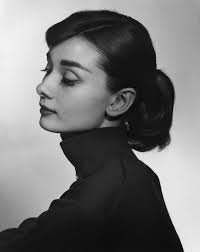
Audrey Hepburn.
Just saying her name kind of puts you at ease just a little bit, doesn't it?
But what else would you expect when invoking the shorter-than-you-think career one of the most startlingly effortless screen presences maybe ever? Ranked by the American Film Institute as the third-greatest female screen legend, ahead of Elizabeth Taylor (#7), Judy Garland (#8), Barbara Stanwyck (#11) and behind only Bette Davis and another Hepburn (Katharine), she also is one of the still relatively few EGOT winners. You know, that relatively arbitrary club made up of people who have won an Emmy, Grammy, Oscar and Tony. By the way, when you have time, pull up the EGOT list sometime; it's quite the wild ride (John Legend is an EGOT winner? When did this happen? I like him, but why doesn't that feel possible?)
More or less hanging it up after a run in the 50's and 60's (she only appeared in four films after 1967), Hepburn dedicated the second half of her life doing humanitarian work with UNICEF and earning the Presidential Medal of Freedom before passing away at the shockingly young age of 63. Her life was relatively short, but she made the most of it. Tapping into that life for a few weeks seems like a nice way to bring in the warmer weather months.
Because this is a purely solipsistic space, the four movies we'll be taking a look at this month will be ones I personally hadn't seen before. This means if you were hoping to catch up on BREAKFAST AT TIFFANY'S, ONE FOR THE ROAD, MY FAIR LADY, HOW TO STEAL A MILLION or CHARADE , you'll have to do that on your own time (and you absolutely must; all have something to offer and/or are great in their own right).
However, if you're hoping to watch ROMAN HOLIDAY, SABRINA, FUNNY FACE and WAIT UNTIL DARK, well gosh-darn-it, you're in luck!
Although she had popped in small things prior to ROMAN HOLIDAY, as well a full theater career in England and New York, this William Wyler film served as her real introduction to the world. And it was quite a first impression; the role won her a BAFTA, a Golden Globe and an Oscar, the first woman to ever do it. With such credentials, it's reasonable to ask, "seventy years on, does the performance hold up?". After all, how many times have you watched a film performance that has been critically lauded and profusely awarded, only to wind up scratching your head wondering what the big deal was (or, conversely, being blown away by a performance, only to learn it was never recognized or nominated at all)?
So, to kick off Audrey Hepburn Month here, let's start at the beginning, more or less. Let's figure out together whether her royal performance lives up to the hype, as well as whether the movie surrounding it is any good.

ROMAN HOLIDAY (1953)
Directed by: William Wyler
Written by: Dalton Trumbo (originally uncredited), Ian McLellan Hunter, John Dighton
Starring: Gregory Peck, Audrey Hepburn, Eddie Albert
Released: August 27, 1953
Length: 118 minutes
ROMAN HOLIDAY is the story of Princess Ann (Hepburn), a key piece of royalty from an unspecified European nation, who is currently on a scheduled trip to Rome. Ann is young and full of ambition and, thus, fully unsuited for royal life. We get a glimpse into her personality very early on, as we see her in full royal regalia, floor-length dress and all, standing in the middle of a hall being greeted by various heads of state. Underneath her dress, she keeps fidgeting with her high heels, slipping her feet in and out as she tries not to distract from the long procession of strangers in front of her.
Ann just wants to take her shoes off.
Every pushback she gives to the schedule laid out for her (and every single second is planned out to the second) is treated as irrational, and she's eventually given a strong, late-acting sedative to calm her mind. This deters her not at all, and she eventually slips out of her room at night, finally free to see the city. Until, of course, the sedative kicks in and she passes out on a park bench.

It's on this park bench that she meets Joe Bradley (Peck, playing a character with the most 1950's movie character name ever), an American reporter in town to cover the Princess' press conference. Thinking she's drunk, Joe does the right thing and takes her home. Not really knowing where she lives (and with her drowsy insistence that she lives at the Coliseum nearly getting them kicked out of their taxi), he takes her back to his apartment.
The next morning, after unconvincingly bullshitting his way to his editor about the press conference he didn't attend (hitting a road block when his editor informs him the conference was cancelled due to the princess' sudden illness), Joe learns that the woman in his apartment is in fact Princess Ann. He then promises his editor that he could snag an exclusive interview with her, who promptly bets him $500 he can't do it.
From there, it's a series of sequences where both of our primary characters are not exactly being straight with the other (who wants to bet they're going to fall in love with each other anyway? ). The concept of "truth" is weaved into ROMAN HOLIDAY's fabric, as Joe keeps trying to conceal the fact that he's a member of the media and Ann thinks she's hiding the fact that she's royalty, even insisting her name is Anya. As a result, there's a minor tension to the otherwise light and breezy Mouth of Truth sequence, where the two and Irving visit the very real statue of an open-mouthed face, famous for allegedly biting the hand of anyone who dares lie when placing their hand in its gaping maw.

To be honest, ROMAN HOLIDAY as a whole is pretty good, but not particularly transcendent (although its decidedly melancholy conclusion came as a surprise). It's lovely, simple and to-the-point, as much a travelogue as it is a character piece; the movie immediately and quite literally advertises the fact that the film was shot on location in Rome, and whole sections of the film are there to take advantage (it turns out that the movie was made smack-dab in the middle of a period in the 50's and 60's known as "Hollywood on the Tiber", where studios were falling all over themselves to shoot their movies on location specifically in Rome, which started after the success of MGM's 1951 epic QUO VADIS.
. And, look, there is absolutely nothing wrong with an on-location romantic comedy that frequently turns into a hang-out romp, especially when they're shot this well. One of the best scenes in the whole feature is just Joe and Ann riding around on scooters while Joe's photographer friend Irving (Eddie Albert) secretly snaps pics. It's just that there are a lot of movies out there that can fill that need, so that in and of itself isn't notable. Even if many of them are nowhere near as good, I could see someone describing the movie to someone else and getting the response of, "that sounds like a million other rom-coms, so what?"
The "so what" is that it's Hepburn that turns ROMAN HOLIDAY into high-class entertainment. Looping back around to the question at the top of this article, "does her performance hold up?", I would say, absolutely, it does. It's just that the reasons why it holds up can be a little tricky to define.
When you think, "Best (blank) Award", we've been trained to interpret that as "Most (blank) Award". Think big crying scenes, or maybe even big yelling scenes or, if you're really lucky, big crying and yelling scenes. Audrey Hepburn does not provide any of these, nor does she provide any large swelling monologues or histrionics. If potential Oscar-winning performances are now built around "the clip" (i.e. the twenty or so seconds of the movie that will play when the nominations are being read), you'd be hard-pressed to figure out which half-minute you would pull from ROMAN HOLIDAY to showcase.
What Hepburn actually provides is mostly God-given charisma, presence and comfort. For reasons that seem imperceptible, whenever she's onscreen, you just notice. Your eyes glide over to the screen and lock in for as long as she's there. When she's not there, part of your brain is just biding time until she comes back.

It's easy to chalk that up to her just being gorgeous, which, look, she absolutely is. It feels insanely reductive to boil people's legacies to something as fleeting and arbitrary as their physical appearance, but it absolutely matters in the argument of "what's the big deal" that Audrey was maybe a top-ten beauty ever. But it's not the whole story. It's also the way she carries herself in front of a camera. There's just this natural comfort and poise to her at all moments in ROMAN HOLIDAY, which totally sells her as European royalty. But it also makes us comfortable as a result. Coupled with all of that is this perfect accent in just the perfect timbre, so every line out of her mouth just seems to flow out of her like red wine.
Thus, even though there's no one moment you could point to in order to say, "That's where she earned her Oscar", it becomes clear once you finish ROMAN HOLIDAY that the achievement is one in totality. Because Princess Ann is not exactly a subtly drawn character. She is not a character of interiority; Ann is clear from the very beginning that she's not happy doing her royal duties and yearns for more beyond her gilded cage. She wants to live. The second she's truly on her own in Rome, she quickly goes to get her hair cut into, a moment that feels like a turning point. And Hepburn embodies this longing for freedom in full, with seemingly little effort.
Let's talk for a second about that word, effort. We've talked in this space before about actors and actresses who feel like they're doing almost nothing at all and how effective that can truly be; for a recent example, see Alana Haim's just beautiful performance in LICORICE PIZZA. But it still takes effort, maybe more effort than wearing your emotions on your sleeve and giving teary performances (which, to be perfectly honest, is also really hard and not something everybody can do).
To be this controlled and this purposeful and still be this comfortable? And seeming to do it without even trying? That's maybe the hardest thing in the world for a performer to do, especially when you again consider this is a film performance, in front of one of the most unforgiving audiences you could have: a camera.
And that's the magic of acting. And movies themselves.
So, to this writer, it didn't come as a big surprise that voting academies fell all over themselves to reward her. As mentioned, the role earned Hepburn an Oscar, a Golden Globe and a BAFTA. However, it also earned her a New York Film Critics Circle Award, as well as a nomination for a German award known as the Bambi. ROMAN HOLIDAY would constitute her only Oscar win, although she would be nominated four times further. Quite the debut.

It helps that her leading man is Gregory Peck, a dude who would probably have chemistry with a dishrag. He is a steady presence in this, and honestly in his own way is just as effortless as Hepburn. Joe is a character that could come off kind of skeevy if not handled with charm, especially considering there's an age gap of about a decade and a half here between he and Ann. But Peck makes him great! He had a knack for being undeniably masculine in that mid-century Hollywood way, while still opening himself up to be somewhat vulnerable (which is why the ending of ROMAN HOLIDAY hits so interestingly). This isn't a Peck retrospective, but it might be worth keeping tabs on Audrey's various leading men as we come across them this month anyway, as it will cover the gamut of Hollywood stars.
After such a successful debut, the ever-eternal question is raised: "What next?" And the answer is that she would join the cast of another popular romantic film starring two huge names; one of them perhaps the most interesting star of the time, and the other soon to be her partner in a very famous, highly publicized relationship.
Next week: SABRINA!
Film School (Three Day) Weekend: NETWORK Is a Movie A Lot of People Who Haven't Seen It Think They Know
NETWORK may be the source of that famous “mad as hell” speech, but what’s even better is how that fiery, inspiring monologue gets commoditized in Paddy Chaefesky’s darkly satirical world.

I feel like I've been in a cultural funk lately, and this past Super Bowl weekend did very little to pull me out of it.
Like a surprising amount of non-football fans, I find myself drawn to the Super Bowl due to it being perhaps the last remaining thing we all experience in real time together that isn't inherently polarizing (unless you're the type to get completely worked up over a fifteen-minute halftime show, I suppose). So I suppose you could say I "watch it for the commercials".
The thing about that, though, is that the commercials are rarely any good. Hell, I'm not sure one could claim more than ten or twenty in the history of the game are actually all that funny or memorable. Yeah, that's totally debatable and the subject for a whole other article, but I think I'm right about that. I'm absolutely certain that nothing from this past weekend would make the list either.
It's been a long, slow march over the years to get to this point, but essentially every commercial felt entirely algorithm-driven, the results of constant studies of the viewing habits and tweet engagement of the night's now-prime demographic (elder millennials!) and just quadrupling down on the top results. Cast members of The Sopranos were selling cars. Two leads of Schitt's Creek were selling different cars. Larry David and two LeBron Jameses were there to shame you into getting into cryptocurrency, ads which will definitely age well five years from now. Even a seemingly-sweet Chuck E. Cheese-inspired ad about a cute animatronic dog just ended up being a fucking Meta ad.
I know that "cashing in on celebrities who are riding high in order to hawk a flashy product" isn't new to advertising; need I remind that the Flintstones used to stop everything to start selling you cigarettes. But for some reason, this year especially felt bleak. The prospect of taking something that people got legitimate enjoyment out of over the years and shoving it back in our faces to say "Buy cryptocurrency!!! Do it, you coward!!" felt extra-cynical this time around.
So, yeah. Definitely felt a little lost this year. I wish I had known where to turn to in order to hear someone talk more about this phenomenon of taking something organic and commoditizing it in a quest for ratings.
Then I watched NETWORK.
Network (1976)
Directed by: Sidney Lumet
Written by: Paddy Chayefsky
Starring: Peter Finch, Faye Dunaway, William Holden, Robert Duvall
Released: November 27, 1976
Length: 121 minutes

There's a lot about the plot of NETWORK that might not even read as satire in 2022.
It all starts with an established news anchor, Howard Beale (Finch), who learns from his friend, news division president Max Schumacher (Holden), that he is going to be let go from the network in two weeks due to "low ratings". Furious, Beale announces on air the next night that he will be killing himself live on the air next Tuesday. If you're a lost media aficionado like myself, this sounded an awful lot like the Christine Chubbuck story, and I immediately assumed that had happened after this movie. I eventually checked and, nope, Chubbuck's on-air suicide was in 1974 and NETWORK came out in 1976. Whether this was an intentional reference to a horrific story remains unclear but, in a way, it's a natural jumping off point for a bitterly cynical film.

Anyway, this is merely NETWORK'S inciting incident. Ratings jump in anticipation of this suicide, which makes the network reconsider Beale's firing. Alas, even righteous indignation can only hold a nation's interest for so long, and ratings dwindle again. The head of the entertainment division, Diana Christensen (Faye Dunaway), reaches out to Schumacher to help bring viewers back by bringing Beale's show under the entertainment division, rather than the news division.
By the way, I think the state of media is such that I'm not sure having a head of entertainment take over a news division even comes off as a joke nowadays. We openly and willingly acknowledge the enmeshment of entertainment and news now, even as we rail against it. Because the truth is, we kind of like it better that way, right? Even though we long for the days of real news shows, we will still happily watch Rachel Maddow or Tucker Carlson give an impassioned screed about whatever we're supposed to be mad at today (Trump, CRT, Antifa, the post office...the list goes on and on) because it validates us and our opinions. It entertains us. And the thing is, I can feel, literally hear, someone out there going, "come on man, you really think there's no difference between Maddow and Carlson???". And, of course, there are differences is delivery style and tone, but I'd posit that the biggest difference between the two is dependent on what you are currently mad about.
And maybe that's the point. We know to reject all "news as entertainment" shows. Well, except for the ones that entertain me the right way. Those are different.
Anyway, this is all leading to The Scene, the one that everybody knows, even if they haven't seen (or even heard of) the movie. You know it.

Watching NETWORK from start to finish for the first time, it struck me as funny that the whole "I'm as mad as hell and I'm not going to take this anymore" speech has kind of become this shareable meme now that we share when, again, we're bitching about whatever cable news network we're willingly watching is pissing us off that day. And there's a reason why the monologue endures over 45 years later. First, who doesn't like a good old-fashioned fire-and-brimstone rant? Second, you couldn't argue it's gotten less relevant to the issues facing society today. Lines like "everything everywhere has gotten crazy, so we don't go out anymore; we sit in the house and slowly the world we are living in is getting smaller" hit especially hard in a post-March 2020 world.
The whole speech is real, organic, and delivered by a man that truly does feel like the world has gone mad, the walls slowly collapsing in on him. It's the kind of moment you rarely see in real life anymore, and it's a scene that probably single-handedly won Finch his posthumous Oscar (he sadly died a few months after NETWORK's release).
But turning this moment into an out-of-context Sorkin-eqsue speech about the state of the world, something you can share with a click and a caption like "THIS" or " Watch this as many times as you need to until you get it!!!" doesn't feel quite right, does it?
That's because it shows either a lack of awareness, or a willful ignoring, of what happens immediately after this speech is given in the movie, the moments after Howard Beale seemingly gets everyone in the country to yell out of their window, "I'm as mad as hell and I'm not going to take this anymore!".

Because what happens is that Diana gets thrilled at the ratings this speech has provided the network and now wants to expand Howard Beale and turn him into a mascot of sorts, an anchor that can only bring the ratings up and up, ever higher. The one real thing that has happened on that station in who knows how many years, and they're going to chase that high right into the ground.
Thus, The Howard Beale Show is borne. Although the show features, among other things, a psychic, Beale remains the star, and he gives his screeds to a live audience like he's Brother Theodore. The audience responds in kind by yelling "I'm as mad as hell and I'm not going to take this anymore!", this very real moment now reduced to a catchphrase along the lines of "set it and forget it".
Look, the movie goes on from there (weaved into the plot is a terrorist group known as the Ecumenical Liberation Army, but...needless to say, I loved NETWORK. Pretty much every major player in this got nominated for an Oscar that year, including Ned Beatty in a glorified, but wildly memorable, cameo where he lays down the law to Beale (as always, money talks). It's very obvious this movie struck a nerve in the mid-70's. And why shouldn't it have? In a post-Vietnam and Watergate world, with major cities like New York on the verge of bankruptcy, people were pissed. And here comes a Hollywood movie that spoke to all of that, a movie just as bitter and acidic in tone as something like TAXI DRIVER, but in a totally different direction.
And, of course, it goes without saying that I doubt NETWORK is a film that could get made today. That gets thrown around a lot, but I think it's really true on this one (I could maybe see it becoming a limited-series prestige television event, and maybe there's a beauty in that). In a world where there are now, like, four major studios, at least one of which having amassed its vast library through corporate consolidation (a topic which is of great importance to the story of NETWORK), I can't really imagine anything like this getting approved at a corporate level without its satire getting defanged, or at least redirected.
Yeah, I guess I am still in a bit of a cultural funk.

Maybe the only thing that holds NETWORK back just a little is the tone the movie takes with the romance between Max and Diana. There's really nothing wrong with it on paper; Holden is fantastic as always and manages to make his character heartbreaking, even as he's the one breaking hearts (although it feels like it's from a different movie, the scene where he confesses his affair to his wife, played by Beatrice Straight, is stirring). Dunaway is equally adept at making Diana acidic and cynical throughout the whole affair, which makes the satire still sing, the concept of "getting in bed with the devil" made literal.
But the storyline as presented feels like it has one foot firmly planted in old Hollywood, relying on good old-fashioned star power and melodrama. This isn't an inherently bad thing; I love that stuff! It's just that NETWORK as a whole feels very New Hollywood to me, with a rebel spirit you didn't see much of in the decades before or since, and I remain unconvinced that the two flavors can really meld in a satisfying way (it's one of the many reasons I didn't really like Scorsese's NEW YORK, NEW YORK). Thus, these sequences feel just a little out of step with the rest of the movie, which is often gleefully abrasive.
Anyway, look. NETWORK is available for streaming on HBO Max right now (speaking of things that only exist due to insane corporate consolidation), which presents a prime opportunity for you to watch it for the first time if you never have, or revisit it to discover that, yes, it really does hold up after all these years; it might even be better, to be honest. It will at least allow you to see the full context of a legendary film speech and the full, black-hearted cynicism behind it.
And isn't that what life is all about?
A Very VALENTINE’S DAY Special!
NETWORK may be the source of that famous “mad as hell” speech, but what’s even better is how that fiery, inspiring monologue gets commoditized in Paddy Chaefesky’s darkly satirical world.

In which I make my wife watch the 2010 ensemble comedy VALENTINE’S DAY instead of doing something nice.
Richard Curtis' LOVE ACTUALLY was released on November 14, 2003 and seemed to immediately burrow its way into popular culture. Whether it was as a form of ironic derision or as a reference point that exists to this very day, its ensemble cast and very British sensibility ensured its place in rom-com history (even if Emma Thompson's story gets no satisfying conclusion whatsoever).
Before he passed away in July of 2016, Garry Marshall, the man behind the creation of legitimate classics such as Happy Days, Laverne & Shirley and Mork & Mindy, was hard at work to the very end to create an American version of LOVE, ACTUALLY, only with focus on some lesser-celebrated holidays. Mission accomplished and, arguably, over-delivered: in true "everything is bigger in America" fashion, he managed to make an entire unofficial trilogy of holiday ensemble films. They're all insane, and I thought it would be a fun treat to review all three over the course of the year.
However, I couldn't possibly take on such a task by myself. No, to take on such masterpieces, I was going to need the assistance of a dear loved one. I was going to need to look across the couch and get my wife, Trina, to help me out with breaking down the nuttiness of the Garry-verse.
We're going in order of the calendar, as opposed to release date. First up, then, is the sugary-sweet VALENTINE'S DAY.
VALENTINE’S DAY (2010)
Directed by: Garry Marshall
Starring: too many to count
Written by: Katharine Fugate, Abby Kohn, Marc Silverstein
Length: 124 minutes
Released: February 12, 2010

R: VALENTINE'S DAY, the first in the late director Garry Marshall's holiday trilogy, was released on February 12, 2010, debuting over two other major openings that week; PERCY JACKSON AND THE OLYMPIANS: THE LIGHTNING THIEF and Universal's THE WOLFMAN, starring Benicio Del Toro. To date, it is the eighth-highest opening in February ever, along with the fifth highest-grossing President's Day weekend film (in front of it: BLACK PANTHER, DEADPOOL, FIFTY SHADES OF GREY and SONIC THE HEDGEHOG.
These extremely cool and interesting records aside, what did you think about this two-hour star-studded debut to the first real commercial holiday of the calendar year? Are you regretting agreeing to this already?
T: First off, I never regret an opportunity to complain about things. You should know me better than that by now.
R: My apologies.
T: Movies already have a challenge of making me care about the characters and the story when it’s just one plot line. In a way, I admire these types of movies that say, “I have 12 different Valentine-adjacent ideas, but I don’t really want to commit to fleshing out any one story in particular, so I’ll just tell all of them at once! It’s too big to fail!”

R: Yeah, it's a very "throw everything against the wall and see what sticks" type of affair, up to and including the cast. There's almost too many players in this get into, especially when they all seem to serve the same essential function as each other. We'll get into a couple cast members in specific, but I want to jump immediately into the real reason I brought you into this. Because, although there are several women in this that the movie could have chosen between to be the lead, rather than smash them altogether (Anne Hathaway, Jessica Biel, Jessica Alba, Julia Roberts all appear in this!), I wanted to give you your long-awaited bully pulpit on the individual that is probably, for all intents and purposes, the main character of VALENTINE'S DAY.
I just put ninety seconds on the clock. Trina, what are your thoughts on Jennifer Garner?
T: Jennifer Garner is the worst.
Okay, if I have a full 90 seconds…
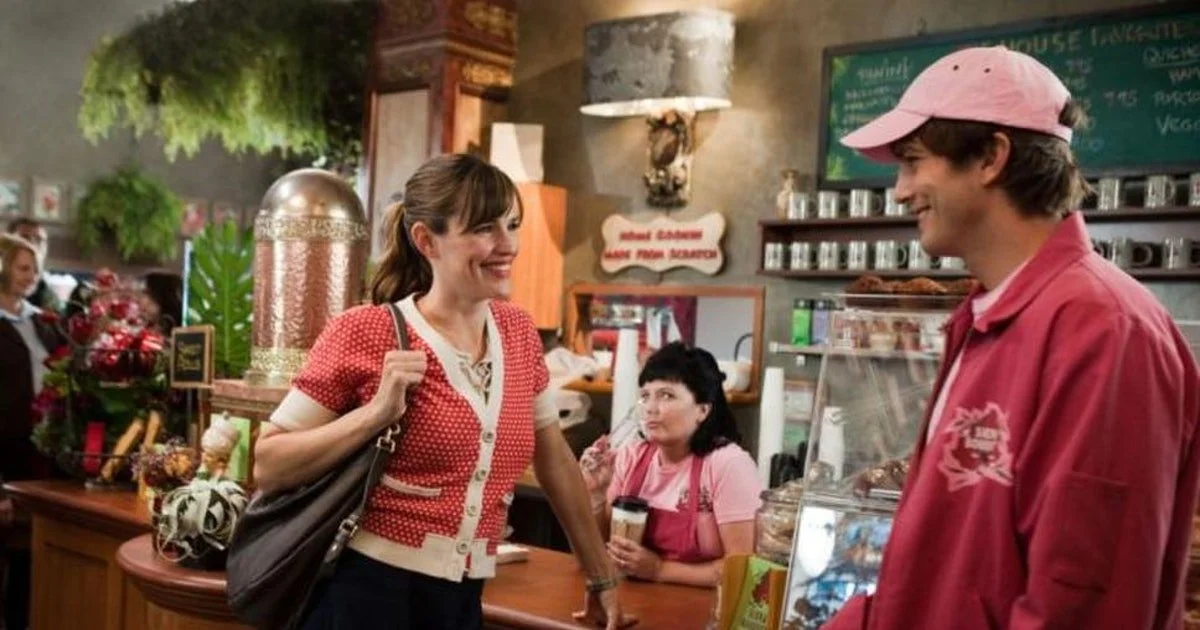
I’ve seen two Jennifer Garner movies (this and DAREDEVIL; the range!) but I’ve seen enough trailers for Jennifer Garner movies to know she’s the worst. She speaks all of her lines either in a little girl voice, or in a “I’m a little girl but I want to be Taken Seriously” voice. Both are bad. You’re a grown woman, Jennifer! 13 GOING ON 30 was a movie, not a lifestyle suggestion.
AND PEOPLE LIKE IT, RYAN. People who are out there in charge of important decisions and responsibility see a trailer featuring Jennifer Garner and go, “oh, that looks good.” Look at minute 1:20 of this trailer, Ryan.
It’s awful. She’s managed to make a career off of being the sweet widdle dew dwop sugar pwum pwincess and has managed to trick people into buying ticket after ticket. Well, not me! She may get my time (that’s worthless), but she’ll never get my money!
R: Aaaand…that’s time! Well done. Do you feel better?
Yeah, besides DAREDEVIL and this, my only real exposure to her was Alias, although I had forgotten she was also in DUDE WHERES MY CAR?, so I guess this counts as a reunion for her and Ashton Kutcher???

Anyway, she sucks and the movie spends way too much time on her teacher character, who’s in love with Patrick Dempsey (I am mostly steadfastly refusing to include character names here), even though he’s secretly still married to his supposedly ex-wife. The whole world seems to revolve around her; Ashton Kutcher is secretly in love with her, a kid in her class is in love with her (technically a spoiler, but it’s a “twist” you would have absolutely guessed within five minutes). You get the idea.
It’s a shame because there are way more insane stories that the movie could have revolved around. Hathaway, for instance, plays a character who conducts a sex phone operator side-hustle from her work cubicle. Queen Latifah plays her boss who, when she finds out about it, turns out to be kinda into it. Shirley MacLaine plays an older woman who confesses an old affair to her husband, then basically forces him in public to get over it the same day.
Then there’s the subplot that most cements this movie as being from early 2010: then-real life couple Taylor Swift and Taylor Lautner play a pair of high schoolers who are in love. And, look, I think we’re comfortable admitting that Swift’s talents aren’t exactly maximized in this. But, I have to ask: of the two ensemble debacles she’s appeared in, do you take her in this or in 2019’s CATS? Or do you just put folklore and evermore back on and call it a day?
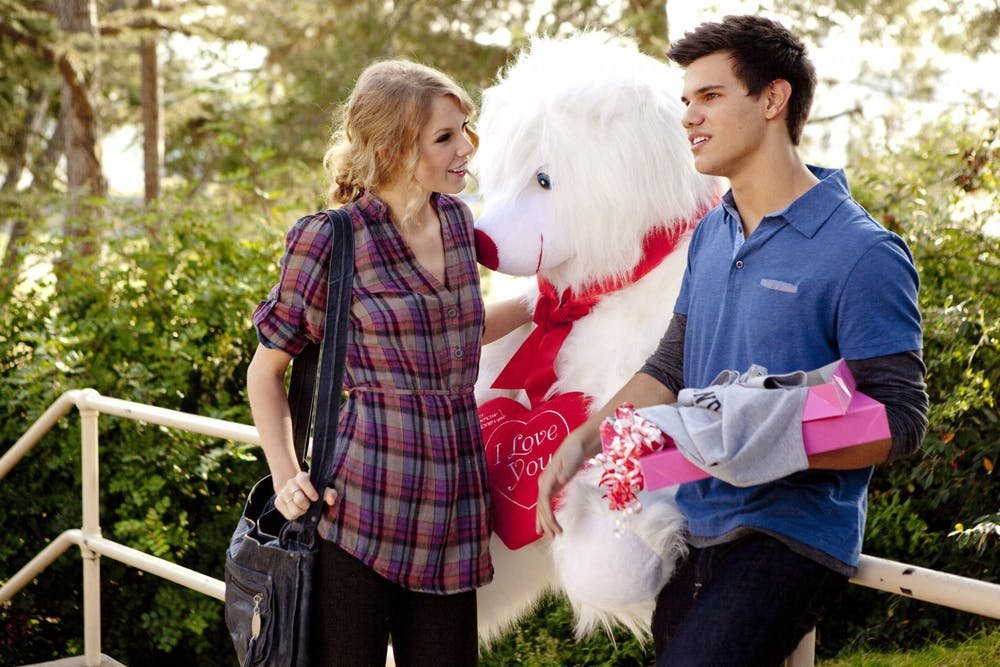
T: Okay well in terms of acting, CATS. Hands down. Mostly because that film is so absolutely insane that her appearance as a sexy lounge cat with boobs is one of the milder moments.
Her in this movie feels like the writers just threw in any Easter egg to make it clear that this was Taylor Swift playing Taylor Swift playing a character. I mean this with love, but the Homeschool Energy is very strong in her presence here. And look, Taylor Swift doesn’t need to be a good actress. She just needs to keep writing me music to listen to while sitting alone in the woods. Time spent acting is taking away from where her talents are really needed.
R: I think I'll take CATS, too. A slightly better performance in a much worse movie isn't a bad deal. It doesn't help that VALENTINE'S DAY was released during a period of her career I don't find particularly interesting (this seemed to be the tail end of her "country princess" era; Red and 1989 were still a few years away). Although I had forgotten that "Today Was a Fairytale" technically came from this movie's soundtrack. More of a fun fact than anything else.
We've been picking on the gals, but the men have just as much of an insane time here as well. One of the bigger stars of this movie is Jamie Foxx, who plays a sports reporter named Kelvin who, for whatever reason, gets assigned by Kathy Bates the human interest story of just interviewing randos on the street what Valentine's Day means to them (the twist? Get this, he hates Valentine's Day!). Why the sports guy has to do this goes unexplained.
Do any of the men escape with their dignity intact in VALENTINE'S DAY? For me, I thought Lautner came off okay-ish, although that might just be my residual respect for him more or less giving it all up after TWILIGHT rubbing off. He seems happy.
What about the other dudes? Bradley Cooper's airplane passenger who makes nice with Julia Roberts' soldier character? George Lopez, business partner and friend of Ashton Kutcher? Kutcher himself? Patrick Dempsey's evil doctor? Eric Dane as the football player who comes out of the closet during a rooftop press conference? Topher Grace, who works in the mail room and has to be told that today is Valentine's Day?

T: I think Bradley Cooper was probably the okay-est, maybe in part because he wasn’t in it enough for the tide to turn, or maybe because I don’t think I’ve ever actively disliked watching him on screen. I do think his scenes with Julia Roberts were..maybe(??) the most enjoyable for me? And by enjoyable I mean that they were just there, and fine, and then over. I’m honestly shocked they managed to write a scene about two strangers meeting on a plan on Valentine’s Day and NOT have them fall in love at 35,000 feet. It was just…normal-ish? Movies should do that more often, says I!
I don’t mind Ashton Kutcher. He had his moment, hasn’t tried for an Oscar, and seems like a genuinely good human being in his free time. But he gets negative points because his character is in love with Jennifer Garner. Request to suspend my disbelief: denied. Sorry, I don’t make the rules, I just happily enforce them in this case.
R: Well, of course, part of the reason Cooper and Roberts don't fall in love is because...well, there's a twist regarding him that I admit I didn't see coming (others may have picked up on it immediately) and thus the one genuine surprise in a movie totally devoid of them. Credit where it's almost due.
If you haven't picked up on it, I also hated this too-long (over two hours!!!) movie. It's ultimately devoid of a real point of view except "isn't Valentine's Day the greatest?" (it seems to exist in a world where society seems to shut down entirely on February 14th to discuss the holiday at length). I don't need it to be deep, of course, but it should at least be fun. Putting this together was the only real fun part about it. Give me character actors getting to do their thing. George Lopez wasn't even funny!
So, really, the only question left to ask is: now having sat through this tribute to one of the last winter holidays we get in the cycle, has it affected your opinion on Valentine's Day at all? Do you like it more? Less? The same? I know for me, it's made me realize that the day is cool and a good excuse to remember to be nice to the people you love, but I ever met anyone in real life that went this hard on V-Day, I really don't know what I would do. Besides worry about them a little. You?
T: I think you’re being extremely kind to say that you took anything away from this movie. Do I have to be mean to you today to recalibrate your outlook? I’d do it, because that’s how much I care.
Suffice to say, no, it did not change my outlook on today. I think it served it’s purpose to run for two hours and give a paycheck to a lot of actors who maybe enjoyed getting top billing for only three days worth of filming at maximum. Oh dear, did I sound cynical? Maybe this movie DID get to me. Am I the Jamie Foxx of our household?
It did remind me that some people buy their partners flowers though. Am I safe to assume those are being delivered today?
R: Answering your questions in order: 1) What would make this any different than any other day, 2) I've long said you and Jamie Foxx are exactly alike and 3) yes, a sad van driven by Ashton Kutcher and George Lopez will be arriving any minute now with flowers that I've ordered. That's, of course, assuming they don't get rear-ended by Eric Dane, causing their loading door to not close right, resulting in a many a bouquet to fall out and spill onto the streets of Los Angeles. If those flowers don't arrive, well, now you know why.
I think that closes the book on VALENTINE'S DAY, both the movie and the day itself. There are still two more of these to come, so be on the lookout in this space the next time a second-tier holiday comes around.

Film School Weekend: I Finally Saw ONE FLEW OVER THE CUCKOO’S NEST
Lorem ipsum dolor sit amet, consectetur adipiscing elit. Aenean eu leo quam. Pellentesque ornare sem lacinia quam venenatis vestibulum. Nullam id dolor id nibh ultricies vehicula ut id elit.
I'll be honest, I seriously considered not doing this one.

Some movies just loom too large to freely admit you've gone three and a half decades without having seen it yet. You know the type of movie. They're the ones where people ask you with their mouths agape "Seriously??" a couple of times once you let it slip, as if you're going to eventually say, "Ha! Got you! Of course I've seen it. I'm not an idiot."
But, nope, never seen ONE FLEW OVER THE CUCKOO'S NEST. There's no ulterior motive as to why, I just never got around to it. It is such a fixture in film history that I've essentially been able to glean the plot just from being around long enough. I was aware that Jack Nicholson takes on an evil, cold Nurse Ratched in a psychiatric institution. I had seen a couple of scenes from when it was reviewed on the very first episode of Siskel and Ebert(back when it was called Opening Soon At a Theatre Near You!). I was also aware of it as a piece of Academy Awards trivia, it being one of only three movies to win what are considered the "Big Five" awards (Best Picture, Best Director, Best Actor, Best Actress, Best Screenplay).
But I'm not sure I was really aware of what ONE FLEW OVER THE CUCKOO'S NEST was about, nor the type of story director Milos Forman was trying to tell with his Oscar-winning film, one that's primarily about flawed humans finding the humanity in other flawed humans. Nor was I prepared for the interesting challenges the script, written by Lawrence Hauben and Bo Goldman, puts into place that actually serve to drive the story's point home.
I'm not even sure I really knew what the title meant.
But, in the spirit of the exercise, that all merely served as a compelling reason to finally knock this one out. Here we go!

ONE FLEW OVER THE CUCKOO'S NEST (1975)
Directed by: Milos Forman
Starring: Jack Nicholson, Louise Fletcher, Brad Dourif, William Redfield
Written by: Lawrence Hauben, Bo Goldman
Length: 133 mins
Released: November 19, 1975
As mentioned, ONE FLEW OVER THE CUCKOO'S NEST is the story of R. P. McMurphy (Nicholson), a guy who has been transferred from a prison work camp to a mental institution with suspicions that he is playing up a psychiatric illness to get out of doing labor. He ends up under the care of the cold and unfeeling Nurse Ratched (Fletcher), and in the company of the various long-term residents of the institution, all played by a murderer's row of future beloved character actors (Christopher Lloyd, Brad Dourif and Danny DeVito, to name just three).
As his time there increases, and he realizes they can keep him there for as long as they want, McMurphy begins a revolution against Ratched and their keepers. Along the way, it becomes clear McMurphy is the only person in the whole facility who sees his fellow patients (inmates?) as humans, creatures beyond their psychoses and medications.
I have to admit, I was a little apprehensive to CUCKOO'S NEST at first. To be fair, I was bringing my own crap into it; I was a little concerned about its portrayal of mental health professionals as uncaring beasts who are interested only in repressing their patients' lives and happiness. No doubt, abhorrent treatment of people with vulnerable diseases has been an issue for centuries, and continues to this very day; I think we all know at least someone with a horror story, especially when the prison industry gets involved with psychiatric care. But I worry sometimes that people still equate therapy with Nurse Ratched when, for most people, it's just talking to someone for an hour every week while you learn to lie to them less and less over time. The movie just had an initial air of "you don't need those meds, you just need to live, maaaaan" (I might be speaking out of ignorance; I have no concept of the state of psychiatry in the 70's).
But once I reached the obvious conclusion that Ratched was meant more as a symbol of a system rather than an individual, it clicked into place. Because, duh, of course she is. In this specific case, she represents a healthcare system, but she could be any system that strips people of their humanity. Justice, prison, insurance.....take your pick, really. I'm not sure why that reframing helped me, but it did (I think I just have sympathy for mental health workers, an underserved job). Under her care, these are patients that are only meant to take their meds and stay under observation. Even when they're outside, they don't really do much. At least, until McMurphy starts throwing basketballs at them.

Something I found interesting about the story as constructed that likely would be a sticking point in modern cinema? It's firmly, clearly established before we really even get going that McMurphy isn't exactly a noble man, or even a nice guy. I mean, that's obvious from the fact that he arrives at the institution from a prison work farm. In one of the first scenes we get with him, though, it's revealed that he's at the work farm in the first place for the a statutory rape of a fifteen-year-old. McMurphy isn't exactly remorseful about it either, making some flippant remark about her looking older.
I would imagine many people might now look at a scene like that and feel the urge to dismiss the movie entirely, just another example of a movie of its time reflecting mores that are no longer acceptable and, thus, not worth my time. And, don't get me wrong, film history is filled with legitimate examples of this. I just don't know that this is one of them.
I actually think making McMurphy a noble hero, someone in the joint for something not actually bad ("he was framed" or "he was defending someone weaker than himself", all the kinds of cheats movies do to make their antiheroes not really antiheroes) might have made the movie weaker.
Because, that's what we're kind of used to, right? We now demand our heroes be flawless, or at least exhibit flaws that we're okay with (the romantic usage of drugs and alcohol), or flaws that aren't really flaws at all ("he just cares too much!" or "he's dark and tortured" are both fun ones). STAR WARS will probably never recover from the backlash against the idea of Luke Skywalker having a significant and consequential lapse in judgment that causes him to hide in isolation, as he did in THE LAST JEDI. Can you imagine if Marvel had made Iron Man a statutory rapist (instead of just a a good old fashioned womanizer, egotist and drunk, which are merely "fun character traits")?
But R. P. McMurphy is. He's nasty, and his reaction to being called on it is, um, really something.
Yet he's still better at, and more capable of, recognizing humanity in scattered outcasts than the state.
And that's the point. At least, I think. Maybe I'm also defending a very outdated piece of screenwriting by over-intellectualizing it. But I don't think I am. I think McMurphy's lack of real nobility is crucial to this particular story this movie is trying to tell.

Even in 1975, Jack Nicholson was starting to slowly morph into "Jack", the goofy version of his persona that we're used to seeing sitting court side at Staples Center (or the Crypto Arena, or whatever it's going to be called in the next three years). He wouldn't go full SHINING for another five years, but he's also already a slight notch up from the controlled performance he gives in CHINATOWN.
However, I think Jack's unique aura pays off here, and it's not surprising that he coasted his way to his first Academy Award (although I personally might have given it to Pacino that year for his performance in DOG DAY AFTERNOON). What I think really helps balance him out is that he's giving these impassioned monologues and speeches to stone-faced observers much of the time. Whether it's Ratched, Chief, or any of the other tenants of the unnamed institution, most people respond to McMurphy's impassioned pleas by doing nothing at all, at least until they do. It's no mistake, then, that one of the best scenes in the whole dang picture is the scene where McMurphy attempts to rustle up votes to get the World Series put on TV, an example of the movie's subversive humorous streak that pops up a lot.

Speaking of Ratched, I'd say we need to talk about Louise Fletcher. Except I don't think there's anything else I can bring to the table that hasn't been said already since the movie's release. It's the clear high mark of her career; there may be no one-off role that is so clearly intertwined with its performer, even these 45-odd years later. And there's a reason she's endured; there may be no greater metaphor for the cold, unfeeling nature of the system than her. She was a no-brainer for her Oscar as well, beating out such iconic performances such as Ann-Margret in TOMMY.
And may I say that there's such a glorious lack of context for Ratched. She just is. It's why I continue to actively avoid that blasted Sarah Paulson prequel series. I'm sure she's great! But I don't really need to know Ratched's origin. I'm barely interested in knowing her first name (I don't think the movie ever says?). It informs nothing to my understanding of ONE FLEW OVER THE CUCKOO'S NEST and, in fact, threatens to do real damage to it. Also, I don't have AMC Plus or whatever. Anyway.

Oh, and I'd be remiss if I didn't mention "Chief" (played by Will Sampson), the titular one who flies over the cuckoo's nest, who the movie might secretly be really about. After all, he's the one who eventually gets out, the one who is the most changed for having been in McMurphy's presence. And Sampson plays it so beautifully, all interiority until he finally makes his move in the final scene. It was kinda insane to learn that, prior to CUCKOO'S NEST, the guy was a rodeo performer. "Chief" was his first real film role. He'd work for another decade or so before passing away in 1987.
Oh, and Scatman Crothers is in this! I wasn't aware that THE SHINING would serve as a reunion of sorts between the Scatman and the Jackman. Cool stuff.
And, of course, ONE FLEW OVER THE CUCKOO'S NEST counts as a Christmas movie.

Of course, the movie went on to also win Best Adapted Screenplay and Best Picture (a nominee pool, by the way, that stands as maybe the best ever: ONE FLEW OVER THE CUCKOO'S NEST, BARRY LYNDON, JAWS, DOG DAY AFTERNOON and NASHVILLE. Not a single miss there, I don't think), completing "the Big Five", something that only IT HAPPENED ONE NIGHT before it and THE SILENCE OF THE LAMBS after it have ever done.
That very short list has always struck me as interesting, as there's an inherent implication that these are three of the very best films Hollywood has ever produced (which is wildly debatable). But, there's also so different from each other, and would make for a very schizophrenic triple feature. I think it's proof positive that Oscar victories tend to be about momentum more than anything else. If you can tap into something that audiences and industry professionals didn't realize they were eager to explore, who knows what could happen? I'm just surprised it's been over thirty years since it happened again. Although a quick glance of the most recent movies that had a shot at it is, uh, not encouraging; LA LA LAND, AMERICAN HUSTLE and SILVER LININGS PLAYBOOK all secured the needed nominations in the last decade.
Yeah, maybe this is a record we don't need to be breaking anytime soon.

THE FRENCH CONNECTION’S Big Car Chase Still Has Drive
Maecenas faucibus mollis interdum. Nullam quis risus eget urna mollis ornare vel eu leo.
The centerpiece scene of this early 70’s classic still rocks, thanks to the power of drama through action!

Ever since I've made the call to turn this primarily into a space for film discussion a couple of years ago, I've had one constant presence in the comments: a guy I know named Tony, an old colleague from my theatre-doing days, who I remember fifteen or so years ago taking over a Wednesday evening acting class for a few weeks, one that was usually ran by the recently-deceased Edward Claudio (who, if you're not from the area, should be said was a legitimate Sacramento theatre legend that will not be easily replaced, if at all), and used the class as his pulpit for his sermon on acting in film.
I learned a lot from this version of the class (including the realization that I shouldn't act on film). I especially remember Tony walking us through his journey towards realizing the power that great movies can offer a person. As the story went, he was a huge aficionado of stuff like the James Bond series as a lad. That is, until stuff like THE GRADUATE, THE GODFATHER I and II, and DOG DAY AFTERNOON started coming out, and it changed his life forever (the movie that served as the specific turning point eludes me, although I want to say it was THE GODFATHER. Correct me, Tony?). To this day, he will happily tell you that the greatest time in American film history was approximately 1967 through 1980, before the JAWS and STAR WARS-ification of Hollywood ended the party forever. Seriously, you'll have a chance to right after you're done with this.
Well, never let it be said that Ryan Ritter doesn't pander to his audience.
February is going to be 70's New Hollywood Month in this here space!
I might be stretching the definition just a bit with one of the choices but, just like French New Wave Month, the only real criteria is that a) it was made and released during a loosely defined period and b) I haven't seen it. Since I arbitrarily drew a line at pre-1970's stuff, that will mean no GRADUATE or BONNIE AND CLYDE, and I've already seen many of the huge hitters (no GODFATHER, THE CONVERSATION or DOG DAY AFTERNOON, and stuff like TAXI DRIVER has already been covered in this space).
But, also like last month, you're still going to be stunned at the stuff I haven't gotten around to. Let's get started with an immediate huge one, a movie that made a huge splash at the 1972 Academy Awards, winning Best Picture, Best Director, Best Actor, Best Adapted Screenplay and Best Film Editing. A movie whose name you already know from reading the title and clicking on the article, throwing the wisdom of adding an air of mystery to this intro into question....
Let's do THE FRENCH CONNECTION.
THE FRENCH CONNECTION (1971)
Directed by: William Friedkin
Starring: Gene Hackman, Roy Scheider, Fernando Rey
Written by: Ernest Tidyman
Released: October 7, 1971
Length: 104 minutes
I suspect at times that people nowadays view American movies from the 70's with some apprehension, maybe due to it being a particularly favorite time period and genre of....well, "film snobs". "If the guy shitting on me for liking Marvel movies are into it," the thought might go, "it must be pretentious and boring".
But, really, a lot of the really famous ones aren'tpretentious or even particularly esoteric at all? Take THE FRENCH CONNECTION, a movie that I think has honestly aged very little, all things considered. The only thing that may have atrophied over the decades might be people's appetite for rogue "bad cops" nowadays (although I guess we'll see if that truly lasts). But, besides that, this movie really is just a well-made crime action thriller. There are gun shootouts, car chases, drug smuggling, and boozing, womanizing cops and criminals all the way through. Y'know, the good stuff.
THE FRENCH CONNECTION is the story of a New York City detective, Jimmy "Popeye" Doyle (Hackman), and his partner, Buddy "Cloudy" Russo (Scheider), who get tipped off on a huge shipment of drugs being brought into the city in the next couple of weeks. From there, it's a race to track down drug lord Alain Charnier (Rey) before he's able to complete his evil transaction.

It's a movie refreshingly light on backstory or deep character arcs; Doyle does have a story and record to him, and it's significant enough that you completely understand why other cops and superiors are reluctant to trust his instincts on this particular case. But that context is relegated to just a couple of quick lines from other characters; it's not particularly expounded on, and we certainly don't cut away to any flashbacks fleshing things out. That would slow down the action, my friend, and THE FRENCH CONNECTION don't got time for that.
The only thing that might be objectionable to modern viewers might be its pace. Hard as it might be for those who were there at the time to believe, I have no trouble imagining someone walking away from THE FRENCH CONNECTION complaining that it's too slow. And who am I to argue? In the fifty years since its release, action films have gotten impossibly big and fast. Call it the "FAST AND FURIOUS effect"; even that street-racing franchise has morphed over the past decade into essentially MEATHEAD AVENGERS, with car chases that have expanded exponentially in scope with the assistance of CGI and characters now literally going into space.
NOTE: I actually generally love the FAST AND FURIOUS movies; I think beyond all the blatant pro-wrestling-esque stupidity and dumb drama between Vin Diesel and The Rock lies a set of generally well-crafted and well-cast summer movies. They're not all created equally, and I think they've gotten so big that there's nowhere for them to go now, but I need it established that I'm no hater. This isn't Old Man Ryan here. Just that I think once you start overstimulating an audience, it's hard to crank down the dial.
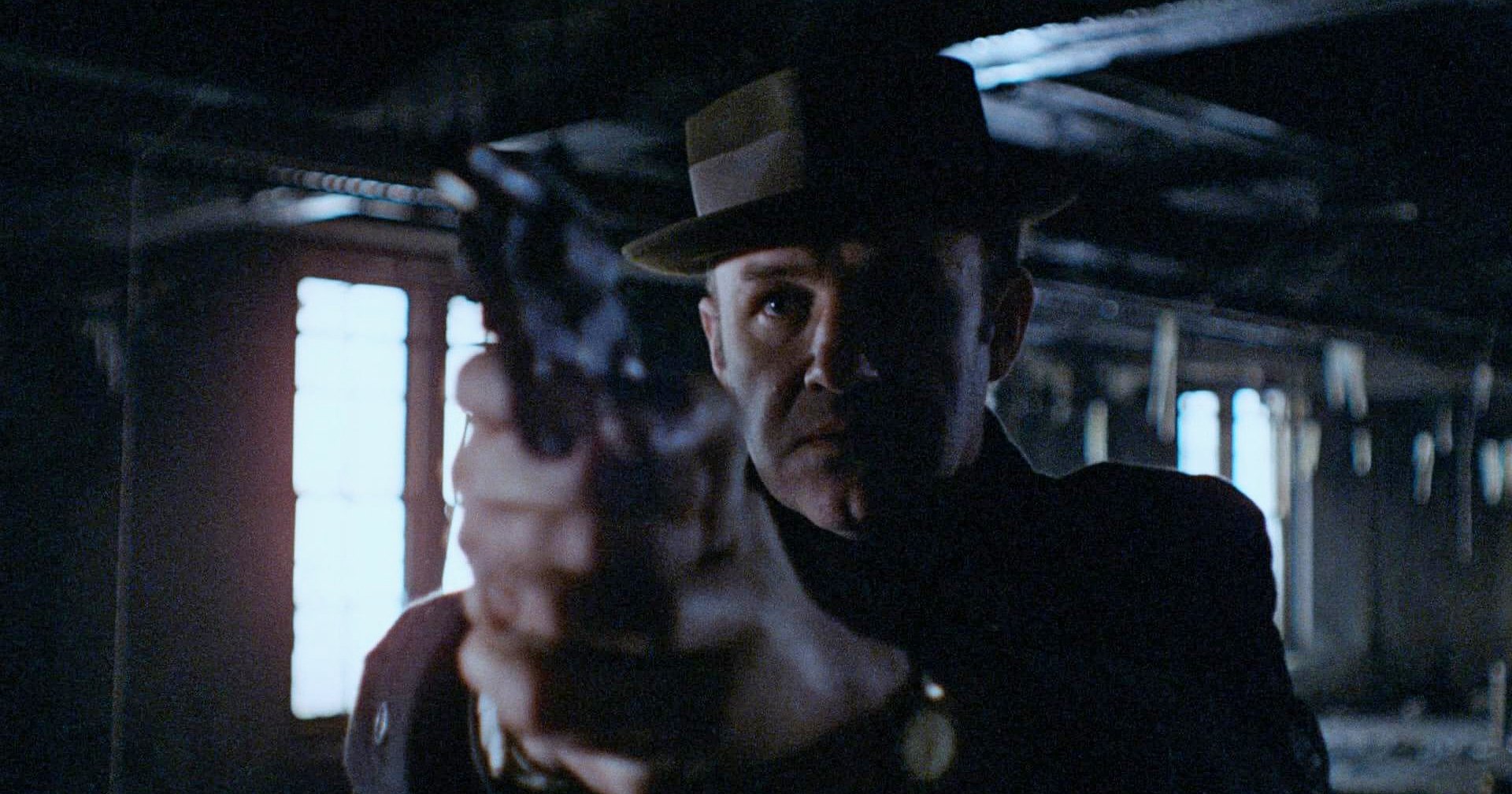
But instead of focusing on the pace of the action, I'd urge a new viewer to instead focus on the craft of it. Because, honestly, once you focus in on it, suddenly its Oscars pedigree becomes pretty clear and justified. THE FRENCH CONNECTION is the kind of movie that should win Best Picture more often, to be frank. Instead of winning its gold with its social themes or huge performances, it does it by knowing exactly how to draw every inch of drama and suspense out of a given situation.
To show what I mean, let's focus on the most famous scene, that car-train chase. Give it a watch if you've never seen it.
It goes without saying, but one of the best things about it is that they didn't have the advantage of computers. Again, I know that's another old-man complaint, and CGI does present other opportunities. But what scenes like this gain from its absence is that, to some degree, what you're seeing is real. Real in a fake movie way, yes, but some human had to strap a camera to a car to achieve that slightly vertigo-inducing weaving through lanes.
But, let's take a look at how the scene builds suspense (Note: to some degree, I'm cribbing my observations about action from an incredible article from Film Crit Hulk, who broke down what makes the action in MISSION: IMPOSSIBLE - FALLOUT work so well. As always, I'm begging you to leave this dumb article to read another, better article. The choice is yours).
Everything seems to flow logically from what's been set up previously, including the fact that Doyle is in many ways a desperate man whose reputation is on the line with this hunch that he's following. From the very start where Doyle commandeers a civilian's car (one of those things I've only ever seen happen in the movies; is this a real thing?) to the end where a hitman ends up dead on the steps of a train station, the whole thing plays out like a short film. Every time it seems like Doyle has a plan of execution to capture an assassin who has hopped on a train to get away, "Frog Two" (the assassin Doyle is chasing, played by Marcel Bozzuffi) manages to get a leg up on him. Doyle runs over to the next station, only to learn that "Frog Two" has commandeered the train and is blowing past all scheduled stops. He has to hustle and play catch-up again.

The problem with commandeering the train, however, is that the train conductor turns out to have a weak heart and panics easily. His response to having a gun repeatedly pointed at his head? He passes out and collapses onto the control panel. The train is now going way too fast with no way to fix it. Now "Frog Two" is in trouble. Now what?
All the while, we get these fast-moving POV shots, from the perspective of either the front of the train or the front of Doyle's stolen car. We're moving forward, always. It doesn't hurt that there are several moments where cars collide in ways that weren't anticipated, even by the film crew. The story of the action is meticulously planned out, but there's an improvisational feel to what actually happens. The result is something that feels just out of control enough (especially a moment where Doyle damn near runs over a woman). It all culminates in a moment that even the police officers on retainer as advisers to the film balked at, claiming it's something that no cop would ever do and claim as an act of self-defense. You watch it and tell me if it even registers as anything to you.
But notice how, throughout the whole thing, which of the two have the leg up constantly changes. It feels for all the world like both the pursued and the pursuer are making it up as they go along, a far cry from the modern "hero and criminal" dynamic in films nowadays, where one always seems to have a master plan that no normal human being could have possibly come up with on their own and failsafes for snags that nobody could anticipate. Adding to all that is the fact that "Frog Two" is established as legitimately dangerous; he shows no issue with killing law enforcement in cold blood, putting the safety of the civilians in real question.
For all intents and purposes, THE FRENCH CONNECTION's signature action sequence stars two characters who don't have a clue what the fuck they're doing. And that's why it's so fun to watch.
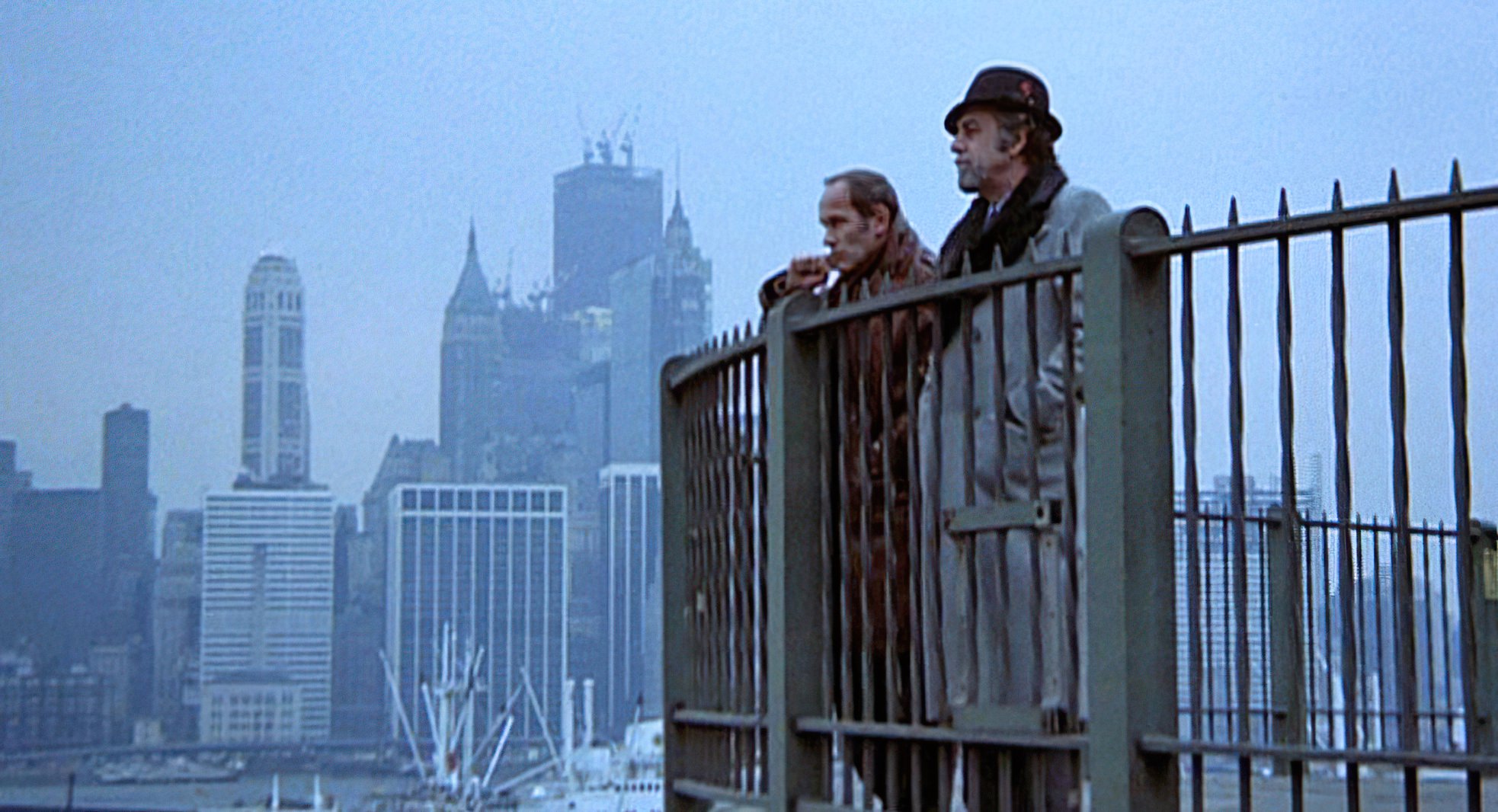
There are other scenes that are just as well-written and crafted; for as much fame as the car chase has gotten, my favorite scene in the movie might actually be Doyle tailing Charnier into the subway. Without really any lines of dialogue, we get what amounts to a complete story from start to finish. You can just feel the wheels turning inside both character's heads, and it's really and truly captivating to watch the power dynamic shift every second between the two. It all culminates in a great little "farewell" moment from Fernando Rey, a moment that pays off in such a satisfying way at the end of the film.
That's really the secret to making an action movie that endures; not necessarily an increase in the scale, but a laser focus on the drama and conflict within it. Hell, going back to the FAST AND FURIOUS example, it's no secret that the best ones of that series (for my money: 2, 5, 6) understand that better than the worst ones (for the rest of my money: 4 and 8). And William Friedkin (who, ironically, would go on two years later to arguably usher in the beginning of the eventual blockbuster culture with THE EXORCIST) and the rest of his creative team knew that intimately with THE FRENCH CONNECTION.
And so, it got rewarded at Oscars night, and it's well deserved, winning Best Picture over FIDDLER ON THE ROOF, A CLOCKWORK ORANGE, THE LAST PICTURE SHOW and NICHOLAS AND ALEXANDRA. Stiff competition, but it's hard to argue against. There's always this backlash against the Oscars as this bastion of rewarding "artsy" movies, ignoring movies loved by the general populace. Well, that may actually be accurate. BUT, the 1972 Oscars are proof positive that there was a time when action movies could win the top prize over "arty" films.
They just need to be made....well, artfully.
Scale is relative, drama is forever.

Film School Weekend: SHOOT THE PIANO PLAYER
Lorem ipsum dolor sit amet, consectetur adipiscing elit. Aenean eu leo quam. Pellentesque ornare sem lacinia quam venenatis vestibulum.
A late programming change allows me to gush about this unexpected masterpiece.
So, full disclosure this weekend.
My initial plan was to devote this space today to Francois Truffaut's third film, JULES AND JIM. After talking a couple of weeks ago about his trailblazing debut, THE 400 BLOWS, it felt like a good idea to jump over to his next nearly-larger-than-life-in-reputation film, his 1962 saga about two friends who end up falling in love with (and being seduced by) the same woman over the course of twenty-five years.
And, indeed, I ended up watching it and, as everybody says, it's great! It features a character-driven plot line that is at once endlessly complex and totally heartbreaking, not to mention innovative (Martin Scorsese devotes a whole section of his Masterclass to the use of voiceover in its opening minutes). To be honest, I'm not sure I fully absorbed the whole thing in the lone viewing of it I have under my belt; it constantly surprised me, which meant I spent much of the time recalibrating my expectations throughout. This tends to make expounding on JULES AND JIM at any length a little tricky since, well, I'm not sure I precisely know what I'm talking about yet.
But, the intent was to write about it, so prepare to write about it I did. And then I found I had a spare eighty minutes on my hands one night. And I noticed that, between Truffaut's first and third films, there sat another movie, SHOOT THE PIANO PLAYER. It seemed like a quick watch, and I thought maybe it would help inform me as to his arc between 400 BLOWS and JULES AND JIM. What was the harm?
So I watched it.
And I was blown away.
Sorry, JULES AND JIM.
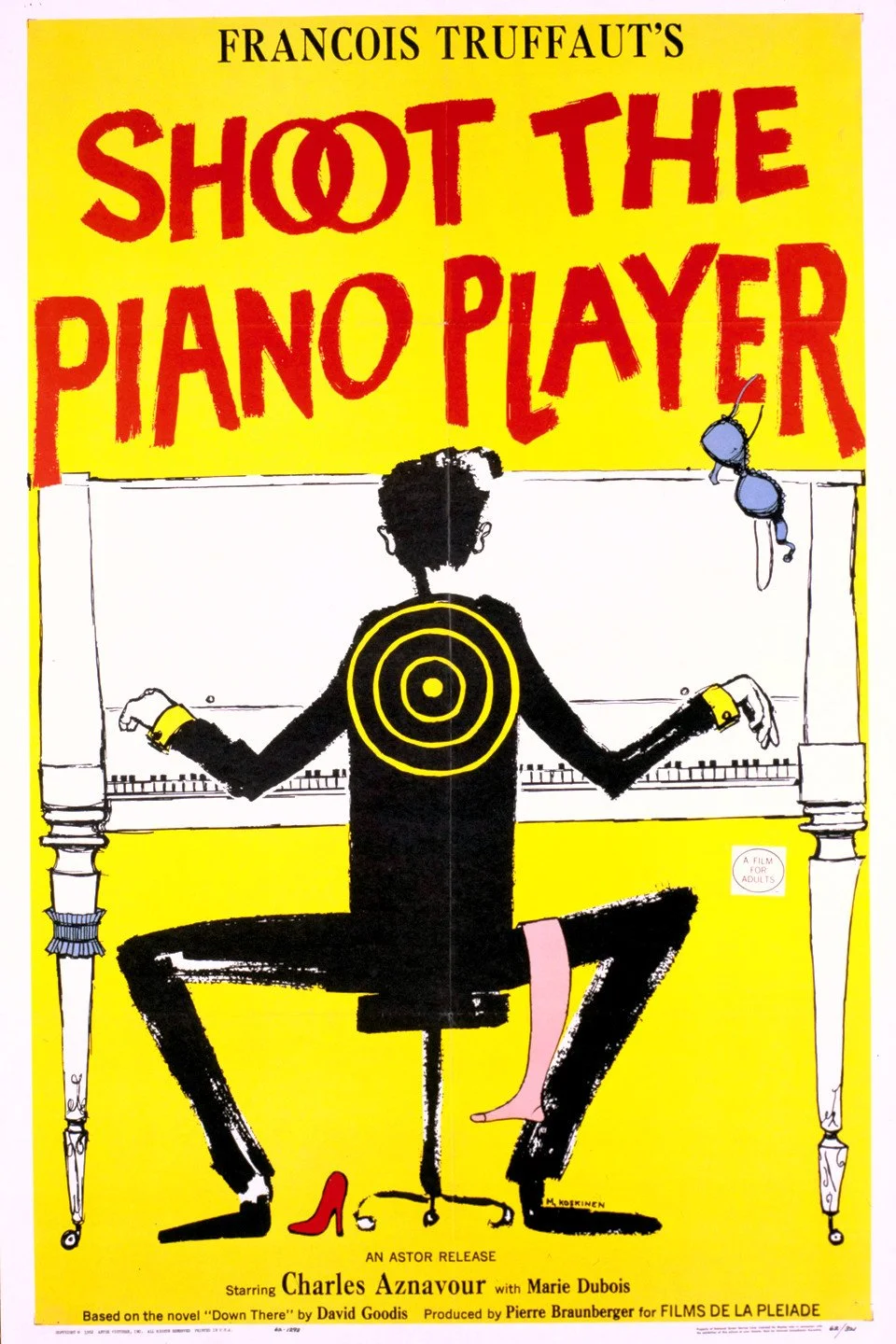
SHOOT THE PIANO PLAYER (1960)
Directed by: Francois Truffaut
Starring: Charles Aznavour, Marie Dubois, Nicole Berger, Michele Mercier
Written by: Truffaut, Marcel Moussy
Released: November 25, 1960
Length: 81 mins
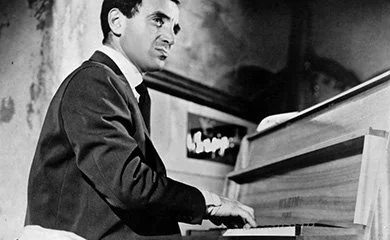
Intended as a tribute to the 30's and 40's American B-movie, the initial thrust of SHOOT THE PIANO PLAYER will seem familiar to any other noir aficionado. We start with a man clearly on the run from some bad people, and follow him briefly as he stumbles into a lively piano bar. He insists on an audience with the piano player, who we quickly learn is his brother. There's clearly a history that the piano player, Charlie (Aznavour) is running from; Charlie isn't even his real name, it's Eduoard. Regardless, he wants nothing to do with his brother's affairs. Alas, as many hapless heroes of noir often find out, trouble finds him regardless. His brother has ripped off a pair of gangsters and is now trying to elude his fate. Alas, just by contacting Eduaord, he's gotten him involved.
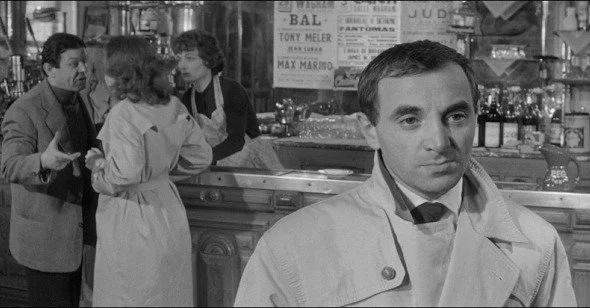
Along the way, we learn more about Charlie/Eduaord through his relationships with the three major women in his life. There's his former wife Therese (Nicole Berger), whose decisions we learn about in flashback and inform his new identity as Charlie. There's Clarisse (Mercier), a prostitute who sees Eduoard often and is raising her little brother Fido. Finally, there's Lena (Dubois), the piano bar waitress who's slowly falling in love with him and finds herself in the middle of his run-ins with a pair of gangsters.
Sure, it's all fairly rote, even by 1960, but this movie isn't necessarily trying to break ground by its plot. No, where it really makes an impression is in its storytelling and directing technique. Simply put, SHOOT THE PIANO PLAYER is probably one of the most playful movies I've ever seen.
The movie seems to change genre at will every few minutes or so. Sometimes it's a noir tribute, sometimes it's a gentle comedy, sometimes it practically borders on broad farce, sometimes it's a heightened melodrama. And it manages to do it with such ease, changing gears practically right before your eyes. I'm sure there have been many films before and since that have threaded this needle before, but I've rarely seen a movie succeed so well at attempting so much.
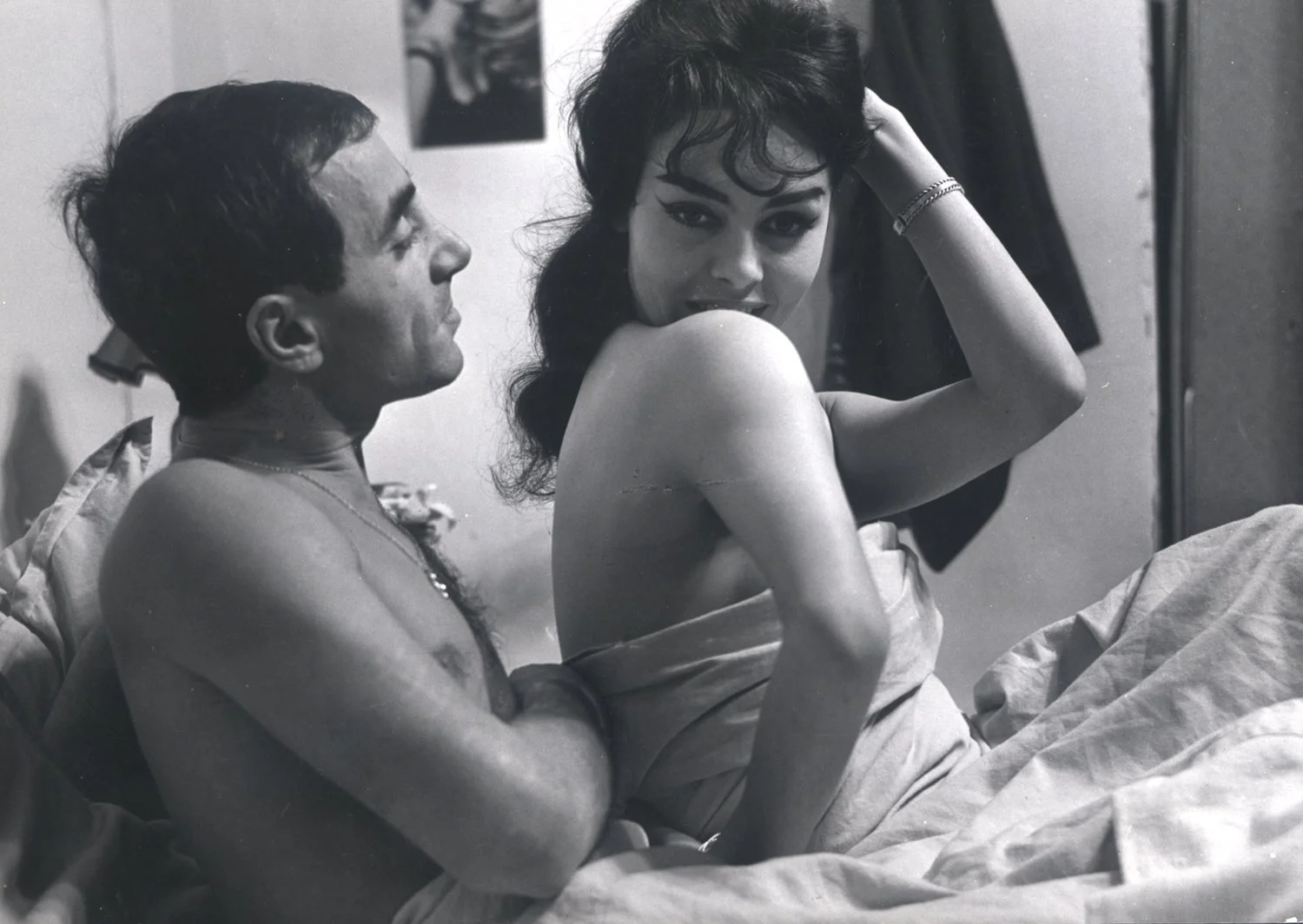
That's not to say SHOOT THE PIANO PLAYER is fully groundless; when the movie aims for both pathos and drama, it's actually genuinely affecting. There's a whole section in the middle where we really get to learn and see Eduoard and Therese's married life, with all the jealousies and perfectionisms that come with living with a professional concert piano player (as well as those costs). But Truffaut isn't afraid to swing for the fences with frequent pauses for things like bawdy songs, or wild punchlines that come out of nowhere; no joke, SHOOT THE PIANO PLAYER contains maybe one of my favorite unexpected jokes ever, after one of the gangsters swears to the truth of his recent statement, lest his mother should drop dead.
This was all an active choice on the part of Truffaut; he found a lot of success with THE 400 BLOWS and rightly so. But there was a common sentiment that it was very French. Wanting to show that he could have a varied and fruitful career, Truffaut went the total other way with his follow-up feature, going for something with uniquely American sensibilities. The screenplay is officially credited to Truffaut and his 400 BLOWS collaborator, Marcel Moussy. But, in truth, Moussy couldn't find an entry point with either the script nor its source material (David Goodis' novel Down There). Moussy wanted to ground the characters, while Truffaut insisted on keeping things loose and abstract. Moussy left the project soon thereafter.
Truffaut was right to stick to his guns on this one. He had an ethos for putting SHOOT THE PIANO PLAYER together; "I wanted to break with the linear narrative and make a film where all the scenes would please me. I shot without any criteria." And you can feel him doing just that, although it does feel like if there were criteria, it might be "pay homage to 40's Hollywood at every turn". There are apparently references to the works of director Nicholas Ray and Sam Fuller crammed in there, as well as more obvious references to stuff like The Marx Brothers (one of the brothers' names is Chico) and the filming techniques of silent films (the use of irises pervade throughout).
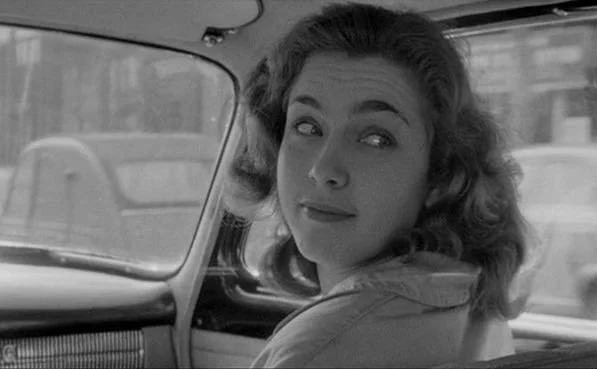
It should be noted that none of this would work without the abilities of the cast at its center. Aznavour is perfect as the man in the middle, the titular piano player. He plays everything straight, which is an informed move. As a result, the comedy around him seems that much funnier, BUT when it's time to play the drama, you easily buy it. He has one of those faces and sets of eyes that connote whole histories without having to write a single line of dialogue.
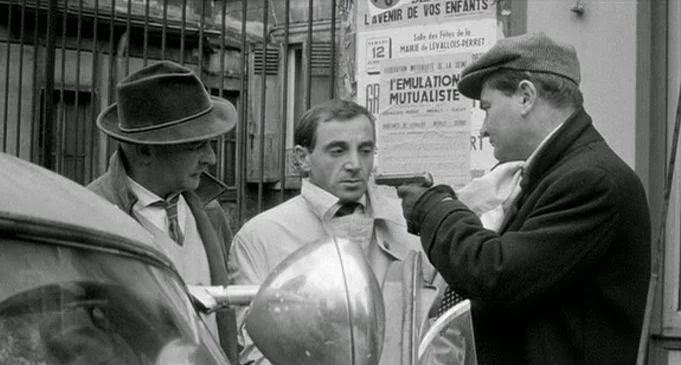
The three women are all great as well; what's fun about them is that they each provide a different personality type. Clarisse is sweet and sexy, Therese is subtly acidic and devastating, and Lena is hopelessly romantic. Special mention, though, should go to Marie DuBois, who plays Lena and endows her with a hopefulness that the other characters don't quite have. The reason I point her out is that she would go on to star in....JULES AND JIM! If you've never seen it, suffice to say she plays a completelydifferent type of character and philosophy, an example of the versatile kind of player you don't always see in the modern day.
Listen everyone, I don't know what else to say without beginning to give stuff away. SHOOT THE PIANO PLAYER is a damned delight, alright? How often do you see a filmmaker's career take such an interesting turn just two films in? Seriously, compare this to the feel and style of THE 400 BLOWS, a movie that's so controlled and so singular in its focus. It's a coming of age story that's told so simply, it's almost not apparent at first what made it so special, either then or now. The particular magic there is in its subtleties and the invisible hand of its creator.
Not SHOOT THE PIANO PLAYER. With this one, you're fully aware of the person behind the wheel, and he's having a blast! And so are you as a result. So, please, check it out. It's available for streaming right now on the Criterion Channel, as part of that massive 44-film French New Wave collection they dropped earlier this month. It goes down so easy and you're gonna have a good time.
And...that'll do it for French New Wave this month! I'll be pivoting to a new series that's a little closer to home and maybe a decade more modern next week. See you then!
Film School Weekend: Breathless
"There was before BREATHLESS, and there was after BREATHLESS!"
Few movies in the French New Wave canon loom quite as large as Jean-Luc Godard's debut (by the way, not to go super parenthetical in the very first paragraph, but the fact that we've already covered two directorial debuts that made such an impact to this particular moment in film history would indicate, I think, just how large a burst of energy the French New Wave really was. Almost like a whole generation of filmmakers were waiting and waiting and waiting, and then when they finally got the chance, BAM! Anyway.)
There are reasons for its strong legacy. BREATHLESS, a sort-of riff on American crime films, hits the ground running right at the start and never really lets up from its pace until the end of its ninety minutes. As well, it features two characters who are aimless in their own ways, and kind of feed off of each other, something that was a little unusual for its time.
And it had style in so many different ways. It had literal style; Jean Seberg's shirts (both the striped one and the one reading New York Herald Tribune) have been recreated and are available to purchase on a plethora of websites to this day. But it also had cinematic style, most famously its unconventional usage of jump cuts, sometimes several in a row within the same scene.
BREATHLESS permeates through pop culture to this day, with references to it being found in diverse sources such as Brooklyn Nine-Nine and Ghost in the Shell. Naturally, I hadn't seen it, which made it a natural choice this month for Film School Weekend.
So....how does BREATHLESS stand up to its almost overwhelming pedigree? Does it stand up to it?
Hop in, let's find out.

BREATHLESS (1960)
Directed by: Jean-Luc Godard
Starring: Jean Seberg, Jean-Paul Belmondo
Written by: Godard (story by Francois Truffaut, Claude Chabrol)
Length: 87 minutes
Released: March 16, 1960
BREATHLESS kicks things off with perhaps the greatest opening line in film history ("After all, I'm an asshole") as we meet Belmondo's charming, nihilistic criminal Michel. He's on the run from the law after stealing a car, which leads to him suddenly shooting and killing a police officer. He hightails it back to Paris and hides out with an American girlfriend of his, Patricia. His plan: get her to run away with him to Italy before the law catches up with him. Eventually, an inspector will make Patricia have to make a choice about her mysterious, free-wheeling man who, by the way, she may now be carrying the baby of.
What's really interesting about BREATHLESS is that the above all makes the film sound fairly plot-heavy, and not altogether separate from an American crime film or noir from the 30's or 40's, perhaps the kind of Humphrey Bogart-starring vehicle that Michel himself would have enjoyed. But this movie really isn't about the plot, nor does it feel American. Instead, it makes its mark in the character scenes, these long, more steadily-shot sequences where Michel and Patricia are talking about anything and everything.

Godard really wants to draw out the fundamental differences between Patricia, who is at a crossroads in her life and desperately searching for meaning and purpose, and Michel, who has long ago found his meaning and purpose: the lack and absence of meaning and purpose altogether. He likes watching movies like THE HARDER THEY FALL and then stealing cars and acting like a general piece of shit ("after all, I'm an asshole").
For a wide a gulf as this difference in philosophy is, you sort of get the appeal on Patricia's end. Admittedly, for someone who's looking for something, the option and permission to stop looking entirely must feel quite alluring. And for Michel, being with someone who is looking for something more must be so foreign as to be completely captivating. The chance to exist in each other's head spaces appears to be fulfilling some sort of psychological need for the both of them.
This brings us back to those infamous jump cuts. There are a surprising amount of theories as to their express purpose, some even suggesting the jump cuts were placed in random spots by Godard, either in an act of spite or desperation. Other explanations offered get deep into editing theory, which is way beyond my education and knowledge base. In my estimation and observation, these cuts seem to occur mostly in scenes where Michel is in transit, either with himself or with Patricia in tow. We're in Michel's territory, his mind-set, and we now have to move a million miles an hour, even when we're sitting in the back of the car. Notice, though, how much the movie seems to settle down when we're in Patricia's apartment. Now we're in her territory and, thus, in a less kinetic, fast-paced space. Whether it was the true intent or not, it felt to me like an indicator as to whose eyes we were supposed to be experiencing a certain scene through.

As you might expect with a sixty-year old movie that was so well known for its frenetic editing and pace, BREATHLESS suffers a little bit now that we have entire generations that have been born and raised after the advent of MTV. A movie that probably seemed incredibly fast, especially when compared to the more modest editing practices of many films up to that point, now seems like nothing compared to the average movie you could find buried in an Amazon Prime category.
That said, I'd argue that, when BREATHLESS is really up and running, some of its jump cuts create a pace that still reads as unusually fast, even in this age of ADD. I'm not kidding when I say there are some scenes of Michel and Patricia driving in a car where it feels like there's a cut every second for several seconds in a row. Just as an example, there's the really famous sequence where Michel, driving Patricia to an appointment, starts listing off parts of the female body he adores, each accompanied by a new jump cut of Patricia sitting in the passenger seat. They're not even shots of particular body parts, just a fresh look at her for every sentence fragment. This is a pace that is usually reserved now for bad modern action sequences, not something so relatively stationary.

This feels like a good time to mention that I stand as a little mixed on BREATHLESS as a whole. Despite how interesting it was to watch, I found it a little difficult to settle into in the way that some of my favorite movies do (side note: something I've noticed when watching a fundamental classic for the first time is that I often experience...not an out-of-body experience, exactly. But almost like I'm watching myself watch it? Like my thought process is more, "here I am, watching RAGING BULL". Almost as if the movie looms so large that I can't focus right away. Does anybody else experience this phenomenon?). With a few days to reflect, I have to wonder if it's because its true innovation was technical rather than thematic. I can usually tell when a movie resonates with me when the analysis flows through me even days after seeing it. This time, I had to look up certain things to jog my memory. C'est la vie.

However, there's still a major take-away that made it worth my, and your, time. Once again, what I want to draw attention to is a performance within BREATHLESS, this time one given to us by Jean Seberg. In a way, she has the harder role between her and Belmondo. Belmondo gets to be extroverted, forceful, the cool Humphrey Bogart wannabe. By comparison, Patricia is often more passive, at least externally. But she is the one where the change occurs in the story, at least it seemed to me. She is the one who has to evaluate the unique, aimless worldview of her criminal lover and ultimately decide to reject it by turning him in, even as she doubts herself all the way to the ambiguous closing moments.
Because Patricia does at least have goals and ambitions, her being an aspiring journalist and all. Michel is happy just to be an asshole, living his life like a Bogart film without much care and regard to who gets hurt along the way. Yet she loves him anyway, maybe too tempted by his disregard.
Seberg is able to register all of these complex emotions without doing much at all. I've already gushed last week how much I latch on to those who act without acting, whose entire inner life is so clear and consistent that the performer can just sit there and you follow along completely. Well, Seberg delivers on that front. She's someone who lived a short, complicated, fascinating life (fun fact: she was a particular target by J. Edgar Hoover and the FBI for her support of the Black Panthers), and I highly recommend Karina Longworth's series about it as part of her bigger You Must Remember This podcast if you're interested in hearing more.
Overall, despite how interesting BREATHLESS was to watch and write about, I was surprised how much of it has faded away from me a few days later. Maybe it's that lack of focus on story that caused me to walk away with less than it felt (this is something I'm still adjusting to in other genres, such as giallo). Or maybe it's the fact that it's hard to shake the feeling that it's mostly an exercise in style. Divorced from its moment in time, its legacy might be more what it would go on to inspire more than it actually is.
Jean Seberg, though, man.