Four From 67: THE GRADUATE Still Resonates Sixty Years Later
Hello!
Sorry for being dormant for as long as I have. I do have excuses, sort of: I’ve been plugging away at a massive article series about another favorite TV show of mine, one turning 25 years old this year. If all goes well, those should start getting posted in November.
However, as always happens, I started getting restless and came up with another idea for a short-form weekly series. I always like using this blog as an excuse to knock out some classic, fundamental films that I had never seen, especially when they’re the types of movies that one typically watches when they’re first getting into the artform. I like making people upset with me, is what I’m trying to say. And I think this series is going to do just that.
1967 was a pivotal year of transition for American film. The old studio system that dominated Hollywood was entering its death throes, and a new way of entertaining audiences at the theaters was beginning to emerge. Even the more “traditional” fare seemed to have more of an edge than you’d expect from the 60s. And, as it happens, there are a ton of movies from that year that I just have never seen, which made this a prime year to explore over the next few weeks.
Also, I chose ‘67 as an olive branch to any Gen-Z or Gen-A readers I may have. Insert wild up-and-down hand gestures here.
Anyway, you get the idea. Let’s start things off with a movie so ubiquitous, so classic, so major that you’re going to be furious I’d never seen it before. Let’s watch THE GRADUATE!
-
It’s a unique thrill to finally get around to seeing a movie that you nevertheless had some functional understanding of, thanks to that good old-fashioned cultural osmosis. Like, imagine those out there who have never seen the original STAR WARS trilogy; I’d have to think that, once they finally get around to them, they’d be surprised at how much they already knew. “Oh, yeah, Darth Vader is Luke’s father. Ah, yes, there’s the backwards-speaking green alien.” The ultimate example might be watching THE SHINING for the first time, a movie where essentially every frame has been parodied by something, whether it be The Simpsons, South Park, MAD Magazine, or Family Guy. It’s entirely possible you’ve “seen” THE SHINING without ever seeing THE SHINING.
So it goes with Mike Nichols’ THE GRADUATE, at least for this writer. Even if you had never seen a frame of the 1967 harbinger of the American New Hollywood to come, how could you not at least recognize “Mrs. Robinson, you’re trying to seduce me” as an instant “classic movie” reference? I think you’d also have to be trying very, very hard to not be aware of the fact that it’s scored by Simon & Garfunkel, since, you know, one of their most famous songs of all is called “Mrs. Robinson”, a name we’ve all just agreed is instantly recognizable. Even as I watched this for the first time, I came in with a lot of knowledge about it without even trying.
The fun part for me came from finally putting those moments into their proper context. Unlike THE SHINING, I constantly found myself caught off guard as to how these moments and aspects of THE GRADUATE presented itself. For instance, imagine my surprise when we reach that famous shot of Anne Bancroft’s leg (framing Dustin Hoffman speaking his famous ‘trying to seduce me’ line) within the movie’s first ten minutes. I don’t know why I assumed that moment was near the end of the movie, but the fact that’s essentially THE GRADUATE’s inciting incident put me on my toes. And, as for Simon & Garfunkel? Yes, as established, their music scores the entire film. But if you haven’t seen THE GRADUATE in awhile, it’s possible you’ve forgotten just how much of their songs you actually get. I think there’s a sequence that, all by itself, is set to two straight S&G songs in full. This is not a complaint, it’s just one of those little differences between how movies were made sixty years ago and now (everybody had so much more patience).
Then, of course, there’s that famous ambiguous final shot, another iconic movie moment that has an entirely different impact when taken in context of the 105 minutes that precede it. It’s a subtle, quiet moment that turns the whole last act (and maybe the movie itself) on its head, leaving you with something to think about regarding the way that youth disillusions itself. Obviously, we’ll dig into it at longer length in a bit, but it’s the kind of moment that makes seeing things the way they’re supposed to be seen (as a longer, complete narrative and not as a series moments) so thrilling and worth the plunge.
Anyway, these are the things you discover when you’re a freak like me and wait almost 40 years to finally see one of the most famous movies of the 1960s. Let’s explore some other things about THE GRADUATE I’m just now getting around to discovering!
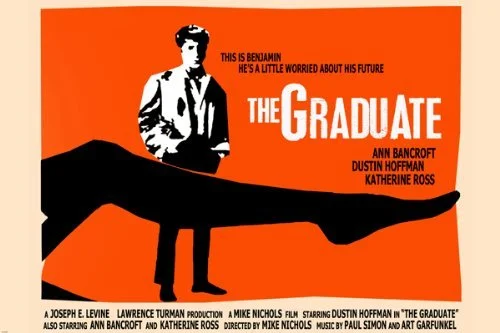
THE GRADUATE (1967)
Directed by: Mike Nichols
Starring: Dustin Hoffman, Anne Bancroft, Katharine Ross, William Daniels, Murray Hamilton, Elizabeth Wilson
Written by: Calder Willingham, Buck Henry
Released: December 21, 1967
Length: 106 minutes
Our titular graduate is Benjamin Braddock (Hoffman), who has just come home to his parents in Pasadena to face…well, whatever’s supposed to come next for a young man fresh out of college (an eternal question that resonates just as much in 2026 as 1967). Despite the many cheerful suggested answers to that quandary from many (including the infamous “plastics” suggestion), Ben can’t seem to shake the feeling that he’s barreling towards an uncertain, boring, presumably unexciting future.
Then Mrs. Robinson happens.
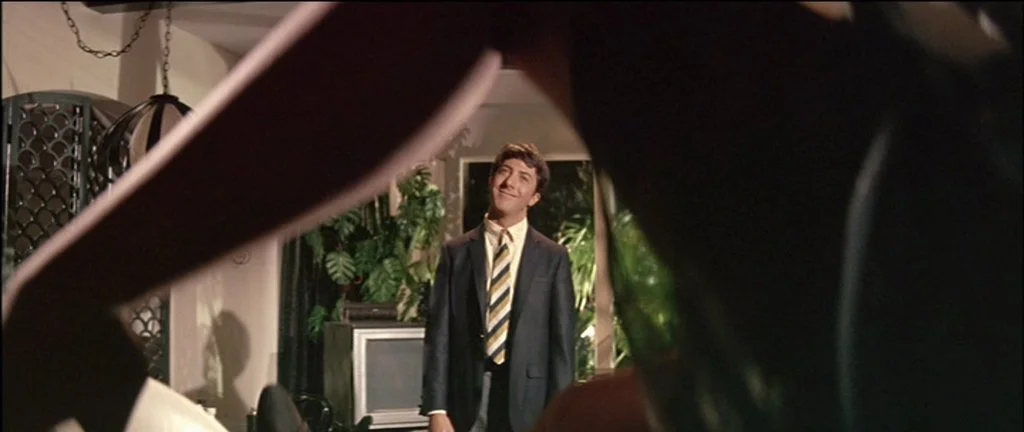
Technically a family friend (the wife of his dad’s law partner), Mrs. Robinson (Bancroft) wants to be so much more now that Ben is a grown man. Despite his initial panicked rebuffs, Ben allows himself to be seduced and, for a while, he settles into his future: floating around aimlessly in the family pool by day, and banging Mrs. Robinson at a swanky hotel by night. It’s maybe not the most nutritious existence, but it’ll do for now. That is, until Ben’s parents start urging him to take Robinson's daughter Elaine (Ross) out.
From there, we watch as Ben navigates the consequences of his dalliance with excitement. Mrs. Robinson forbids him to see her daughter but, despite his attempts to bomb out on their first date, he finds himself falling in love anyway. As things get tangled ever further, the movie seems to shift from a sharp comedy to something a little more melancholy. It all leads to the aforementioned ambiguous ending, a final shot that colors what otherwise plays as a familiar romantic comedy finale (male lead crashes the wedding of female lead and finally gets the girl).
As mentioned, we’ll dig into that ending in a bit, but first, I want to zero in on what stood out to me about THE GRADUATE right from the very beginning, and that’s the direction of Mike Nichols. It’s probably long past time for me to cover Nichols in this space, having already covered the filmography of his comedy partner Elaine May just a few years ago. Well, consider this the first step to rectifying this oversight on my part: his direction here is magnificent, well-deserving of the Academy Award THE GRADUATE would go on to earn him.
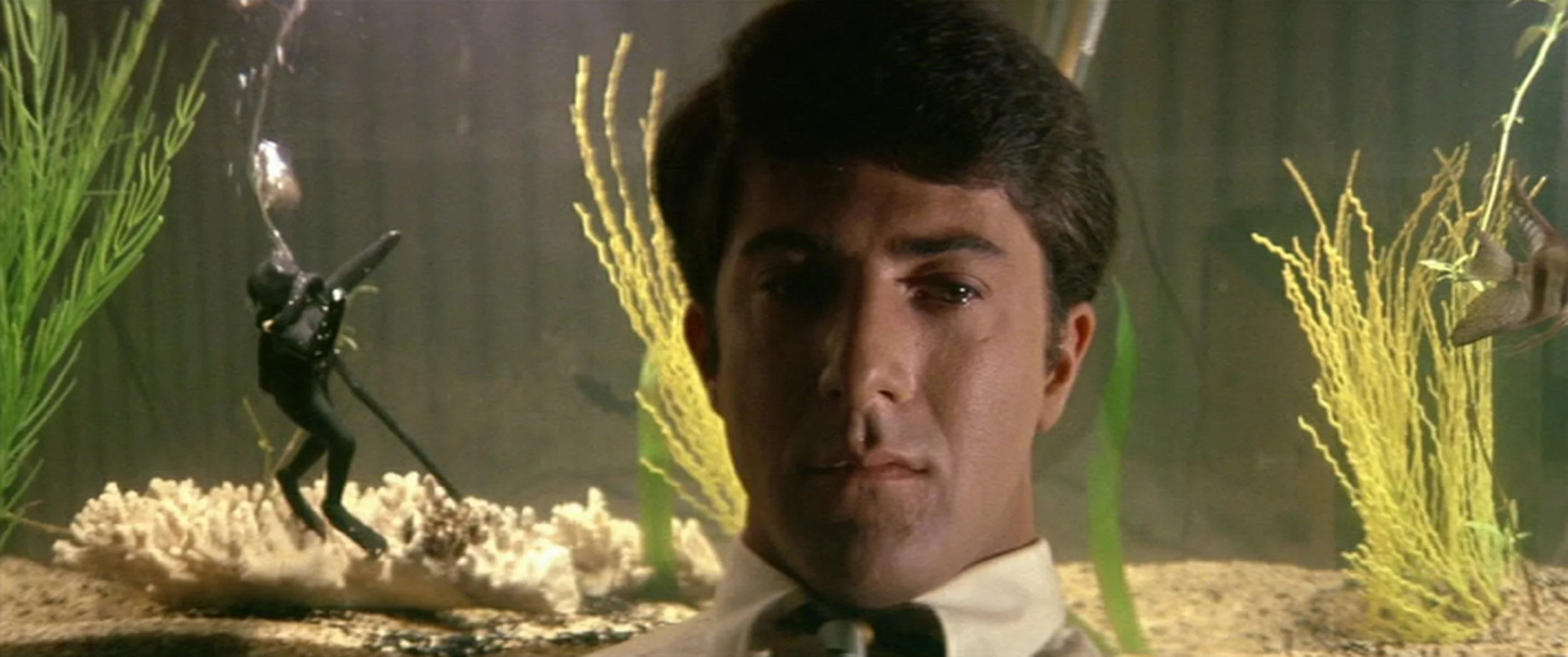
So much of THE GRADUATE depends on us buying into Ben’s post-grad disillusionment, that sense of not belonging anywhere, that feeling of aimlessness. To that end, most of the opening act keeps us locked in on Hoffman and his portrayal of Ben*, putting us metaphorically inside his head as he hops off a plane, crawls slowly across a people mover to leave the airport, arrives home to deal with the many well-meaning family members and well-wishers doling him out advice about archaic nonsense like “plastics”. Even as we are clearly watching Hoffman, it feels like we’re experiencing everything through Ben’s eyes. It’s all a little claustrophobic and overwhelming, but it psychologically puts us right there with our titular character, perfectly capturing that early-20s feeling of “now what?”.
*This ethos expands out to the whole movie, in a way. I don’t actually know for sure as I write this, but it sure feels like Hoffman is in every single frame of THE GRADUATE.
Another thing that stood out to me is how stacked the cast is, even in THE GRADUATE’s smaller moments. Obviously, Dustin Hoffman would quickly become an icon of the New Hollywood movement, making at least eight movies in the decade to follow that would become fundamental classics of the genre. And, yes, it goes without saying that Anne Bancroft was an interesting get here, infusing a very troubling, yet realistic, character with some good old-fashioned Hollywood class. But, oh my goodness, the amount of people that zigzag in and out of this movie that you’d recognize for much bigger roles is pretty solid. Screenwriter Buck Henry pops in, with all of his dry glory, as a wry and knowing hotel clerk. Elaine May, Richard Dreyfuss, and Kevin Tighe all swing by, with barely a syllable to split between them all.
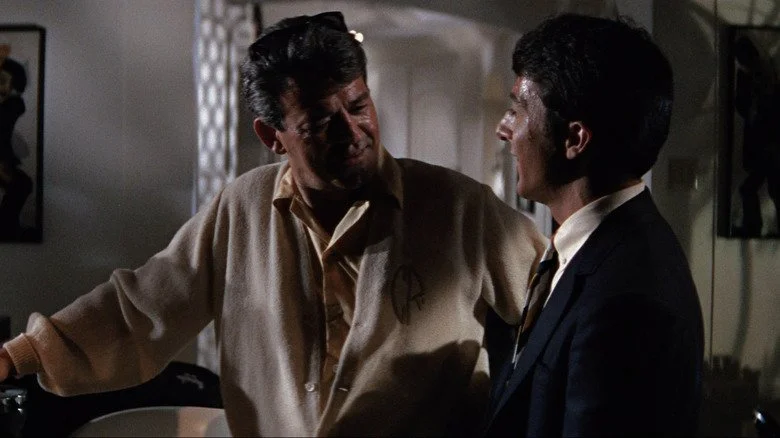
Then, of course, there’s Murray Hamilton, who even the most cursory film fan would recognize instantly as the foolhardy Mayor of Amity in JAWS. In that 70s classic, Hamilton so perfectly personified that classic of all obstacles, the city official who is so scared of making a decision that would affect his electability that he instead dooms the entire town. In a way, though, his turn in THE GRADUATE is even more rattling, even if only because his fury and ire is well-deserved.
As the cuckolded Mr. Robinson, Hamilton does an incredible job playing the type of guy who can be both your best friend and your worst enemy. He presents himself initially as the exact kind of well-wisher that Ben is overwhelmed by throughout the movie, who constantly encourages young Ben to enjoy his youth, to sow his wild oats, who deep down wishes he was Ben’s age again. So, it makes the discovery that Ben has been sleeping with his wife all the more painful. Mr. Robinson is a man betrayed by his own younger proxy. When he finally confronts Ben, asking plainly if he’s going to tell him why he did it, if it’s “just the things I stand for that you despise?” It’s a question made all the more troubling because the answer might be yes.
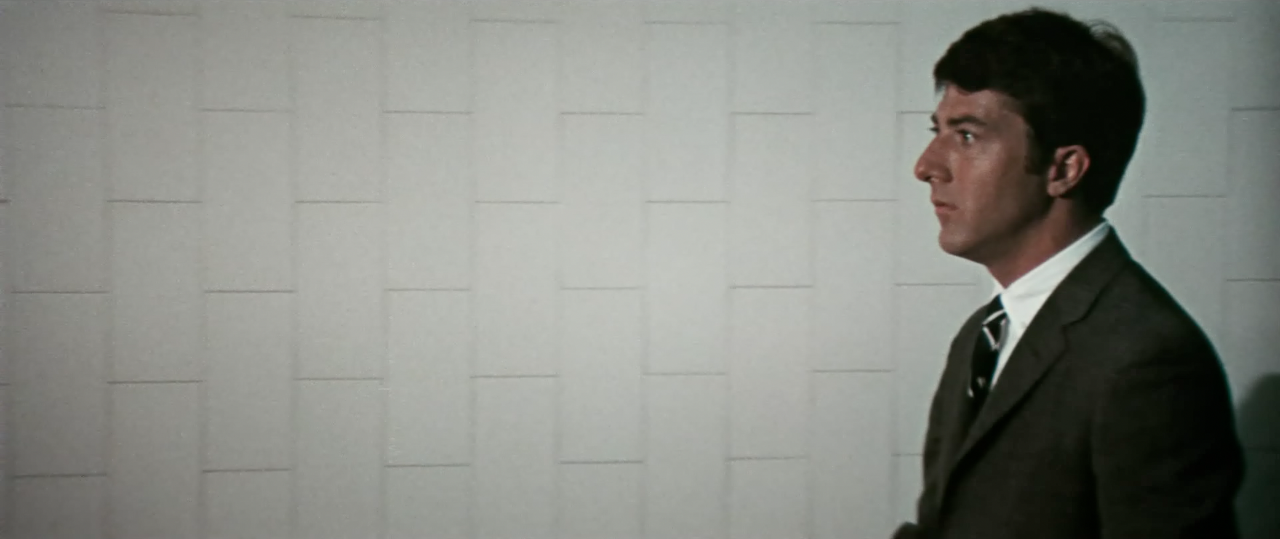
That brings us to the Graduate himself, Dustin Hoffman, in one of his very first film roles and, to this reviewer, almost certainly one of his finest. An actor that would quickly be known for putting stones in his shoes to enhance his onscreen limp for MIDNIGHT COWBOY, and for (allegedly) being chastised by Laurence Olivier for not just acting, it’s kind of astounding how simple and quiet his performance here really is. People tend to associate great acting with gesticulations, weeping, emoting, the proverbial gnashing of teeth. But it’s so much harder to simply exist in front of a camera and still have every emotion read perfectly. On the other hand, when taken too far, disaffected performances can risk audience alienation.
Maintaining that balance is why Hoffman shines so much in this, resulting in a performance that earned a well-deserved Oscar nomination (losing to Rod Steiger for IN THE HEAT OF THE NIGHT). So many of the most memorable moments of THE GRADUATE for me are the scenes where Hoffman is just…kinda standing there. Floating in (or under) a pool. Staring ahead on an airport people mover. Listening to another person speak. And at no point are you ever less than clear as to what Ben is thinking. At no point can you not, to some degree, relate to him, even as his situation gets more and more comedically tense.
We’ve all been young and aimless once. The feeling hasn’t changed much in sixty years. And, sometimes that pursuit of a direction can leave you with even less idea of what you’re doing.
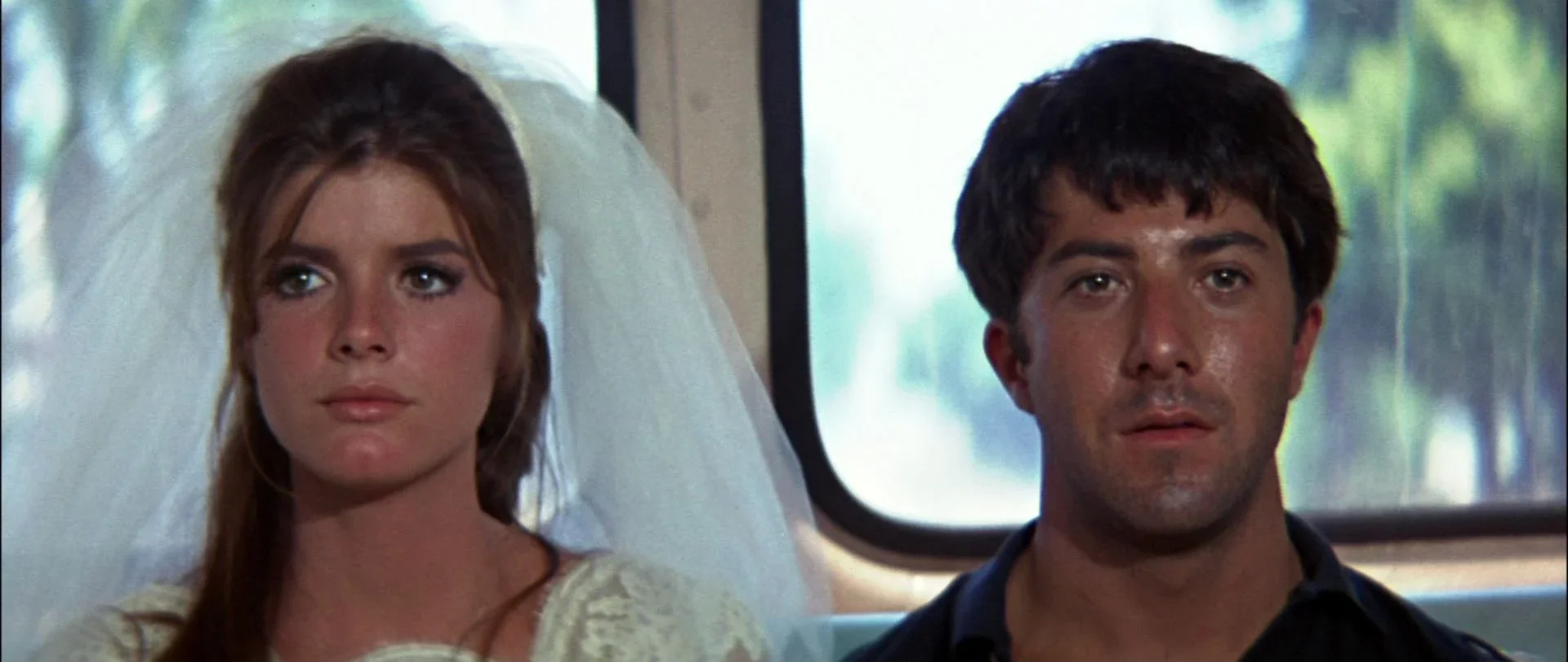
So, that gets us to that famous final shot*, that of Ben and Elaine on a bus. It’s the culmination of a rather wild final act where Ben, having fully fallen in love with Elaine, is barred from ever seeing her again after his affair with Mrs. Robinson completely blows up in his face (I guess daughters don’t love it when you sleep with their mothers). Elaine disenrolls from college to get married to another man at the behest of Mrs. Robinson, who is clearly doing this to spite Ben.
*More or less. Technically speaking, the final shot is that of the bus driving off into the distance. But, when you say “final shot of THE GRADUATE”, there’s only one moment that you’re thinking of.
This kicks off a lengthy road trip across California for Ben, who bounces between Pasadena and Berkeley trying to find Elaine and stop her wedding. Because this is a movie, he manages to find her at the last second, in a madcap sequence involving Dustin Hoffman swinging a giant cross at all of the wedding attendees. But, the point is that Ben ends up getting the girl. The wedding is officially interrupted and Elaine, swept up by the romance of it all, runs away with him. They hop on a bus, headed quite literally to who knows where. As the bus careens down the road, we zoom in on Ben and Elaine’s smiling faces. This is where most movies would have left it, the disaffected young grad having finally found real and true passion, maybe even love.
But THE GRADUATE isn’t most movies. Instead, it spends just a few extra seconds bringing reality back into the proceedings. Ben and Elaine’s smiles give way to more neutral expressions, as we literally watch the adrenaline of the wedding escapade wear off. It turns out that Ben and Elaine, through all the Hollywood film proceedings, are just as disaffected and uncertain as they were before, only this time their lives are upended. The movie, then, ends on a moment of ambiguity rather than elation.
It’s a significant moment for many reasons. For one, it’s realistic. Post-grad life often amounts to just attempts to feel something, usually in vain. If you’re lucky, those attempts will just lead to horrific bombing at local open mics, maybe regrettable tattoos. Sometimes, those attempts lead to sleeping with older women, running away with their daughters, then realizing you feel basically the same as you did before it started. It’s an uncomfortable regularity not often reflected in Hollywood filmmaking, so it’s rattling to see it done with such efficiency here.
For two, this moment is likely what solidifies THE GRADUATE as Ground Zero for what would become the New Hollywood movement. What the real first movie of the the decades-spanning genre is a topic of real debate (American movies were starting to defy the studio system at least as early as 1963), but the ending of THE GRADUATE feels like this tangible, mass-consumed moment where the rules and expectations were starting to change. The ending moment represents a new beginning for where the film format could go, even if the final destination was just as unclear as Ben and Elaine’s.