Recent Articles


Four From ‘67: The Legend of COOL HAND LUKE Endures
This week, let’s explore the legend of 1967’s COOL HAND LUKE, both the movie (which contains one of the most quoted lines of all time) and the character himself, who stands as an avatar for every outsider to society, and proves the best way to endure is simply to keep standing on your feet for as long as possible.
Welcome to Week Three of “Four from ‘67”, a series where I go through…well, four American movies from the year 1967. The twist? They’re all humongous fundamental movies that I haven’t actually seen yet. Two weeks ago, the article series premiered with THE GRADUATE, and last week’s Memorial Day extravaganza prominently featured THE DIRTY DOZEN. You should go and read those, mostly out of a personal favor to me.
Now, I should repeat the fact that I have not seen these, and were chosen for this series mostly out of reputation. That said, what stands out to me about those two titles is that they’re fundamentally about outsiders to society. Benjamin Braddock feels alienated from the people around him after finishing college. All twelve of the Dirty Dozen are literal prisoners that are excised from society, finding purpose and meaning only after being assigned a potential suicide run against the Nazis. This wasn’t an intentionally themed block I was trying to build, but it developed anyway.
So, imagine my delight when this themed marathon continued with the next entry in my series, 1967’s COOL HAND LUKE. Much like THE GRADUATE, it’s a movie with a line that has permeated popular culture in ways only a handful of movie lines ever do (in this case: “what we’ve got here…is failure to communicate”). However, I had no real other frame of reference for COOL HAND LUKE, besides knowing that Paul Newman eats a bunch of eggs at one point. Had no idea why! So, I was eager to finally see the film in its full context.
It turns out that the movie is a bit of a slow burn. About an hour in, I found myself enjoying it, but having the thought of “...is this all it is?” buried in the back of my wind. By the time it ended, though? I found myself pretty moved by the whole thing. And now, as I sit down to write a couple of pages about it, I find myself fairly convinced it’s one of the best movies of the entire decade? The longer I see it with it, the bigger its esteem grows in my mind.
Such is the legend of Cool Hand Luke.
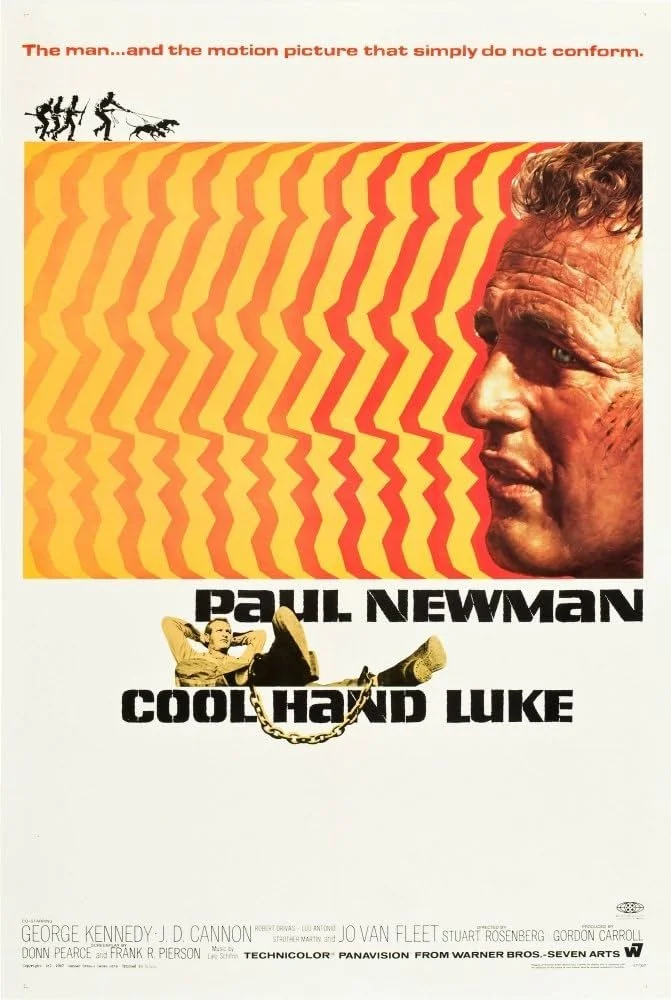
COOL HAND LUKE (1967)
Directed by: Stuart Rosenberg
Starring: Paul Newman, George Kennedy, Strother Martin, Jo Van Fleet, Joy Harmon, Morgan Woodward
Written by: Donn Pearce, Frank R. Pierson
Released: November 1, 1967
Length: 126 minutes
COOL HAND LUKE tells the story of Lucas Jackson, a WWII veteran who has found himself in the hands of the law for cutting the heads off of parking meters. For this heinous crime, he gets sentenced to two years on a chain gang, the other members of which make up a “who’s who” of 20th-century faces, including George Kennedy, Harry Dean Stanton, Dennis Hopper and Joe Don Baker. The work the chain gang does is inconsequential, manual side-of-the-road type labor, a work program that is regimented by a strict set of barely-verbal “bosses” who manage and approve every little move the inmates make. This leads to the iconic exchanges along the lines of “shakin’ it off there, boss!” “Shake it off there”, the specific cadences of which are still quoted by people sixty years later, maybe without realizing what they’re even quoting (I can’t quite prove it, but I feel cartoons from my childhood were making fun of this, too, which is a choice that is as literate as it is kind of wild. Was it maybe Animaniacs?)
All the inmates have an intensely strict schedule, with any perceived out-of-place hair making them subject to a “night in the box”. Luke, though, is a freer spirit than most you’ll see in incarceration. He’s not mean or ornery, but he is defiant. For a while, the Captain of the chain gang doesn’t seem to be able to get that easy smile off of his face, nor do the various Bosses seem to have a disciplinary answer for Luke’s frequent escapes from the facility. Worse yet, the other inmates are starting to rally around him, supporting his antics and cheering on his escapades. The Captain’s goal, then? Help fix this “failure to communicate” between himself and Luke by breaking him. By any means necessary.
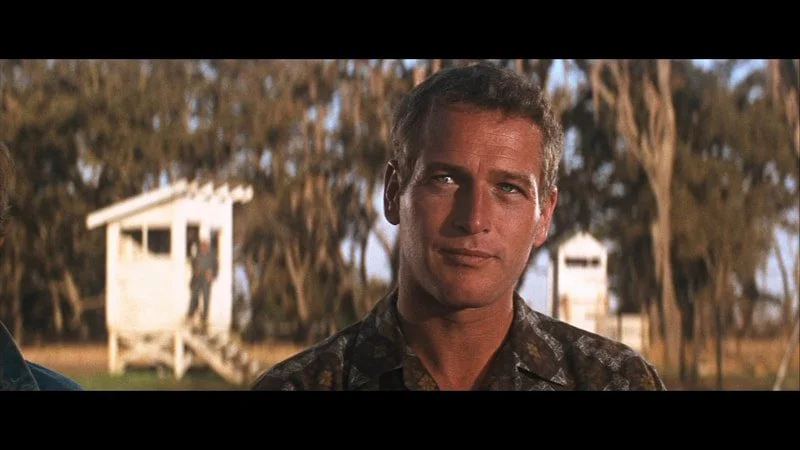
If it wasn’t immediately obvious, COOL HAND LUKE presents itself as a parable about the human spirit, and just how hard we can be to break when we want to be. Luke winds up being an avatar for an entire generation of outsiders who don’t feel like they fit into a world that seems specifically designed to consume them. It takes nearly the entire runtime of the film for us to really get Luke to speak about himself openly, but he eventually does when he prays directly to God about his place in the world.
Consider his background: here we have a man who fought for his country during one of the only fondly-remembered wars in modern American history, the “good fight” against the Nazis and the Axis Powers. Yet he returns disillusioned, and somewhat broken, all the same. He spends his days wandering around committing petty crimes. For this, he gets put into a labor camp, which seems excessive; destroying parking meters isn’t nice nor is it even good behavior, but is it worth two years of incarceration? But, because it’s municipal property, the country he sacrificed his formative years for locks him up anyway.
So, when he has his confessional moment of prayer in an abandoned farmhouse, in what amounts to Luke’s last stand against the law, he lays out his plight pretty plainly. After being made by God the way he is, someone who is ill-fit for following a litany of rules and regulations? After killing for his country and making a few moral mistakes along the way in the years after? For this, he’s abandoned? Left without any other cards in his hands? For his part, Luke admits he’s a hard case and has to find his own way out of all of this.
God’s response?
Police lights off in the distance.
Luke retorts, “I guess you’re a hard case, too.”
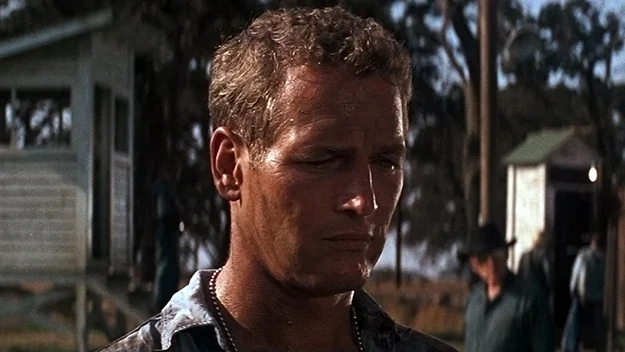
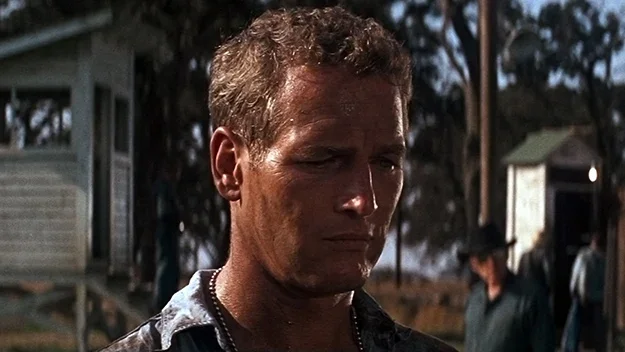
It’s a moment that could really only be sold by Paul Newman. In the pantheon of legendary 20th century American actors, no one had quite the gravity that Newman had.
An effortlessly cool and handsome presence (with the steeliest blue eyes in the business), he also always seemed to play relatable men dealing with shattered dreams or unfulfilled ambition. You see it within Brick Pollitt in CAT ON A HOT TIN ROOF and within Fast Eddie Felson in THE HUSTLER and THE COLOR OF MONEY. In both characters, we see unique men with promising talents (Brick, an elite college athlete; Eddie Felson, a charming pool hustle) taken down by immovable forces (tragic, career-ending injury in the former, and a seemingly unbeatable pool shark that can’t be hustled in the latter). In these two characters, we see the tragedy of a man dealing with the aftermath of the joy of living being stripped away.
I mention these two examples because it made Newman uniquely qualified to play Lucas Jackson, perhaps the ultimate version of this character archetype.
It’s not that Cool Hand Luke is a perfect guy or anything; he wasn’t arrested for absolutely no reason, after all. He’s a flawed man, but…then, aren’t we all sometimes? He doesn’t feel like he can fit into a world that seems made specifically to cast him out, but…then, don’t we all sometimes? They’re uncomfortable truths, but they’re truths all the same. And for COOL HAND LUKE to work, you have to be able to relate to Luke despite these flaws and despite his outsider status. He has to remind you of the ways you’re a flawed outcast. If he doesn’t, the movie could wind up being a chore.
And, well…has there ever been another actor who can help you tap into that side of yourself more than Paul Newman? The effortless cool “leading man” looks and demeanor of his is actually a help in that regard, in the sense that I think we’re more willing to see ourselves, warts and all, in people who are good-looking (itself another uncomfortable truth). But Newman’s ability to underplay Luke’s defiance, doing more with a self-assured smile on his face than many of his peers could with pages of dialogue, takes the character the rest of the way home. And his restraint from emotion makes his eventual pleading break all the more devastating, not just for the other chain-gang members, but for us at home. As he breaks, we break.
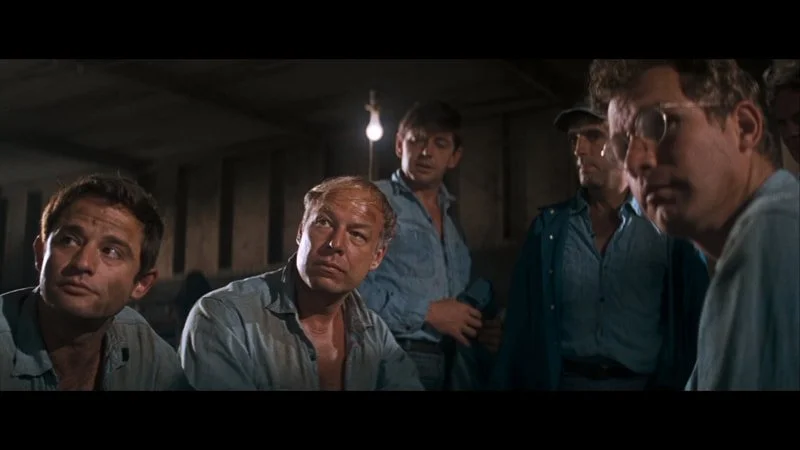
Speaking of the chain gang, it’s a group that’s made up of a bunch of different personalities, and the mix of types, both in terms of faces and in acting styles, really does go a long way toward establishing the kinds of people our society loves to lock up and never look at again. George Kennedy’s performance as Dragline earned him a Best Supporting Actor win at the Oscars in 1968, and it’s not hard to see why. He’s big, boisterous, horny and very comfortable playing the alpha of the gang…until Luke’s constant defiance of authority begins to build his “folk hero” status, and Dragline becomes his most loyal disciple. By the end, he’s the one telling the tale of Cool Hand Luke to his fellow inmates like he’s sitting around a bonfire telling the tale of a mythical figure to a bunch of camp-goers. Kennedy’s ability to play both ends of that arc is masterful; the transformation is gradual and nearly invisible, no easy feat.
But, as previously mentioned, the whole gang is made of different kinds of oddballs, the kinds that society likes to sweep under a rug, probably best exemplified by the silent and mentally disabled Babalugats (played by an impossibly young Dennis Hopper). This makes Luke’s ability to get them all to rally around a cause, his ability to make himself that avatar for the common man, really moving. This innate goodness within him makes the one solitary scene we get between Luke and his mother (played by Jo Van Fleet) all the more poignant, because it tracks: when she tells him he’s the one good thing she ever provided to this world, you believe it.
On the other side of the goodness scale: special mention has to be made of Strother Martin and his ability to make his trademark nasally drone the voice of oppression in his portrayal of the Captain. As mentioned, his famous “failure to communicate” line is one of those phrases that has become such a pop culture fixture that, for a first timer, you sit around just kind of waiting for it to be stated. It comes relatively late in the film, and it drives home the kind of vile, almost mocking cruelty that you can see in incarceration systems. But, when you start digging into the amount of thought that went into the phrase, it’s even better.
Screenwriter Frank Pierson initially worried that the “failure to communicate” line would be a little too high-falutin’ for a character like the Captain to be using in conversation. He worked hard to codify a backstory, explaining in the text of the script that employees within the Florida incarceration system had to take intensive criminology courses in order to advance. This makes a certain amount of sense, but I like the alleged* explanation given by Strother himself: the phrase is something he picked up from the type of “pointy-headed intellectuals” that had started infiltrating his territory, trying desperately to add “compassion” to incarceration.
*I say “allegedly” because I can’t actually find definitive proof that he really said this, but I like the explanation anyway.
The current state I reside in is presently attempting a bit of prison reform called “The California Model”, a model being administered to its state-run facilities based around successful, compassionate systems in countries such as Norway, and receiving mixes in both end results and public opinion. Given all of this, the idea of a venomous warden spitting back out so-called intellectual terms like “failure to communicate”, using them as bitterly sarcastic weapons against the man he’s trying to break? It hits home. It’s a character dynamic that still reads as true sixty years later.
Because we do, in fact, have a failure to communicate. We as a society are basically made up of either folks who support the authority figures whose only solution to a problem is to beat and beat and beat until compliance is achieved, a solution they love administering so much that they’ll invent problems in order to do it. Or we are the beaten, the social outcasts, the ones who served their country the best way they do how and came out of it abandoned. Those whose only real act of defiance, the one thing they can’t make illegal is to keep living. And smiling. And doing what you can to not let them break you. Even if that defiance leads you to a conversation with God, one that ends with God selling you out.
But…even if that defiance ends in a blaze of glory (as it does for Luke), and you go on to be a legend, an inspiration to others suffering from the same common injustice, a potential source of strength for them to find their own defiance? Well, then maybe it’s all worth it.
Now that Dragline is spreading the gospel of “Cool Hand Luke”, it’s worth considering that maybe Luke didn’t get broken after all. Perhaps, God didn’t push him to his finale.
Maybe Luke got pushed to his salvation.
And to ours.