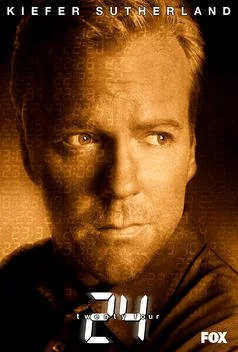
A story being told in real time wasn’t new in 2001.
Movies were telling real-time stories for decades, with one of the earliest examples probably being Alfred Hitchcock’s ROPE. Perhaps the finest Western ever made, HIGH NOON, is one giant real-time countdown to a pivotal confrontation. Other enormously influential “real-time” films include RUN LOLA RUN, 12 ANGRY MEN, MY DINNER WITH ANDRE, CLEO FROM 5 TO 7, and of course, the 1995 thriller NICK OF TIME, starring a young Johnny Depp and a young-ish Christopher Walken rocking the most ridiculous mustache you’ve ever seen.
The idea of real-time storytelling wasn’t foreign to television either. One of the earliest “proof of concept” episodes for SEINFELD was “The Chinese Restaurant”, which detailed every excruciating second our main characters sit and wait for a table to be made available for dinner. No less than M*A*S*H* and FRIENDS had also taken a stab at “22 minute story” episodes prior to Jack Bauer being unleashed unto the world.
So, no, 24 telling a story in real time was absolutely not brand-new territory. Hell, it wasn’t even the only real-time show to debut in the 2001-02 television season. In March 2002, NBC would premiere WATCHING ELLIE, Julia Louis-Dreyfuss’ first post-SEINFELD project, and one that would come and go by the summer of 2003. However, 24 is probably the real-time show that endures the most this century, to the point where every other high-profile real-time program draws an immediate comparison to it (Say it with me now: “THE PITT is like a cross between 24 and ER”). And this is likely because 24 was both an intense product of its time, and a throwback to a style of storytelling that goes back hundreds of years.
To be blunt, Jack Bauer is perhaps the fictional character that is most associated with the George W. Bush era of American history, to the point where I’m genuinely hard-pressed to even identify an alternative. In the 24 universe, the entire world is actively working against our country and imminent threats from our various enemies surround us at all times. The only thing keeping us safe is a Terminator-like federal agent who likes playing by the rules about as much as he likes pissing and shitting on the clock (which, if the show was any indication, he did not). If he has to torture a couple of people to diffuse attacks…well, that’s a moral trade-off we can’t afford not to make.
Now, I think that is a very broad (and vaguely inaccurate) way to paint the premise of 24, but that was everyone’s feeling about it, and was ultimately why an increasing amount of people began to tune in every week*. Mostly it showed up right at a time when the average American felt like maybe the show had a point. In the fall of 2001, a not-insignificant amount of us thought, heck, maybe we would get attacked by a nuclear bomb or a deadly virus one day. Maybe our enemies are here right now, waiting for the right time to attack. Wouldn’t you want to see how our lone savior would protect us?
*Or, as was becoming more and more popular in the 2000s, buy the DVDs and immediately binge the whole thing over the weekend. Another little fortunate piece of timing for a heavily-serialized show.
The way he did it, of course, was one cliffhanger at a time, just the way our grandparents used to do it. The show’s structure harkens back to a time back when movies used to be a whole thing. You’d get a double feature, preceded by a cartoon, perhaps a newsreel and…a serial! It’d be the exploits of Dick Tracy, Flash Gordon, Superman, Batman or some such fella, told in twenty-minute increments. To make sure you showed up next week, it would always end with our titular hero in some kind of predicament, one almost certain to get resolved in some unsatisfying matter. But, oh well, you’re just happy to see what happens next.
24 is basically the same as that. Yes, yes, cliffhangers are a TV staple, especially when the summer rolls around and you have to make sure people come back the following fall. But, outside of maybe a small handful of special exceptions, no episode of 24 ends in any other way but a cliffhanger. Things explode. Cars flip. Plans go wrong. It’s a constant stream of “oh fuck, what’s going to happen next?”, a chain of “tune in next week!”s 23 episodes long. And, frankly, it’s a formula that works. Even when you know nothing bad is going to happen to our heroes at the Counter-Terrorist Unit, you tune in anyway. You know, just in case.
Because 24 was also never afraid to start killing people at a moment’s notice, which was also part of the appeal. Even during its occasional boring stretches, the stakes always felt kind of high, just because your favorite character could unceremoniously be executed by the end of the hour, no matter what. It compelled you to tune in to every episode, just in case you missed something crazy. And believe me, things got crazy often.
So, the legacy of 24 is an interesting one. It’s a show using techniques from a hundred years ago to tell stories of its moment. A show that wasn’t afraid to kill off its cast in gruesome fashion, to the degree that its gore eventually became the most notable thing about it. A show whose politics became intertwined with the most villainous warhawks of the 00’s, even if its actual beliefs were more balanced than you might recall.
But, we’ll get there. For now, let’s start from the very beginning. To begin celebrating 25 years of 24, Let’s talk about the 24 most notable things of Day One!
1. The Pilot
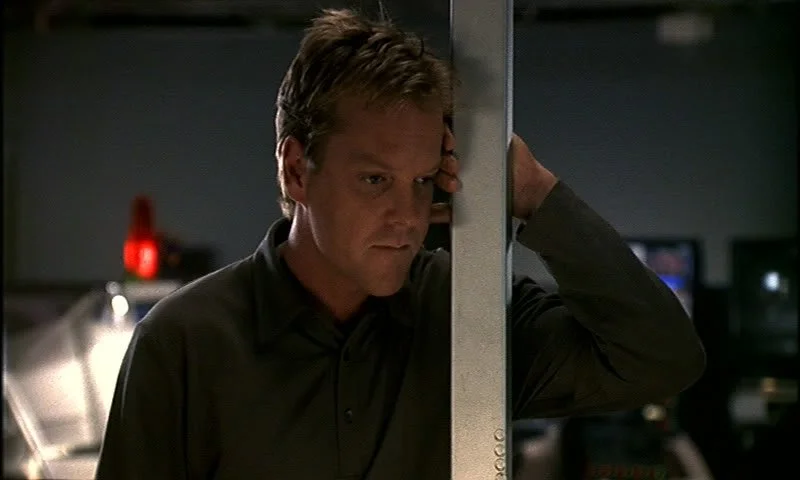
For as action-and-adrenaline-soaked as 24 would be known to be over his decade-long run, it’s astounding to watch the very first episode and notice…just how quiet it is. After an extremely 2001-ish “computer hacking” scene set in Kuala Lumpur, the first big scene with Jack Bauer is…a quiet (if tense) family night. On the day of the California presidential primary, Presidential candidate David Palmer is doing some soft last-minute preparations for the morning ahead. Everyone seems ready to go to bed. When Jack is called into work, everyone at CTU speaks in hushed, somber tones, befitting their graveyard shifts. When Kim and her friend Janet sneak out of the house, they meet a pair of boys at an empty furniture store. There just doesn’t seem to be a lot of people around.
The unusual quietness of the pilot, at least relative to the rest of 24, comes from the choice to start the day off at midnight. Per tradition for this show, night episodes tend to play differently than day episodes; as in-universe NPCs drive home to their families and go to bed, the world of 24 gets pretty desolate, which can sometimes make it scarier and lonelier. Starting us off with night is a pretty bold choice, making the initial threat (someone is going to try to assassinate a presidential candidate) that much spookier.
Another reason for the lack of adrenaline, of course, comes from the fact that pilots are often just proofs of concepts, a way to establish both character and plot in a way that makes a boardroom of executives (and, hopefully, a nationwide audience) want to see Episode 2. It’s not like 24 knew it was going to become the torture show. All it knew was that it was going to be a real-time action show.
To that end, it’s funny just how much the pilot keeps its eye on the clock. Yes, the ever-famous ticking clock that leads us into and out of the commercial break is there, as is the clock that frequently appears at the bottom of the screen. But time seems to surround our characters in other ways too. Kim and Janet drive by a clock that tells us it’s 12:07. As Jack gets off the phone with an old boyfriend of Kim’s, Sugarcult warbles the lyrics to “Bouncing Off the Walls”(“Twenty-four hours on an empty brain…”). Make no mistake, the 24 pilot wants you to know this damn show is happening in real time. Compare this to future seasons, where people are able to zip around Los Angeles and New York in about ten minutes, no matter the distance or time of day.
It’s not that nothing happens. Jack tranquilizes his direct superior, and a fucking plane explodes out of the sky before an hour of 24 has passed. But, there’s no running around cutting people’s shoulder blades out and yelling, “Damn it!” At least not yet. For now, before Jack becomes the Tortured Terminator, we briefly get to see…
2. Jack the Family Man
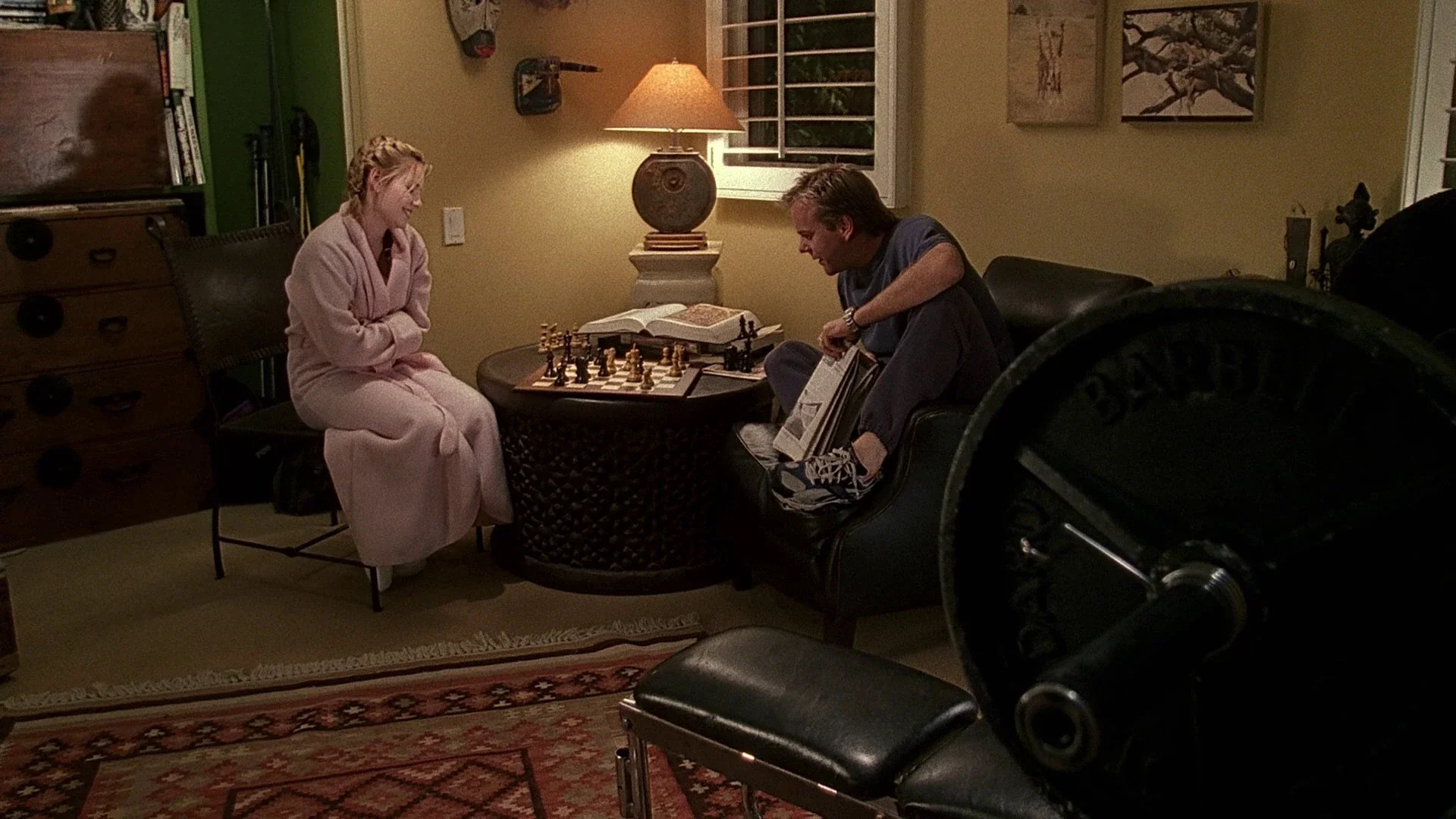
It’s something that’s easy to forget once the show gets going and Jack Bauer becomes more and more of a lone wolf, terrified to get close to anybody lest they be hit with his curse, but Jack is initially characterized as a family man. As we open on Day One, the Bauer family is all together, although hanging by a string. Jack and his wife Terri are back together after a period of separation, and the strain of the rift is hanging on Kim. Although she’s happy her dad is back, there’s clearly no love lost between her and Terri, for reasons that will be explored later.
It’s a tried-and-true storytelling device, giving our main character a fractured family that he desperately wants to hold together. But it works so well for Jack, who seems like such a normal guy at the outset of the series, a man whose tortured action hero path is still to be forged. And I think his family being on uneven ground before everybody starts getting threatened is actually more interesting than if he was living a perfect suburban life. The stakes are now obvious: if Kim or Terri die, then he’ll never get a chance to patch everything back up. If he fails to reunite them, he’ll never be able to redeem himself for failing to keep them together in the first place. And, of course, the ultimate failure at the end of the season will turn Jack into the man we know for the rest of the series. But…we’ll get there.
First, let’s meet the rest of the cast….
3. Tony Almeida
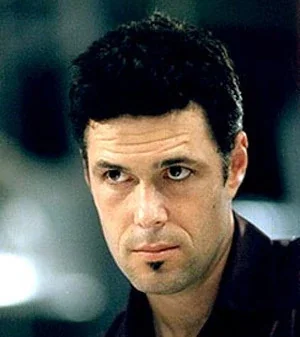
When we first meet Tony Almeida, a character that would become a fundamental piece of the overall 24 puzzle, he’s a little nondescript. The most notable thing about him is his awkward little soul patch, with the runner-up being his vaguely detectable Hispanic accent that gets quickly dropped after a couple of episodes. For the most part, he serves as an uncomfortable skeptic of Jack Bauer and his tactics, complicated by the fact that he’s currently seeing Nina Myers, Jack’s current partner and former lover. His season-long arc that ends with him becoming a Jack ally is a satisfying Day One highlight, and sets the stage for the fan-favorite character he would become.
That said, much of the core tenants of 24’s secondary male lead are there from the outset. Tony’s famous Chicago Cubs mug appears as early as Hour 2, as well as his penchant for responding to questions with a hushed, frustrated “yeah”. Crucially, so is his habit of doing the right thing once presented with the evidence to support doing so (which differentiates him from Jack, in the sense that Jack just sort of feels out the right thing to do, and finds evidence later). Tony’s facial hair would come and go over the years, but his defining characteristics were set right from the beginning. The only thing missing from his life is Michelle Dessler. But, we’ll get to her on another day.
4. George Mason
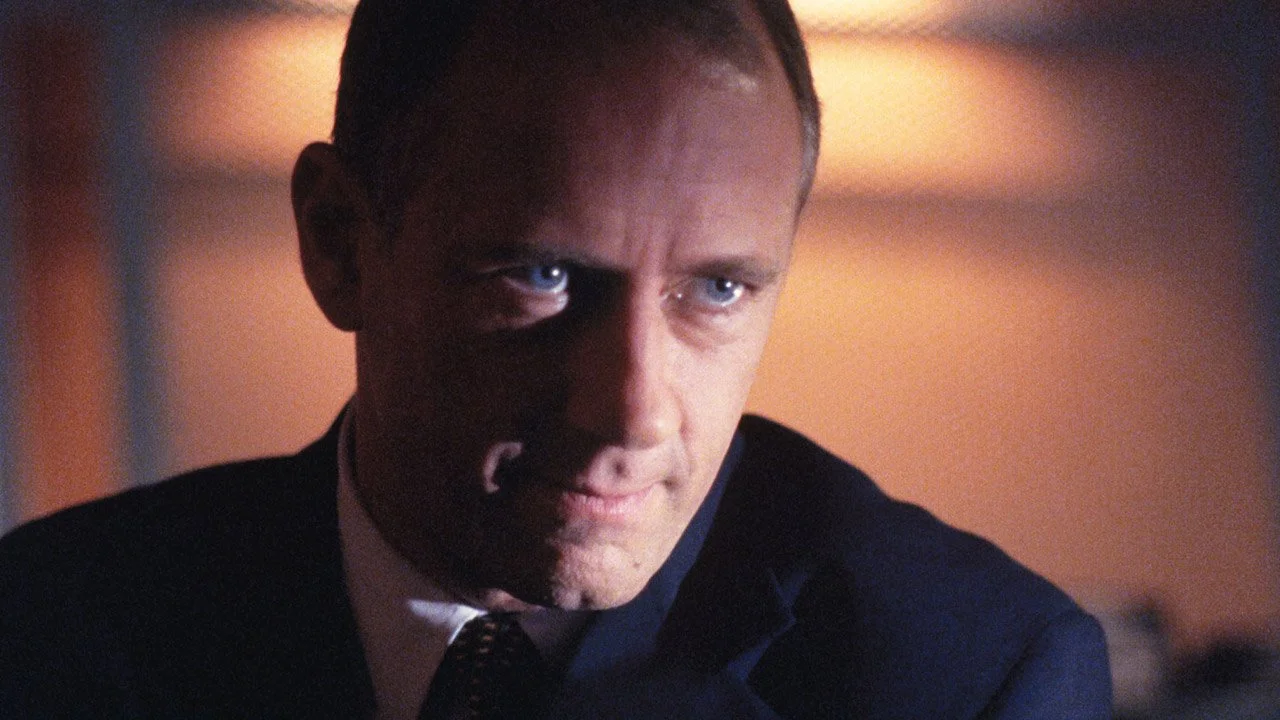
Never underestimate the power of a luxury casting.
The simple move of casting elite character actor Xander Berkeley in the role of CTU District Director George Mason elevates what could have been a vaguely generic shifty government executive type into one of my favorite dudes in the whole damn show.
In the hands of Berkeley, George Mason is a downright rascal right from the jump. A major turning point in the pilot is Jack’s decision to tranq and blackmail Mason, his direct superior, after suspecting he’s withholding information from him regarding the plot to assassinate Palmer. To Jack’s credit, Mason is shady as hell in the lead up to this, making implications that a Palmer administration would likely gut CTU, and refusing to give Jack a source regarding a data-filled disk. Berkeley takes this all one step further, making these little cocky smiles and eye rolls the whole time, which is maybe overplaying the script’s hand a bit, but is also objectively hilarious.
That said, Mason steps up when needed. He’s unafraid to hold Jack accountable himself throughout Day One, such as when the aforementioned Alexis Drazen sting goes sideways, and is surprisingly stone-cold during a tense Drazen negotiation near the end of the season. Sure, he’s no saint (it’s heavily implied in the pilot that he stole a bunch of money after a recent drug bust), but he’s an intuitive leader, willing to make hard decisions even when they’re unpopular. Of course, this quality will wear on him in future days. But, for now, let’s just enjoy one of the most engaging actors to ever walk through the CTU halls.
5. Milo
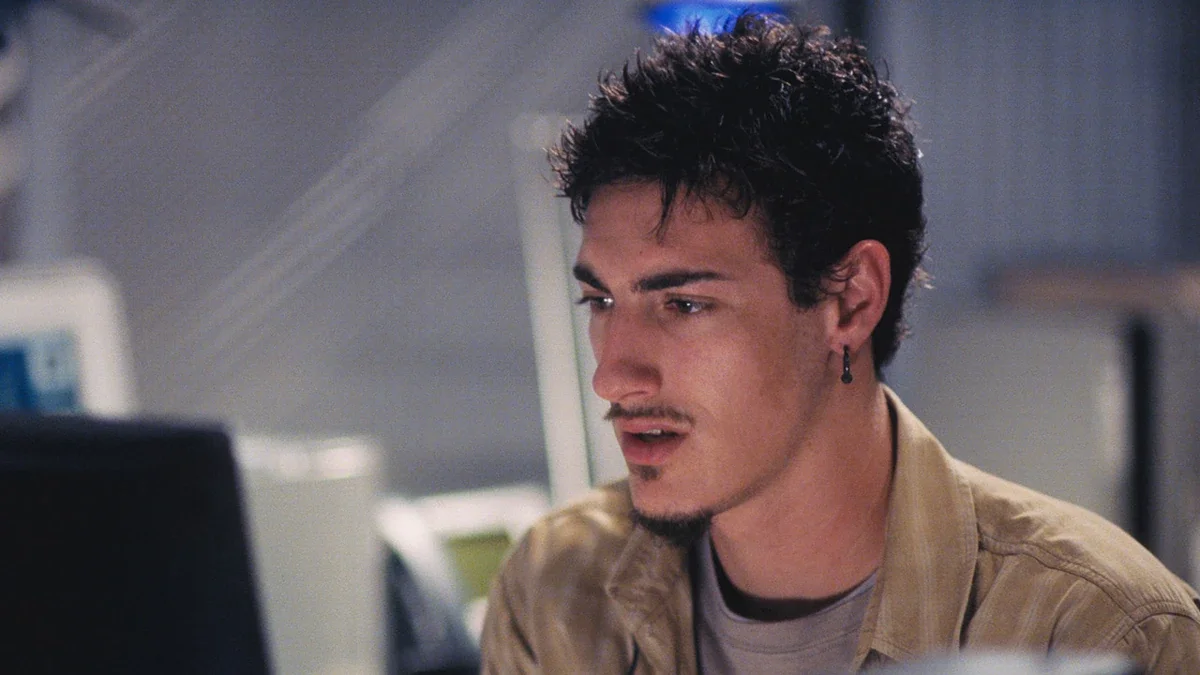
Early on in Day One, we’re introduced to Milo Pressman, an analyst called in by Nina to help decrypt a keycard that contains information related to the plot against David Palmer. To his immense credit, he proves to be competent, smelling a rat immediately when the keycard all of a sudden jumps from somewhere around 20% decrypted to 99% decrypted (it’s later revealed that a compromised Jack Bauer switched the cards out at an opportune moment). He’s also pretty smug, constantly asserting his superior knowledge to other analysts like Jamey. His final piece of characterization is a Fox Mulder-esque penchant for snacking.
The reason I give Milo his own special section is not for his immense importance to the plot; he actually spends a lot of the season actively sitting around waiting for something to do (I’m pretty sure he has multiple scenes where he literally says stuff like, “why am I here?”). No, I bring him up for two reasons:
As portrayed by Eric Balfour, Milo may be the most 2001 person to ever live. Seriously, go Google “Milo 24 Season 1” and tell me what you think
For whatever reason, the show brought this character back years later, in Day 6, this time as a member of management. Good for Milo! Just goes to prove that literally anybody could get brought back into the 24 fold.
6. Jamey
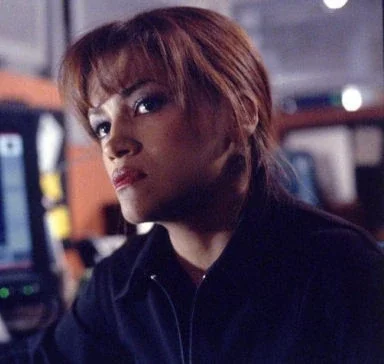
Any spy action thriller worth its salt will eventually reveal that an established good guy is not who they appear to be. The idea of a mole within the CTU halls is seeded right from the start; as just mentioned, we’re meant to believe that George Mason is working for the bad guys.
But, after a few hours pass, it’s revealed that none other than analyst Jamey Farrell has been siphoning classified information over to Ira Gaines, our main villain of the season’s first half. The reveal is in dramatic fashion, too: after a fleeing-from-the-bad-guys Teri Bauer gives her location over to Jamey so that CTU can pick her up, she’s devastated to find that further goons arrive instead. As we cut back to Jamey crossing out the written address from her notepad, the treachery is clear.
Of course, Jamey isn’t fully presented as black-hearted; we learn that she turned coat in order to earn extra side money for her family. The level to which her info is used for evil seems to genuinely cause her anguish, and Tony’s decision to bring her son to CTU is fairly emotionally manipulative for a hero, even if it’s the pursuit of justice. So, when Jamey ends up killing herself by slashing her wrists, you can’t help but feel awful for her.
And, of course, Jamey’s reveal as a mole perfectly covers the even later reveal of CTU’s second, way more evil mole, the person who actually killed her and made it look like a suicide…
7. Nina Myers

Oh, spoilers, I guess.
We’ll get into Nina’s true character later on, but for most of the season, she’s presented as Jack Bauer’s partner, both currently in the field and formerly in the bedroom. She is second-in-command at CTU, and seemingly one of the only people that seems to believe in Jack as he barrels around Los Angeles looking for both his family and the people trying to kill a presidential candidate. This trust seems to have derived from an extended relationship between the two when Jack and Teri were officially separated. Given that she also stands by his side when on missions, it’s safe to say that Nine knows Jack in a way that nobody else in the world does, not even his wife and daughter.
In the present, Jack and Teri are back together and Nina is now seeing Tony, thus kicking off a long-running trope of everyone in CTU sleeping with each other (you can only populate a building full of Hollywood-level-attractive-looking people before nature just kicks in). This causes a lot of tension between the three as Jack and Tony take the day to learn how to trust each other. And, yes, as Teri and Kim get folded into the main narrative, Nina’s presence in the investigation causes a lot of drama. However, as played by Sarah Clarke, she’s just a character that you hold beyond reproach, because she just vibes with Jack so much.
This becomes crucial as the day concludes.
8. David Palmer
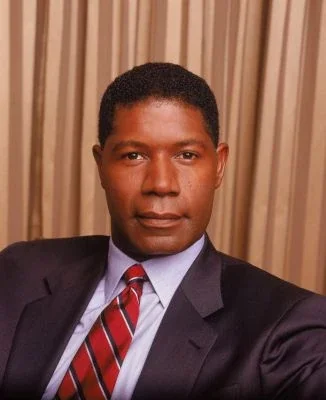
(Yes, I chose this picture because it looks like an awkward Facebook profile photo.)
I’ve started wondering if somewhere down the line, several decades from now when world events start conflating on the timeline, if prospective new viewers to 24 will assume the Palmers are intentional riffs on the Obamas.
To be clear, besides the obvious, David and Sherry are not perfectly analogous to Barack and Michelle; Sherry is way more cravenly ambitious and power-hungry than the real former First Lady has ever publicly expressed herself to be, and Barack has not ever had his hands full mitigating the rape of his daughter, the accidental murder of her rapist at the hands of his son, and the subsequent years-long coverup of such by his wife (at least, not to our knowledge). And, yeah, I guess there’s that thing where Season One first started airing seven years before Obama was actually elected.
But…it is kind of remarkable how adeptly the show predicts the type of guy it would take to become the first Black POTUS. David is a man of principle, married to his photogenic and media-savvy sweetheart with two kids. He appears to be a candidate of destiny; although the season is set on the day of the California Presidential Primary, months away from the general election, it is essentially assumed knowledge by the finale that he is the next President of the United States. He’s soft-spoken, well-read, reassuring in his speech, and honest with the media. As portrayed by Dennis Haysbert, David Palmer is such an inarguable “perfect candidate” that I think many of us watching just started pretending he really was running for President. Of course, in 2001, the idea of a Black president was a fiction, worthy only of implausible genre television.
Anyway, David Palmer is one of the things in the first season that basically works the whole way through. Even as the Palmer family’s toils and troubles veer the most into daytime soap opera (Murder! Cover-ups! Infidelity!), Haysbert keeps it all grounded by portraying a man who is almost too good for all the drama…and pushes through it by sticking to what he believes is right. It’s good stuff.
Speaking of the Palmers…
9. The Palmer family
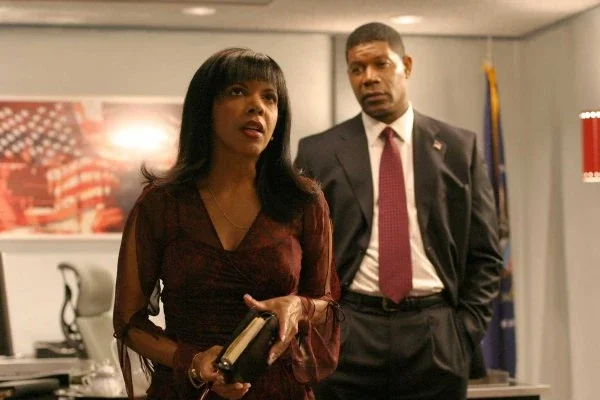
There are many long-standing, popular characters that would go on to make 24 what it is that simply didn’t exist yet in Day One; no Michelle Dessler, Chloe O’Brian or Charles Logan for us to enjoy. On the other hand, Day One does have a set of characters that we largely never see again in subsequent seasons. Ladies and gentlemen, David Palmer’s family!
Yes, I know, I know. We get plenty of David’s brother Wayne in Days to come. But he didn’t exist in Day One, either. And, of course, 24’s resident Lady Macbeth, Sherry Palmer, will haunt the show for years to come. I guess I’m specifically talking about David and Sherry’s kids, Keith and Nicole. We never see either of them again after the conclusion of this season, save one brief scene of David and Keith fishing in a lake at the very beginning of Day Two.
Which makes it all the more incredible just how central to Day One Keith and Nicole really are. The entire David Palmer storyline basically hinges on it; one of the big revelations of the season is the discovery that Keith accidentally killed the man who raped Nicole seven years prior. This story is about to leak to the press after Keith’s therapist broke confidentiality rules and reported the killing. Thus, besides having to deal with an assassination attempt against his life, David is constantly faced with a choice: does he cover the story up further in order to protect his family? Or does he disclose the event to the public, possibly eroding their trust, as well as his own success on that day’s primary?
Vicellous Shannon plays Keith convincingly, portraying accurately the emotions of a kid whose dad is impossibly ambitious, popular…and not available. Megalynn Echikunwoke does an equally good job with a role that, frankly, has less to do. Nicole isn’t a junk character or anything; she represents the human cost at the center of the Palmer family debate (to cover up or not cover up?) with the real question of “is any of this worth making her rehash the worst day of her life?” hanging over every decision. But, when you watch the season in totality, in conjunction with Kim Bauer being repeatedly kidnapped and threatened with violence, Terri being kidnapped and raped, and now Nicole Palmer, whose whole storyline revolves around a rape and murder…not that those things don’t happen in real life (they do), but when it feels like every female character on the show is there to reflect back trauma, you start wondering how many women were in the writer’s room; (the answer: one, Andrea Newman).
If you haven’t picked up on it yet, 24 has much more soap opera in its DNA than its torture-porn reputation would suggest. The Palmer storyline in Day One is a great narrative example of that, and no character has more “soap opera (complimentary)” vibes than David’s wife, Sherry. She’s ambitious, she’s loyal (although to whom is a real question), she’s smart, she’s conniving…she’s got it all! Her slow “frog in boiling pot” evolution from cutthroat partner for David to active antagonist is one of the best threads of 24 Day One. Some could probably criticize her being the first woman in the 24-verse that falls into a well-worn trope for the show (here, one who backstabs and manipulates for her own gain), but when she’s portrayed as brilliantly as Penny Johnson Jerald does…honestly, who cares? Thankfully, though the Palmer marriage is no more at the end of the day, the show had enough sense to bring Sherry back for more.
But not those kids. Fuck them kids, I guess.
Anyway….I’m not kidding that the season features….
10. Not that much torture!
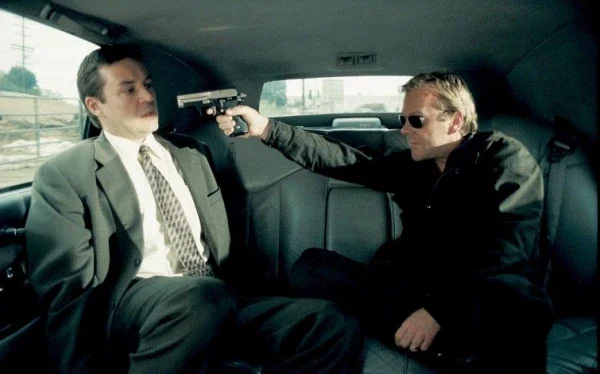
If you were to find somebody who had heard of the show 24, but had never seen it, then asked them what they knew about it, they’d almost certainly say, “oh, it’s that show where Jack Bauer tortures terrorists”. And look, if you observed the show from up above, this wouldn’t be the most inaccurate high level summary. 24’s constant heightening of the next gory, torturous thing for Jack to submit someone to in order to gain some vital information is its ultimate legacy, for better or for worse.
So it’s surprising to go back to the first season and realize…there really isn’t that much torture baked into the proceedings. Really, most of its big “gory” or “torture” moments are either only threats (like the famous scene where Jack explains how he’s going to shove a towel down a guy’s throat and let it eat his stomach lining) or happening to people who are already dead (like when Jack cuts off a dead bad guy’s thumb in episode two). Keeping in line with the season’s revision to being about a personal vendetta against Bauer and Senator Palmer, Jack is mostly a complicated man trying to hang on for dear life (more on that later). The question “when does Jack Bauer officially become a depressed, perp-torturing Terminator?” is not something I’d really thought to track, but believe me, I’m keeping an eye on it.
Speaking of perps, let’s talk about some of our initial villains…
11. Ira Gaines
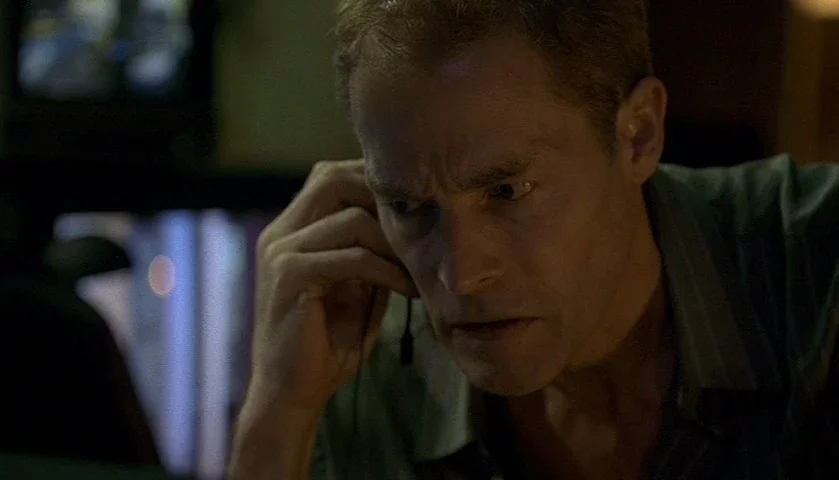
As portrayed by the late Michael Massee, Ira Gaines perfectly fits into that “first boss in a videogame” archetype. At first blush, he seems imposing, perhaps even invincible: Jack is first introduced to him via voice in an earpiece, and Gaines quickly establishes dominance over our beleaguered hero. His wife and daughter in the clutches of the bad guys, Jack’s choice is clear: follow Gaines’ remote instructions (a process that will lead to the attempted assassination of Senator Palmer), or lose everything. And, early on, you have to hand it to the dastardly Gaines: he seems to have his shit figured out. This plan to frame Jack for the murder of Palmer depends on not losing track of him, and Gaines turns out to have eyes everywhere. He has hacked access to just about every hospital security cam, traffic cam, and news feed. When in doubt, he has burly thugs follow Jack around with a camcorder. This guy has thought of everything!
Everything, that is, except a contingency plan, just in case. Jack manages to obfuscate the assassination attempt, and Gaines immediately pulls the plug on the operation, but doesn’t follow through on his threat to kill Jack’s family. Instead, with his employers (the Drazen family) breathing down his neck, he holds onto them. His new plan: find the now-in-custody Jack, and then just force him to kill Palmer under threat of family annihilation again. Not coming off great here, Ira! As Andre Drazen puts it, “If Plan A doesn’t work, you should have a Plan B, not Plan A recycled”.
Gaines eventually dies scared and outmatched, shot through the chest in the middle of an abandoned piece of L.A. brush, a far cry from the terrifying figure at the beginning of the season. That said, I’ve always liked his final moment, a simple “good luck” to Jack before being put out of his misery. There will be more imposing villainous figures to come in future Days, but Ira Gaines was our first. Thus, I’ll always have a weird soft spot for him, even if he turned out to not be the greatest on-his-feet thinker to ever live.
12. Mandy
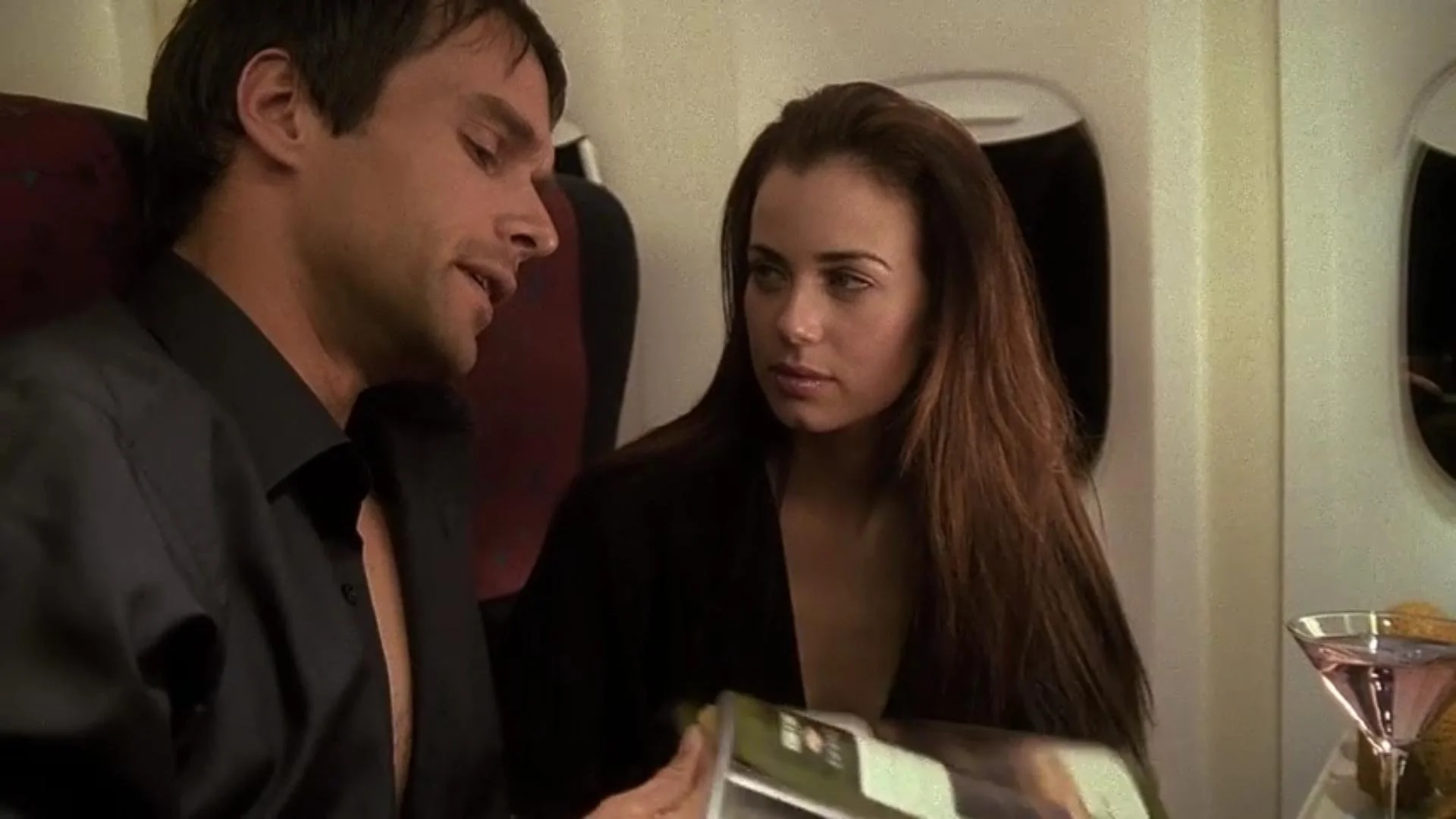
The first couple of episodes in Day One spend a lot of time on a mousy, sapphic assassin named Mandy (Mia Kershner). She’s the one who blows up the plane in the pilot, steals the ID of the man who is supposed to be taking photos of Palmer at a breakfast, and spends two hours trying to mitigate her fellow assassin/lover Bridgit holding the ID hostage. Bridgit’s goal: to get an extra million from Gaines, split the money with Mandy and run away together. Gaines, of course, is not a man to be trifled with: as soon as the ID is turned over to him, and the money transferred to Mandy, Bridgit takes a sniper bullet to her brain. She remains in the employ of Gaines, who asks her to stay available for another job next summer. She has no choice but to acquiesce.
For first-time viewers wondering where this may all be setting up, the answer is: nothing in particular, outside of establishing Ira Gaines as a cold motherfucker. It also establishes Mandy as a familiar face in the 24-verse, popping up again as a recurring villain in Days Two and Four. Beyond that, however, it’s a stretch of the show that could charitably be referred to as “time killing”.
That said, I’ve always liked her scenes. It’s the most the show has ever resembled a scuzzy, direct-to-video adult thriller. Every moment is shrouded in total darkness. There are multiple cold and brutal deaths. There are juicy, saliva-soaked lesbian kisses. Mandy’s scenes feel like from a version of 24 that’s completely unrecognizable, and it’s a shame. You wonder what 24 could have looked like had it been a 90’s Showtime series. Hell, it could have still starred Kiefer Sutherland.
13. Rick

One of the first characters we meet in all of 24 are Kim Bauer’s eventual abductors Dan Mounts (Matthew Carey) and Rick Allen (Daniel Bess); they show up about halfway through the pilot episode, greeting Kim and Janet at their midnight rendezvous at a closed-up furniture store. A few hours later, Dan will be buried in the ground, after learning too late not to lie to Ira Gaines. But Rick hangs around for a while, eventually appearing in 18 episodes of Day One, making him one of the most prolific one-season wonders of the entire show.
Rick’s story is in two acts. In Act One, Rick establishes himself to be a sweet, reluctant criminal, in opposition to Dan’s attitude towards kidnapping. Dan is all in, breaking Janet’s arm as a way to get Kim in line, then denying her any sort of pain relief, refusing to dig into his stash of drugs. Rick, though? Rick has a more compassionate view of the situation; he steps up and provides Janet some heroin for the pain (“compassion” in this situation is all relative). He seems to have feelings for Kim, which comes in clutch for the Bauer family as the day goes on. Consistently throughout the first half of Day One, Rick puts his ass on the line to provide Teri and Kim a cellphone, a gun, a van, and a way out. He’s a convenient narrative device, the nice kidnapper who facilitates an escape in ways that would be impossible without him. But in the hands of Daniel Bess (one of those actors that I don’t think I’ve ever seen in anything else?), he comes off as a character that’s easy to root for.
So it’s a shame, then, at how far the character falls in Act Two. Roughly two hours after their initial rescue, Kim and Teri are on the run again (more on that later). While Teri wanders around with amnesia (again, more later!), Kim catches a cab to Rick’s house. It’s here that Rick’s life is displayed in full: it turns out he’s a huge fucking loser. He lives in a big, but not nice, house adorned with several beaded curtains, with the most 2001-coded shrew of a girlfriend named Melanie who doesn’t seem concerned that Rick has been mysteriously gone all day, and now is covered in dirt and in need of a nap. When Kim shows up to request Rick’s help finding her mom, Melanie’s move is to not so much demand Rick explain where he’s been all night, but to get jealous of Kim. You wait and wait for some sort of catharsis for Rick as he muscles through Dan’s brother’s idiotic scheme to rip off a bunch of drug dealers, then wonder where Rick getting arrested by the undercover cop* might lead him.
*This all happens in the course of about three hours, by the way. Busy day for Rick.
It turns out…who knows! We never see Rick again in Day One post-arrest, nor do we ever see him ever again. We can presume he’s still alive, and one has to hope he’s moved into his own place, so he can hang out with a guy he’s lost touch with (himself). But beyond that, no future season or spin-off has given us any sort of update on Rick Allen.
14. Alan York
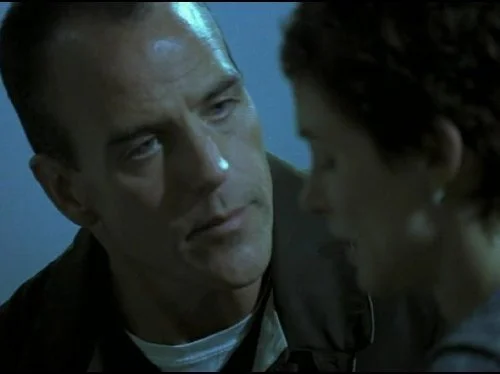
24 is a show that would become famous for its constant stream of “oh shit” moments. Perhaps its first is the heel-turn reveal of Alan York.
When we first meet Alan, he is presented as the father of Janet, Kim’s friend who snuck out alongside her. He calls Teri to coordinate with her, and they eventually start searching for the girls together. The conflict he is initially meant to represent is that of the “present husband”. Although Jack has a good goddamn reason not to be at Teri’s side this evening (he’s trying to save the life of a presidential candidate), the fact remains that Alan is there searching for their children and he is out. This is the last thing a wounded marriage needs, and the vague contempt Jack has for Alan is palpable.
Of course, Alan’s true identity begins to get alluded to when their search leads them to a local hospital. Although Kim is nowhere to be found, Janet is in surgery, having been hit by a car hours before. When she gets out, Jack wants to submit her to questioning. Alan is hesitant, asking to speak to her first.
As she enters her room, Janet is disoriented. Alan is calming, telling her everything is going to be okay.
Janet gets a good look and asks, “who are you?”
“Alan” clamps his hand around her breathing tube and pinches down.
Janet asphyxiates.
It’s a genuinely chilling, distressing moment. It’s 24’s first shot across the bow, a declaration that almost nobody is to be fully trusted, a signal to its audience to always stay on its toes, lest an Alan York* sneak past you. It’s an underrated early 24 twist, one that is eventually overshadowed by the sheer volumes of turns to come.
*The man impersonating Alan is later revealed to be named Kevin Carroll, a much less intimidating name.
Speaking of Janet York, I guess it’s time to talk about her friend, one of the more infamous Bauers in the whole TV show…
15. Kim Bauer

Kim Bauer is a difficult character to write about.
Any discussion of her inevitably leads to her status as perhaps the most shining example of a 21st-century “damsel in distress”. Her literal entire function in Day One is to be either actively in danger, or to be running from perceived danger. She spends almost a quarter of the season wrapped in duct tape. She spends a good half of the Day locked in a barn with her mom, terrified of what will happen next. This victimhood is something that will hang over the character for years, the Powers That Be never really knowing what to do with Kim besides put her through the most insane series of perilous situations (we’ll get to some famous ones in Day Two).
And it’s a shame, because I actually think Kim has her moments in Day One. I find her actively compelling in the pilot, as a teenager caught in the crossfire of her parents’ fragile marriage. The most interesting thing she ever does is in this initial hour, when she tells Rick that her dad is dead, a lie that is in direct opposition to her active hostility towards her mom. Maybe her anguish comes from both sides.
And, yes, the peril she and her mom suffer often becomes ghoulish; the two of them holding hands over their open graves, awaiting bullets in the back of their skulls that get staved off at the last second, is one of the most upsetting things I’ve ever seen in a network TV show. The later moment where one of Gaines’ goons busts in to rape Kim, only for Terri to offer herself up instead, isn’t much better. BUT, to Kim’s credit, she never really gives up trying to extricate herself from the situation. Until Gaines’ men arrive with her mom, she has every intention of busting out of the compound she’s being held at. She constantly leans on her one ally, Rick (more later!), to provide resources, such as a stolen cell phone that allows Jack to find their location.
Most importantly, she uses the time she has with her mom in that barn trying to patch things up, working through the difficulties of her parents’ attempt at reconciliation. They may be “damsels”, but they also have agency, with feelings, thoughts, and regrets. Maybe this is why Kim never quite feels like the narrative device that she ultimately is.
Of course, as the Day goes on, Kim’s decision-making atrophies further and further. But this is a constant problem for everybody as the season goes on.
Before we move into the show’s second main conflict, I want to mention briefly how Day One wraps up its first one….
16. The actual assassination attempt
An interesting thing about Day One is how quickly it resolves its initial primary threat. In Hour One, the mission is established almost immediately: somebody is going to try to kill Senator Palmer by the end of the day. This feels like a reasonable thing for a real-time TV show to lay out. We instantly have a road map for the rest of the season; someone will try to assassinate Palmer by the finale, and our hero Jack Bauer will be there to stop it just in time for the day to end.
Thus, I’ve always found it rattling that the attempt happens in Episode 8 (at the compromised hands of Bauer himself). It’s an early example of the 24 writer’s room philosophy that would make it what it was: have your initial idea for the season, write until you catch up to it, then wing it from there. By the time 24 started clicking, it was essentially written four episodes ahead of time, enough to lay down a little road and keep things feeling steady, but with enough of a crunch to inspire creativity and sudden plot twists.
This would sometimes get the show in trouble: some of 24’s worst lulls occur at times when the show has found itself in a corner it can’t get out of. But it’s also generated its many zeniths, a fine argument against the ethos of “having everything planned out”. We’ll talk about all of them in due time, but it’s worth noting that one of the show’s all-time great twists came from the “four episodes ahead” method, and we’ll be talking about it in a couple of minutes.
Even if it hadn’t, though, this early “oh, we’re here already” moment did at least create a lot of intrigue in thirteen-year-old me. Seeing the assassination attempt foiled (at least for the time being), watching Jack get dragged away by the police, pleading for his family’s release…it all left me with one burning, exciting question:
“What now?”
Well…
17. The “middle nine”
What stood out a lot on this rewatch of Season One is…well, how much of it is actually kind of bad.
For context, the first thirteen episodes were essentially written as one big arc, done so to mitigate the possibility that the show wouldn’t get picked up for the whole season. So, as the clock on Day One reaches 1:00 pm, Ira Gaines and his crew have been scattered or killed, Jack has been reunited with his family and (save for the tease of another assassin entering the country) David Palmer seems to be safe. Had the show ended here, it wouldn’t be anything more than an early-00s curio, but it would be an essentially complete experience.
Obviously, though, 24 did get picked up for the rest of the season and it becomes clear (at least to me) that the show didn’t really have a gameplan for how to get everyone into place for the finale. This becomes most obvious when you observe the arcs of Teri and Kim through Episodes 14 through 22.
Let’s start with Kim. To review: once reunited with her father, she and her mom are taken to a safehouse, where she immediately starts calling Rick, asking for his address and urging him to turn himself in. The safehouse gets hit by one of the Drazen brothers, and Teri and Kim escape in a car, only for that car to go accidentally over a cliff and explode…with Kim inside! Oh, wait, she’s fine, for some reason. She hails for a cab to take her to Rick’s house, where she finds herself in the middle of Rick’s squabbles with his girlfriend, Melanie, and Dan’s brother Frank’s pending drug deal with some undercover cops. After they all get arrested, Kim stands up for Melanie in the drunk tank, causing Melanie to clear Kim’s name with the undercover cop. As the cop drives Kim to CTU, the car gets hit by Drazen’s men. Kim is dragged into the van and gets roped and gagged, basically placing her back where she was in, like, Episode 5.
But, hey, what happened with Teri?? Well, her adventures are even more pointless. She walks away from the car explosion with a case of amnesia. After hitchhiking to the most desolate, strangely decorated cafe I’ve ever seen, she manages to get in contact with Phil, a doctor friend* who, it is revealed, wanted to be more than that during the period in which she and Jack were separated. He takes her back to her home where, despite the efforts of her doughy, uninspiring friend Dr. Phil, they get immediately attacked by another Drazen brother. Tony arrives in the nick of time, but the trauma snaps Teri out of her amnesia. From there, she gets taken to CTU, where she wanders from room to room asking for updates on Jack and Kim’s whereabouts, (often receiving them, sometimes truthfully), then crying or freaking out when things take a turn. That’s about it!
*Yes, Dr. Phil, although disappointingly he’s not called that in any of his four episodes.
To be sure, there are exciting moments throughout the “middle nine” in other storylines. But the constant circling and marking of time for two presumably lead characters is a fairly damning admission that the show just didn’t quite know how to fill 24 episodes of television just yet. I’m not getting on them; it’s fucking hard! But this would be a lesson they’d have to learn fast considering it’s, like, the premise of the show.
18. Teddy Hanlin
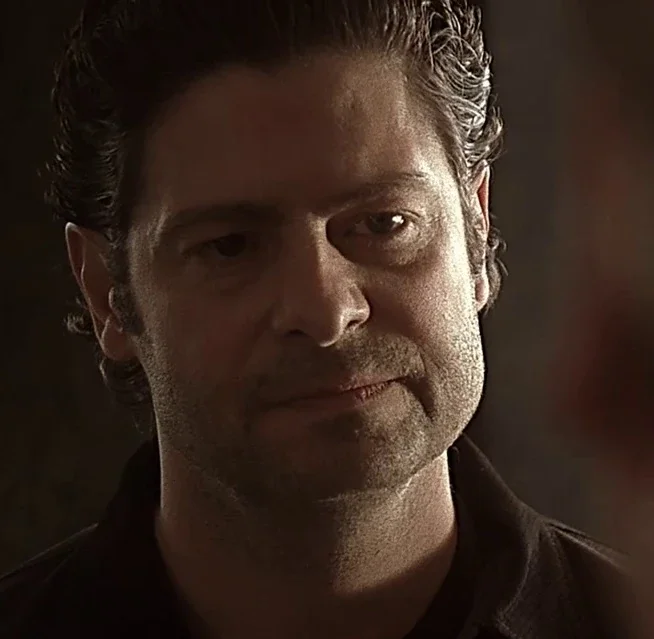
Perhaps the quintessential moment of the “middle nine”’s propenstiy for grasping at conflict straws is the most hilariously, frustratingly bad one-off character in the decade-plus history of the show: Teddy Hanlin, a CTU agent who has a personal grudge against Jack Bauer. His grievance? Jack put his former partner away for an embezzling scheme that he sure sounds like he was guilty of. This is enough for Teddy to constantly harass Jack during a crucial mission, of which he is serving as Jack’s fucking backup. The excuse is made that Teddy is the only one available on such short notice, but considering he spends the whole mission threatening to fucking shoot Jack in the head, before capping it off by ignoring Jack’s direct orders and screwing up the mission, putting a presidential candidate’s life in danger in the process….why did CTU ever think putting Teddy on this team was a good idea? What was anybody thinking?
Also, Kirk Baltz’s performance as Teddy is really weird here, not helped by the video-game NPC-style dialogue, with lines such as “I always get a little bit nervous about target confusion and I’d hate to see one of the good guys go down by mistake”, and “Why don’t we go to a Starbucks, get ourselves a couple of cappuccinos and we can have a little chin wag?” Chin wag? Baltz is an accomplished actor (he’s the cop who gets his ear cut off in RESERVOIR DOGS, and teaches acting in New York), so I’ll give some benefit of the doubt that this was just a difficult shoot, having to bring to life an unplayable character. But Teddy Hanlin goes down as the strangest bit of forced conflict on 24.
Seriously….chin wag?
19. Andre Drazen
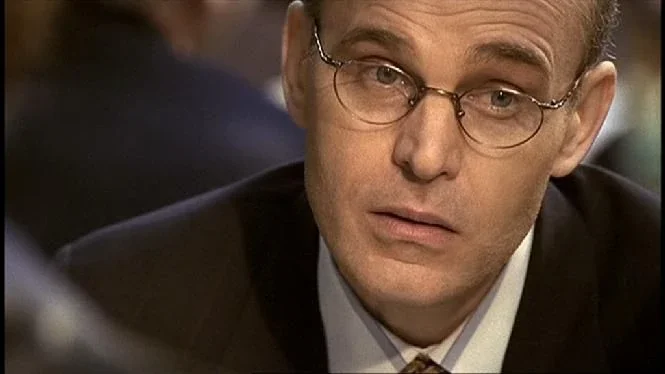
Our second half villains are the members of the dastardly Drazen family. Among them, there are two brothers. The oldest, Andre Drazen, is the more business-oriented one. As played by Zeljko Ivanek, Andre is the one that handles the day-to-day type stuff with the Drazen crime syndicate. We first meet him breathing down Ira Gaines’ neck as it becomes clear the latter’s team isn’t going to be able to assassinate David Palmer as previously agreed. Throughout the season, Andre is the one most often working the phone calls making deals with Jack, CTU, or other stakeholders.
Ivanek is a guy I know from a million other things, most notably as Juliet’s ill-fated husband on LOST and a very unfortunate early episode of THE X-FILES. But this was my introduction to him, and what an introduction it is. He always managed to make Andre feel scary even while he was being completely calm and sitting in a cafe somewhere. I love Gaines, but Andre’s introduction made for a perfect escalation in Day One villainy. His chilling nature puts him in perfect contrast to…
20. Alexis Drazen

Of the two Drazen brothers, Alexis is the clear ladies’ man, with his flowing locks and soft face. He’s also a little dense. His whole function in the greater Day One Drazen operation is to be continually undercover as a mysterious dalliance for one of David Palmer’s staff members, Elizabeth. His cover is maintained almost entirely by being handsome, but he really isn’t subtle in his intelligence-collecting. As an example, he ascertains where the Palmer crew is being relocated to basically by just asking Elizabeth, “where is David Palmer going to be?”
This never raises any red flags with Elizabeth because, again, Alexis is really, really pretty (he’s played by Misha Collins, who would go on to be a cult TV star on all 38 seasons of Supernatural). Thankfully, his lack of brains will come in handy once Elizabeth learns the truth about Alexis. As she gets recruited by Jack and CTU to go undercover herself, she proves to be the worst undercover agent in the world. Her demeanor with Alexis becomes immediately cold, even hostile. Alexis’ response is more or less, “Ah, well. Chicks!”. As the whole operation falls apart after Liz stabs him in the gut, you can’t help but feel like the Drazen syndicate has just added by subtracting.
21. Victor Drazen
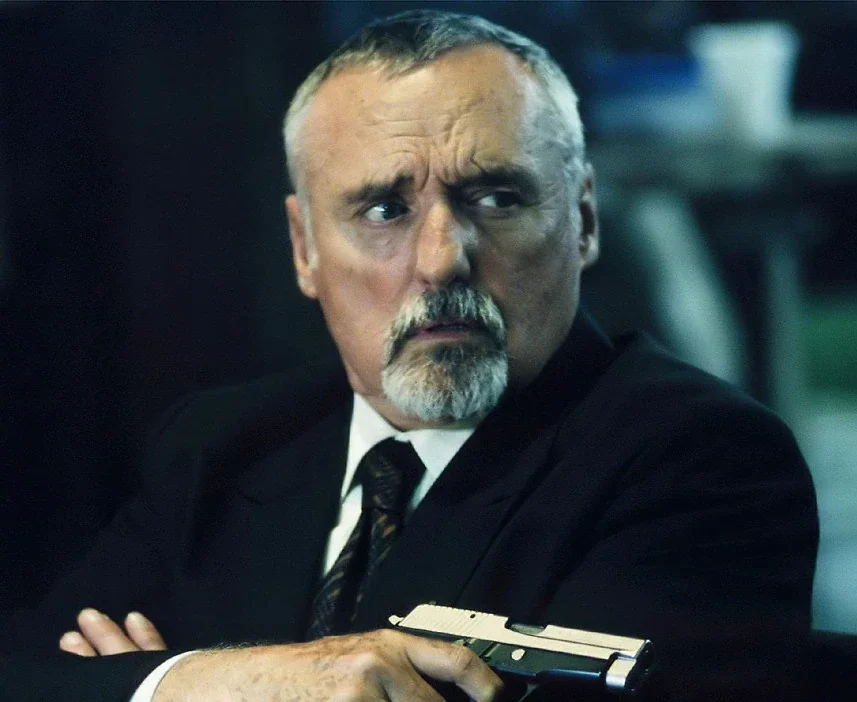
One of the most glorious things about Day One of 24 is its reveal of the ultimate baddie. For about half of the season’s run, we’re led to believe the villain of Day One is Ira Gaines. For about another five episodes or so, the scope of the plot against Jack and Palmer’s life expands to include the Drazen brothers. For Day One’s final four hours, however, we learn that the previously-assumed dead Drazen patriarch, Victor, is actually alive!
And…he’s played by Dennis Hopper!
And…it’s horrible!
Don’t get me wrong; it’s a delightful “horrible”, the kind of giddy “horrible” that occurs only when a somewhat-fledgling action show manages to snag an infamously temperamental guest star and does not dare to give him even one note of direction. As a result, Hopper is playing Drazen with this insane, impossible-to-define European accent that turns “Mr. Bauer” into “Meester Bow-rrrr”. It’s the performance you only receive from a professional lunatic, reinforcing Day One’s direct-to-video actioner feel.
And, look, it’s all fun and games; I adore the runup to Day One’s finale because I’m so entertained by Hopper’s one-take-only style of acting. But the goofiness does undercut the supposed scariness of Victor Drazen. We’re told for hours that Victor is an international war criminal and human rights violator, on par with Mussolini or Saddam Hussein. Andre and Alexis are also kind of goofy, but they’re played with such slickness and smoothness that they’re still a little spooky. And then, we reach the endgame of the Drazen villany and…it’s “Meester Bow-rrr”. Day One wouldn’t be what it is without Hopper in some ways, but one has to wonder what Victor would be with another actor.
22. The morality of Jack Bauer
Considering how many boundaries both 24 as a show, and Jack Bauer as a character, would eventually cross over its eight-ish seasons, it’s easy to miss the “lead action hero” taboos Bauer would thumb his nose at even in his first day.
To wit: in the final hour of Day One, Jack Bauer guns down an unarmed Victor Drazen. I’m not sure this even registers in 2026 as a thing to analyze; Victor has been firmly established as a dangerous war criminal, guilty of multiple human rights violations, and has been proven to not be beneath going out of his way to enact convoluted petty revenge against anybody who would ever dare to bring him to justice for it. Oh, and he bears an unsettling resemblance to an out-of-control Dennis Hopper. Why wouldn’t you plug him in the chest as soon as you could?
But…in 2002, action TV heroes just didn’t kill people who didn’t represent an immediate threat. When their villain is backed into a corner, begging them not to shoot, you’re supposed to do that thing where you point your gun at them, keep a shaky finger over the trigger for a few seconds, before relenting and pulling out the handcuffs. On other shows, doing anything different could trigger seasons-long arcs; members of the law doing corrupt things was a constant point of analysis for programs like NYPD Blue and The Shield
So for Jack Bauer to just fire away at Victor Drazen, then for the show to just move on, was a big fucking deal, and it didn’t go unremarked upon in the media. Much was also made of the fact that Jack commits this revenge kill off of a false pretense: he believes that Kim has been murdered. So, even the supposed catharsis of “eye for an eye” doesn’t quite hit true. We just like that Jack kills a killer. This type of morality was a new thing for modern media! As the show moves forward, the idea of a hero that operated in the gray (and that gray being noble) would become more and more noble as the seasons went by. But, at the conclusion of Day One, we would be confronted with a man pushed to his limit and rewarded for breaking the rules. And the show basically leaves us to decide how we should feel about it. A dark question for a post-9/11 world.
23. The Nina Twist
Some of the best twists in media are the ones that are planted in plain sight for you, so thought out in advance that you feel like a fool for not seeing it before. THE SIXTH SENSE is one of the premier examples of this type of twist. On first watch, you find yourself compelled well enough with this Bruce Willis-led spooky ghost story. Once you finish it, however, and are now in on its famous twist ending, you realize the second time around that the movie reads completely differently, yet perfectly with the knowledge that Willis’ character is himself a ghost (spoilers). The movie miraculously works both ways, since the whole thing is engineered to get to that moment of realization.
Of course, sometimes a twist works because the Powers That Be made it up at the last second, so you had no way of ever seeing it coming.
That brings us to Nina Myers’ heel turn, a plot turn that only came about once Day One got picked up for all twenty-four episodes, leading to the need for the writers’ room to develop additional threats beyond the already-established Drazen family. And it’s a good choice for a surprise villain; what more devastating move can there be than for Jack’s closest confidant to now be his most dangerous enemy?
Rewatching Day One, however, it’s almost comical how little the idea that Nina is secretly working undercover makes any sense*. Nina certainly seems to be actively working on preventing Palmer’s assasination from happening; why? One of Gaines’ big moves is to have Jack kill Nina; even if Nina’s mole status is a “need-to-know” thing, shouldn’t the Drazens realize not killing one of their inside assets would be something Gaines would “need to know”? Why is Nina a mole anyway? It’s not even really clear what her function as a double agent is, until about thirty minutes prior to her reveal.
*That said, there are some moments that line up pretty perfectly, even if just in happenstance. An early plot complication that tags Nina as a double-agent, only for her name to be cleared, plays as a particularly cruel “nooo, they almost had it!” moment for the characters in hindsight.
None of it matters. The rug pull that is “Nina is a bad guy” is a punch in the gut all the same all these years later, a compelling character we’ve gotten to know instantly becoming even more fascinating now that we realize we don’t really know her at all. For seasons to come, Jack will have a recurring antagonist who knows him even better than he knows himself, and is likely maybe even more dangerous than he.
Which brings us to the other famous season-concluding twist…
24. The Teri Twist
In some ways, Teri Bauer is a wildly underserved character. Had she lived long enough for us to do so, we’d likely recognize her as even more of a dead-weight figure than Kim.
That’s a fucking shame since she is Jack’s guiding light, the reason for all his remorse and regret, as well as his reason to change and grow. The two obviously love each other, a remarkable thing for us to understand considering Kiefer Sutherland and Leslie Hope share the screen for maybe two episodes’ worth of footage. And Hope does a pretty incredible job with the role, every horror Teri endures weighing on her face, expressions, and body language as each hour goes on. She’s a broken woman trying to heal her life and being thwarted by the hands of fate at every turn. A potential source of light appears, as it’s revealed that she’s pregnant with another child*, but other than that, it’s just trauma after trauma for poor Teri.
*Which I think the show sometimes tries to draw drama out of by making us wonder if the baby is fathered by her attacker, Eli, despite that not being how pregnancy works at all. Maybe that was just my dumb 13-year old brain not understanding gestational timelines back in 2002.
Unfortunately, outside of a handful of key moments, Teri is a bit of an aimless character. Nowhere is this more apparent than the aforementioned back half of the season, where, as mentioned, she literally just starts wandering around until she finds herself at CTU. Even there, she mostly just sits in a room begging people to tell her where Kim and Jack are. She briefly makes it into another room, but this turns out to just be her getting into place for her ultimate fate.
That is, of course, being tied to a chair and shot in the gut by the woman her husband briefly slept with during their separation. All in all, a tough run for Teri Bauer.
That said, the closing twist of Day One is an all-timer, a declaration by the show that it was never going to play nice with its lead character, nor with its audience. Even though 24’s inaugural season was often bitterly dark, it never dawned on me at the time that it would end with anything besides a Bauer family reunion. But it gets denied to us by a desperate villain with her back against the wall.
It’s here, as Jack cradles his dead wife in his arms, desperately pleading for a recovery that isn’t coming, that 24 the show truly begins. Jack arrives at the end of Season One at the point where most action heroes would have already been at the very start: a shattered, disillusioned and paranoid man. His relationship with the job he loves, and the country he swore to protect, would never be the same again.
Day MVP: Jack Bauer
As we go through the nine seasons of 24, I thought it’d be fun to track who amongst the dozens of characters we meet each day made the biggest positive difference to the season’s successes. It’s time to pick the Day’s Most Valuable Player! Hmmm, maybe Most Violent Player fits more with 24’s M.O. I’ll get back to you on that one.
For Day One’s MVP, I’m not sure there’s any other option than the man at the top. We didn’t know it just yet, but Jack Bauer would become one of the most iconic television characters in the 21st century, if not the history of the medium. A lot of that is due to his hyper-violent, do-anything-to-get-answers, wounded machismo that the show would rely on again and again and again over the years, to the point where the guy starts becoming an avatar for post-9/11 America itself. But I’d also like to think the reason Jack makes such an impression in Day One is all the other stuff. That relatable desire to heal his family. His desperate attempts to keep the people he loves and trusts out of danger. His sense of duty. His preternatural ability to hold his piss in. In the hands of Kiefer Sutherland (who himself managed to drag himself out of 80s nostalgia and into 00s relevancy with this character), Bauer proves himself to be somewhere between everyman John McClane and murder robot Terminator. It’s a damn-near impossible line to balance on, but balance he does. For all the novelty of the real-time scenario, 24 may not have lived to see another day if Sutherland didn’t nail it.
Nail it he did. And 24 would become the premiere TV action franchise as a result.
Also receiving votes: David Palmer, Nina Myers, Tony Almeida, George Mason, Rick Allen, that one homeless male prostitute who helps Kim and Janet run away from the kidnappers, Agent Mark DeSalvo (played by Lou Diamond Phillips), Robert Ellis (the guy who gets killed while taking a pee).